§ 07Industries / IND-08
Waste brokers & environmental firms
Waste brokers and environmental service firms handle their clients' tote disposal and frequently find that the container stream is worth more as a container than as a waste movement. That is a straightforward partnership.
- Load composition
- Highly mixed, variable documentation
- Unknowns
- Higher proportion than any other sector
- Timelines
- Usually deadline-driven
- Documentation needs
- Manifests and destination records essential
§ 07.aWhat arrives in totes
The products we see in this sector.
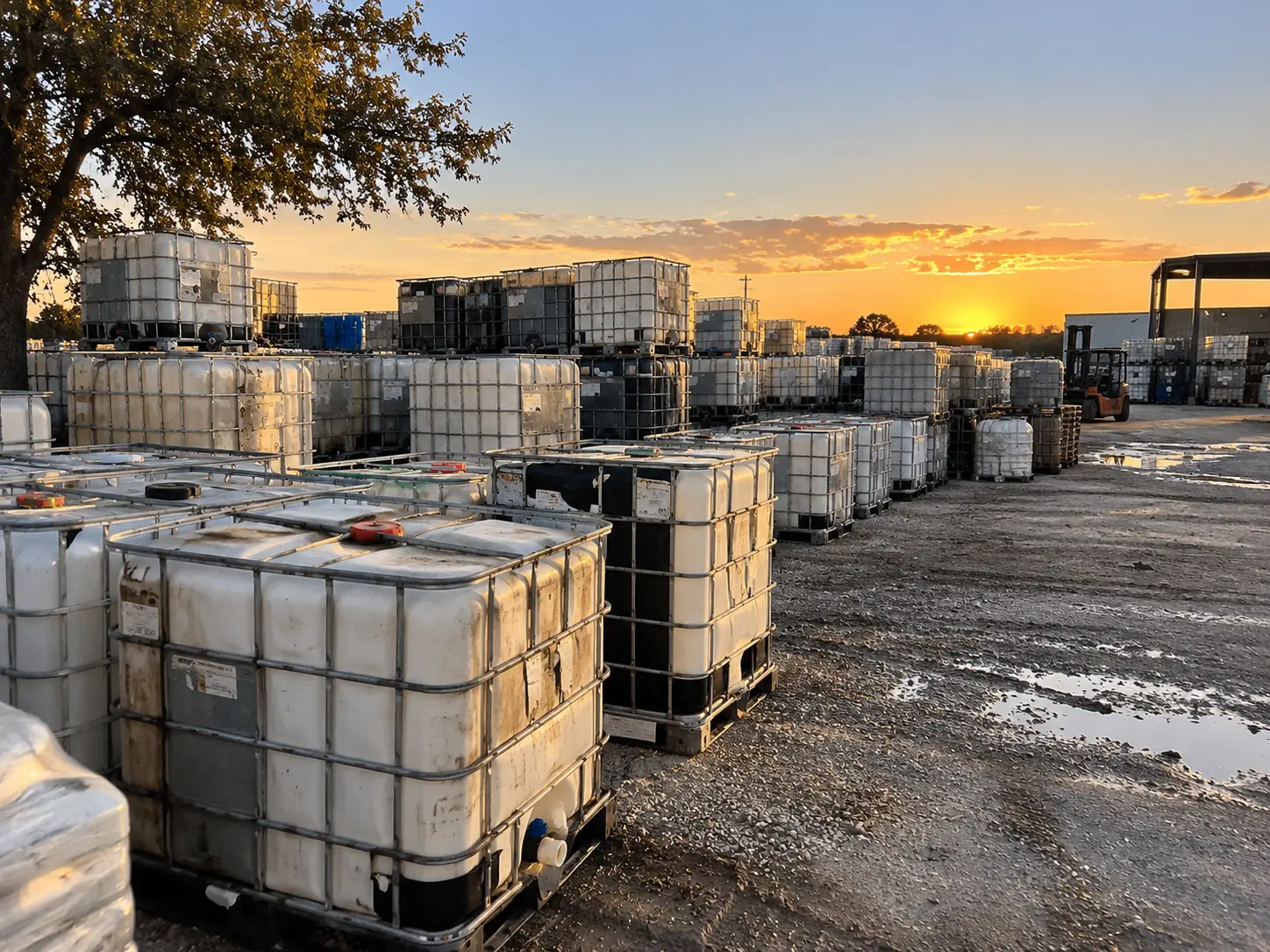
- Mixed client-site tote accumulations
- Decommissioning and plant closure clearances
- Lease-exit yard clearances
- Regulator-driven clearance programmes
- Part-full units requiring profiling
- Unknown-contents units from abandoned sites
§ 07.bWhat we recommend
Specification for this duty.
- Our role
- Container stream only
- Your role
- Residue handling and client relationship
- Division point
- Agreed at assessment, before anything moves
- Documentation
- Destination records by stream, manifests, per-unit grading
- 20–40%
- Of 'scrap' loads that are reusable
- 3/4
- Of cleanouts settle as a credit
- Free
- Assessment
- 7years
- Manifest retention
We triage every load.
Across our history.
Photos or site visit.
For your compliance file.
§ 07.cReference
Typical cleanout composition and disposition
| Category | Typical share | Disposition | Cost or credit |
|---|---|---|---|
| Empty, sound, reusable | 28% | Wash, test, back into service | Credit |
| Empty, cosmetically poor | 24% | Grade B / B- service | Credit |
| Empty, failed bottle, sound cage | 19% | Rebottling line | Credit at cage value |
| Cages and pallets, no bottles | 11% | Reuse or mill-grade scrap | Credit |
| Rainwater-filled | 8% | Drained on site, then as above | Credit |
| Part-full, declarable | 7% | Residue profiled | Quoted |
| Part-full, unknown | 3% | Field screened and profiled | Quoted |
Only the bottom two rows can carry a cost. That composition is why cleanouts so often come out in the client's favour.
§ 07.dSector-specific problems
What goes wrong here, and what we do about it.
Four problems we see repeatedly in this sector, with the answer rather than a sales line.
The problem
Mixed loads where no single buyer wants everything
Our answer
We take all of it — six capacities, four pallet types, stainless units, bare cages, rainwater-filled units — and grade individually.
The problem
Unknown-contents units stalling an entire project
Our answer
Field screening on site, classification into compatibility classes, segregated handling, and a clear upfront statement of what the worst case costs.
The problem
Clients expecting a cost and getting a credit
Our answer
Roughly three quarters of cleanouts settle as a credit. Twenty to forty percent of what arrives labelled scrap goes back out as a working container.
The problem
Deadline-driven clearances
Our answer
Give us the date and the count and we will tell you honestly whether we can meet it. Most yards clear in a single day.
§ 07.eOther sectors
Different problem? Different page.
Each of these covers a genuinely different container requirement rather than the same text with the name changed.
- Chemical manufacturing & blending
- Food, beverage & flavour
- Agriculture & crop inputs
- Water treatment & municipal
- Breweries & distilleries
- Oilfield & industrial fluids
- Construction & concrete admixtures
Services used most in this sector
Sector-specific quote
Pricing for waste brokers & environmental firms.
Give us the product, the volume and the duty. We'll specify the grade, the gasket and the pallet, and tell you if a cheaper option would do the same job.