§ 02.4Sustainability / Zero-Landfill Pledge
Zero landfill.
Ten years running.
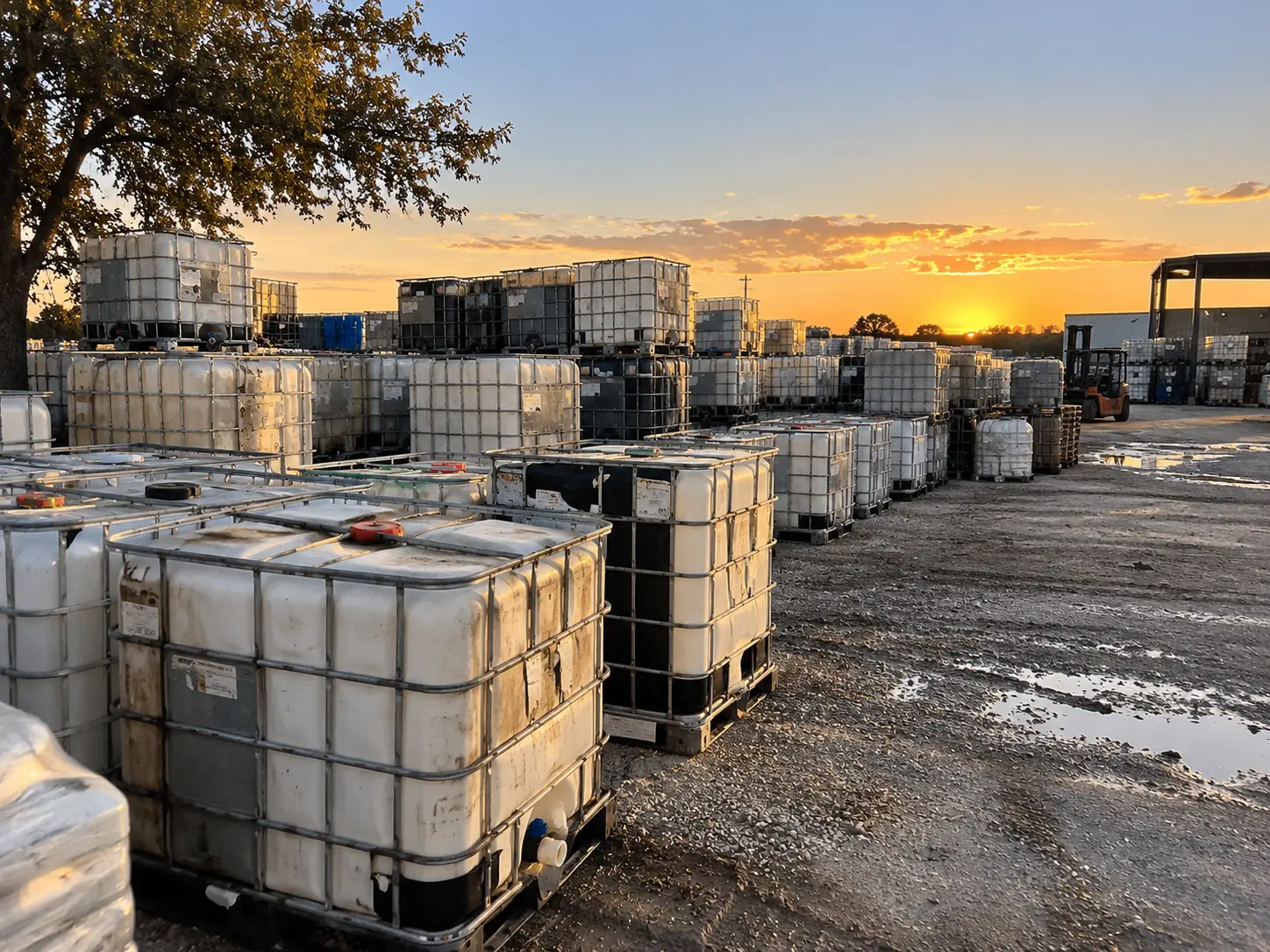
Since 2016, no component of any tote that entered this yard has left it for a landfill. Not a bottle, not a cage, not a pallet board, not a cracked valve body. This page says exactly what that claim covers, how we check it, and what would break it.
- In force since
- 2016
- Components covered
- All tote components
- Breaches to date
- 0
- Verification
- Waste manifests on request
§ 02.4.1The pledge, stated precisely
A promise you can't audit isn't a promise.
Most zero-waste claims are quietly scoped to exclude the inconvenient streams. Here is ours with the scope written out, including the one stream it genuinely does not cover.
What the pledge covers
Every physical component of every IBC tote that crosses our intake dock. Specifically: HDPE bottles, galvanised steel cages, plastic, steel and timber pallets, valve bodies, caps, gaskets, labels and the strapping they arrive with.
Every one of these has a declared destination that is not a landfill. The table below lists all of them.
What the pledge does not cover
Liquid residues. Heels drained from inbound totes are captured, profiled by compatibility class and sent to licensed processors for recovery, treatment or compliant disposal. Some of that material is genuinely destroyed — incinerated or treated and discharged under permit — and a small fraction of treatment residue does ultimately reach a landfill as stabilised solids.
We could have scoped residues out of the headline and said nothing. We would rather tell you: the pledge is about tote components, and liquid residue handling is a separate, regulated, honestly-described process.
The containers never get buried. The chemicals somebody else put in them are handled lawfully by people licensed to handle them.
0components
Landfilled since 2016
Across roughly 310,000 units processed in that period. The figure is zero because every component has a declared, economically viable alternative — not because of a technicality.
How we verify it
- We hold no landfill disposal contract for solid tote components. There is no account to bill against.
- Every outbound waste stream has a manifest naming the receiving facility and its permit.
- Monthly reconciliation compares intake weight against outbound destinations; unexplained variance is investigated.
- Any customer can request the manifests covering the period their load was processed.
§ 02.4.2Component destinations
Where everything actually goes.
Every row below is a real outbound stream with a real receiving facility. None of them is a landfill.
| Component | Condition | Destination | Share |
|---|---|---|---|
| HDPE bottle | Passes pressure test | Reuse — washed, recertified, resold | 93.9% |
| HDPE bottle | Fails test, watertight | Upcycled build — rain tank, sump, planter | 2.4% |
| HDPE bottle | Fails test, not watertight | On-site granulation → hot wash → pellet | 3.7% |
| Steel cage | Passes geometry jig | Reuse — straightened, reassembled | 98.4% |
| Steel cage | Weld fatigue or deformation | Baled to mill-grade scrap steel | 1.6% |
| Plastic pallet | Sound | Reuse | 96.1% |
| Plastic pallet | Cracked feet | Granulated with bottle stream | 3.9% |
| Steel pallet | Any | Reuse or mill-grade scrap | 100% |
| Timber pallet | Sound or repairable | Reuse after repair | 71.0% |
| Timber pallet | Deck fracture, rot | Chipped — animal bedding and mulch | 29.0% |
| Valve body & cap | Sound | Reuse after inspection | 39.0% |
| Valve body & cap | Chemically attacked | Polypropylene recycling stream | 61.0% |
| Gaskets & seals | Any | Rubber recovery stream | 100% |
| Labels & strapping | Any | Separated to paper and PET recycling | 100% |
Shares are FY2025 figures. The timber pallet row is the weakest number we publish and we say so on the Impact Report page as well.
§ 02.4.3What would break it
The pledge has failure conditions. Here they are.
Naming the conditions under which we would have failed is the only way to make the claim meaningful. If any of the following happened, we would report it on the Impact Report page rather than quietly adjust the wording.
- Any solid tote component leaving this site under a landfill manifest.
- Opening a landfill disposal account for solid waste of any kind.
- An unreconciled variance between intake weight and declared outbound destinations exceeding 0.5% in any month.
- Sending failed bottles to a third party without a named, permitted recovery destination.
- Chipping timber pallets that were economically repairable, purely to clear yard space.
- Breaches to date
- 0 since 2016
- Largest monthly variance
- 0.21% (March 2023, resolved)
- Landfill accounts held
- None
- Manifest retention
- 7 years
§ 02.4.4Fair questions
Challenges to the pledge.
Isn't chipping a timber pallet just a nicer word for throwing it away?
It is a downgrade, and we call it one. Chipped hardwood goes out as animal bedding and landscape mulch — genuine uses with genuine buyers — but it is a material cascade, not reuse. We would rather repair the pallet, and 71% of the time we do.
What happens if a customer sends you something you can't process?
It gets quarantined on a sealed pad and goes back out to a licensed handler, with the cost passed on. That is a residue question rather than a component question — our declared exclusion list is on the certifications page precisely so this does not happen by surprise.
Do you count exported material as diverted?
We do not export any recovered material. Our HDPE flake and pellet is sold domestically, and our scrap steel goes to North American mills. We have seen too many diversion claims that rely on a container ship and an optimistic assumption.
Is zero landfill certified by anyone?
No. It is an internal commitment backed by manifests we will show you. We are not going to describe it as certified when it is not — see the assurance note in the Impact Report.
Extend the pledge to your yard
Your empties are the easiest tons you will ever divert.
One pickup turns a disposal line item into a credit, and turns a roll-off into a reclaim load. Tell us the count.