§ 03.2Products / Rebottled
New bottle.
Reclaimed cage.
Best of both.
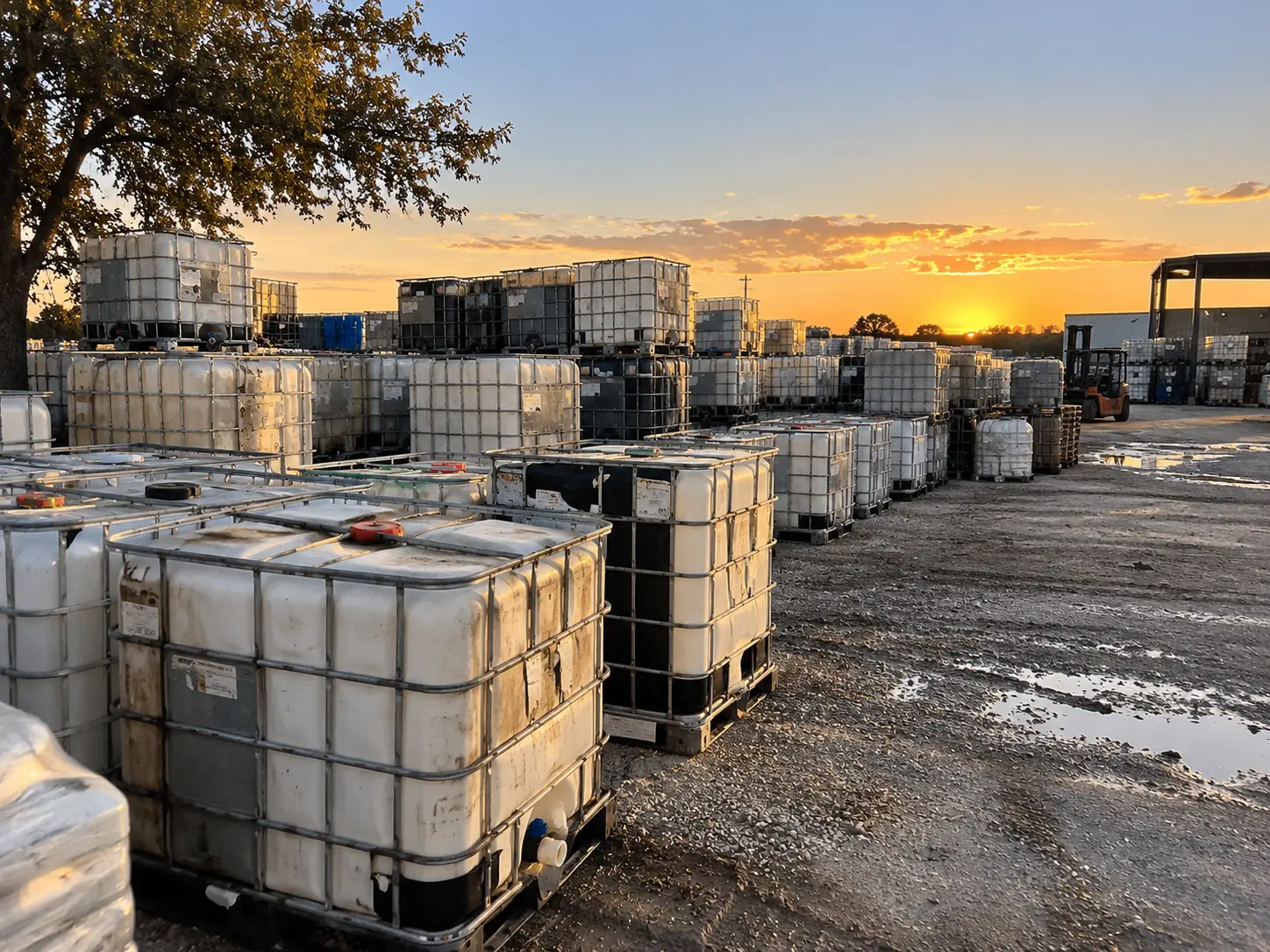
The galvanised steel cage is the most carbon-intensive component of an IBC tote and the longest-lived. Scrapping a perfect cage because its bottle failed is the biggest avoidable waste in this industry. Rebottling is our answer: a brand-new bottle in a reclaimed frame.
- Grade
- A
- Bottle
- New, virgin HDPE
- Reclaimed by mass
- ~65%
- Saving vs new
- 176 lb CO₂e / unit
§ 03.2.1The case for rebottling
A cage outlives three bottles.
Across our rebottling history a single reclaimed steel cage typically carries three bottles through their full service lives before the cage itself retires. Those are three new cages that never had to be drawn, welded and galvanised.
A bottle fails for reasons that have nothing to do with the cage. Stress crazing around the valve boss, permeation staining from an aggressive dye, heat distortion from a summer in a Texas yard — all of these end a bottle’s service life while the steel around it is barely worn.
The industry’s default response is to scrap the whole assembly. That throws away 132 lb of CO₂e locked into the cage and another 35 lb in the pallet, to avoid the inconvenience of separating them.
Rebottling keeps the cage, keeps the pallet, straightens what needs straightening, and drops in a brand-new bottle. You get a container whose interior has never held anything — the property most buyers actually care about — at roughly 44% of the embodied carbon of a fully new unit.
When to choose rebottled over reconditioned
- Your fill is sensitive to permeation from unknown previous contents
- The container is retail-adjacent or customer-visible
- You need full UN/DOT marking without questions about bottle age
- Your QA process requires a virgin-contact surface but not a certificate of virgin assembly
When reconditioned is the better call
For the large majority of industrial fills — surfactants, glycols, oils, water chemistry, admixtures — a properly washed and tested original bottle performs identically for materially less money and materially less carbon. We will say so.
Embodied carbon by option
- New composite IBC315lb CO₂e
- Rebottled139lb CO₂e
- Reconditioned53lb CO₂e
Rebottled sits exactly where you would expect: it spends the bottle’s carbon again and saves the cage’s. That is 176 lb CO₂e avoided per unit versus buying new.
3:1bottles per cage
Observed across our rebottling line
Each reclaimed cage carries three bottles through full service lives. The steel is doing three times the work it was designed for.
§ 03.2.2The rebottling process
What gets replaced and what gets saved.
| Component | Disposition | Treatment before reuse |
|---|---|---|
| HDPE bottle | New | Virgin blow-moulded bottle, never filled |
| Steel cage | Reclaimed | Geometry jig check, hydraulic straightening, weld inspection |
| Pallet base | Reclaimed | Foot and deck inspection, replaced if cracked |
| Discharge valve | New | New ball or butterfly valve to specification |
| Valve gasket | New | EPDM standard, Viton on request |
| Fill cap & gasket | New | New 6" buttress cap with fresh seal |
| Labelling | New | Fresh UN/DOT marking and grade label |
The failed original bottle does not go to landfill. It is granulated and hot-washed on site into recycled HDPE, or cut into an upcycled build.
Cage acceptance criteria
A cage only enters the rebottling line if it passes all of the following. Cages that fail are baled to mill-grade scrap steel.
- Geometry within tolerance on the jig in all three axes
- No fatigue cracking at any weld joint under inspection
- No deformation that prevents stacking or forklift entry
- Galvanising intact enough to resist corrosion for a further service life
- Base frame to pallet attachment sound
- Cage pass rate
- 98.4% of intake cages qualify
- Capacities
- 275 gal and 330 gal standard
- UN/DOT
- Full 31HA1/Y marking on completed unit
- Lead time
- 5–10 business days typical
§ 03.2.3Specification
Dimensions match new, because the cage is the same cage.
A rebottled unit is dimensionally identical to a new one — same footprint, same height, same stack rating, same forklift entry. It will drop into an existing racking system without adjustment.
| Capacity | Footprint | Height | Tare | Per trailer |
|---|---|---|---|---|
| 275 gal / 1,040 L | 48" × 40" | 53" | 125 lb | 48 |
| 330 gal / 1,250 L | 48" × 40" | 62" | 148 lb | 48 |
§ 03.2.4Rebottled, questioned
What buyers want to know.
Is a rebottled tote the same as a new one?
Functionally and dimensionally, yes. The bottle is new and has never held anything; the cage and pallet are reclaimed and have been inspected and straightened. If your specification requires a certificate that the entire assembly is virgin, you need new stock — and we will tell you that rather than stretch the definition.
Can a rebottled tote be food-grade?
Yes, and this is a common path. The bottle is new FDA 21 CFR 177.1520 compliant HDPE and has never held anything, so the usual previous-contents concern does not arise. Handling still runs on our segregated food-grade path — see food-grade totes.
How old is the cage?
Typically three to twelve years. Galvanised steel tube has a service life well past twenty years in this duty, and the geometry jig and weld inspection are a better guide to remaining life than age. We will tell you the age range in a lot.
Does it carry a valid UN/DOT marking?
Yes — completed rebottled units are marked 31HA1/Y, with the marking applied as part of the rebuild and recorded against the unit. Packing group suitability still depends on your material.
What happens to the bottle that came out?
Granulated, hot-washed and pelletized on site into recycled HDPE, or cut and fitted into an upcycled build. Never landfilled — see our zero-landfill pledge.
The honest recommendation
Most buyers who ask for rebottled actually need reconditioned.
Tell us what's going in the tote and who sees it, and we'll tell you which one you need — including when it's the cheaper one.