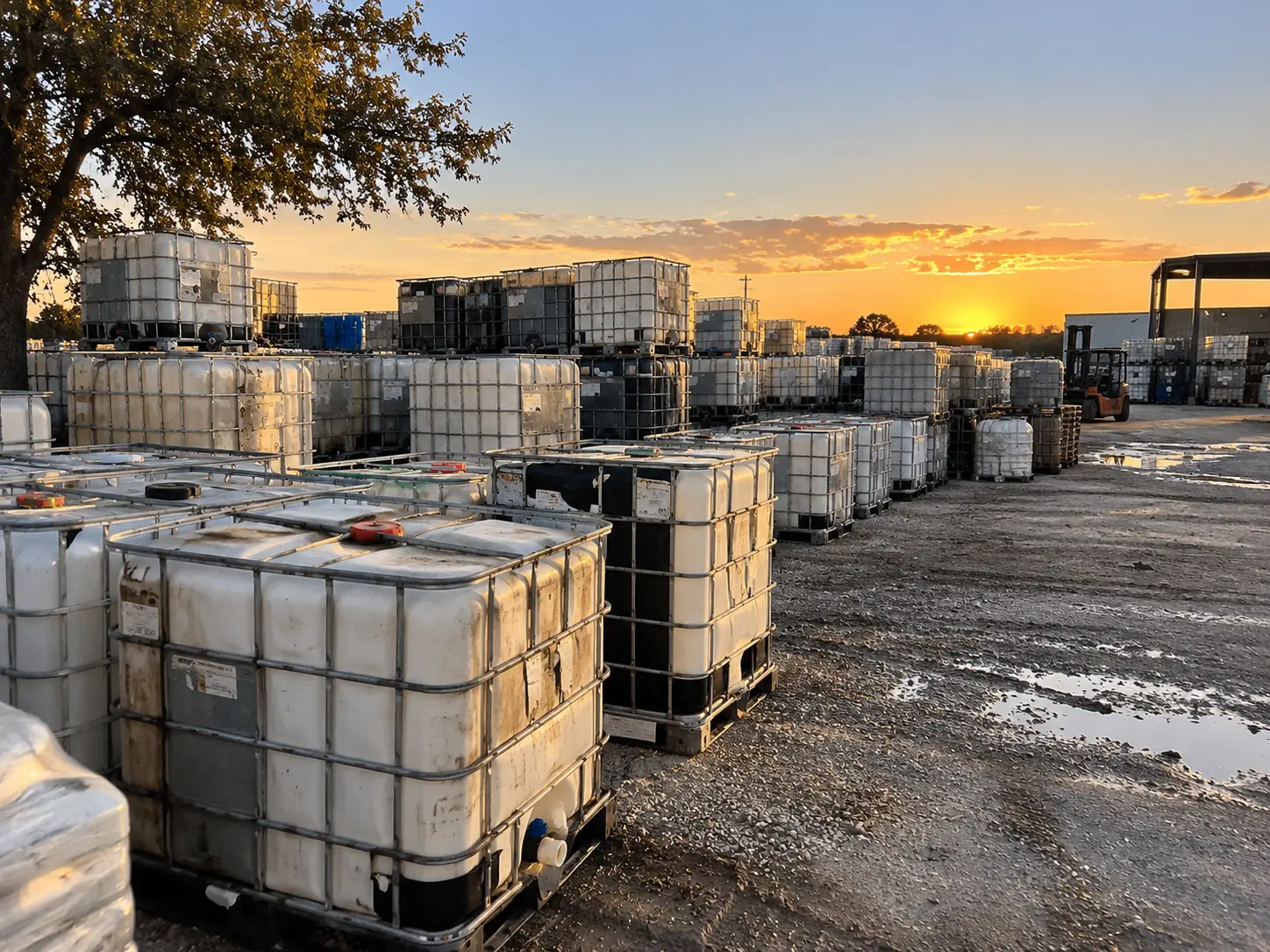
§ 03.1Products / Reconditioned
Reconditioned totes.
The whole point.
Original bottle, original cage, original pallet. Washed to the programme its residue demanded, pressure tested with a hold phase, and recertified where it qualifies. This is the product that makes the environmental arithmetic work, and it is also the cheapest thing in our catalog.
- Grades
- A- · B · B-
- Capacities
- 275 & 330 gal
- Testing
- 100% pressure tested
- Saving vs new
- 262 lb CO₂e / unit
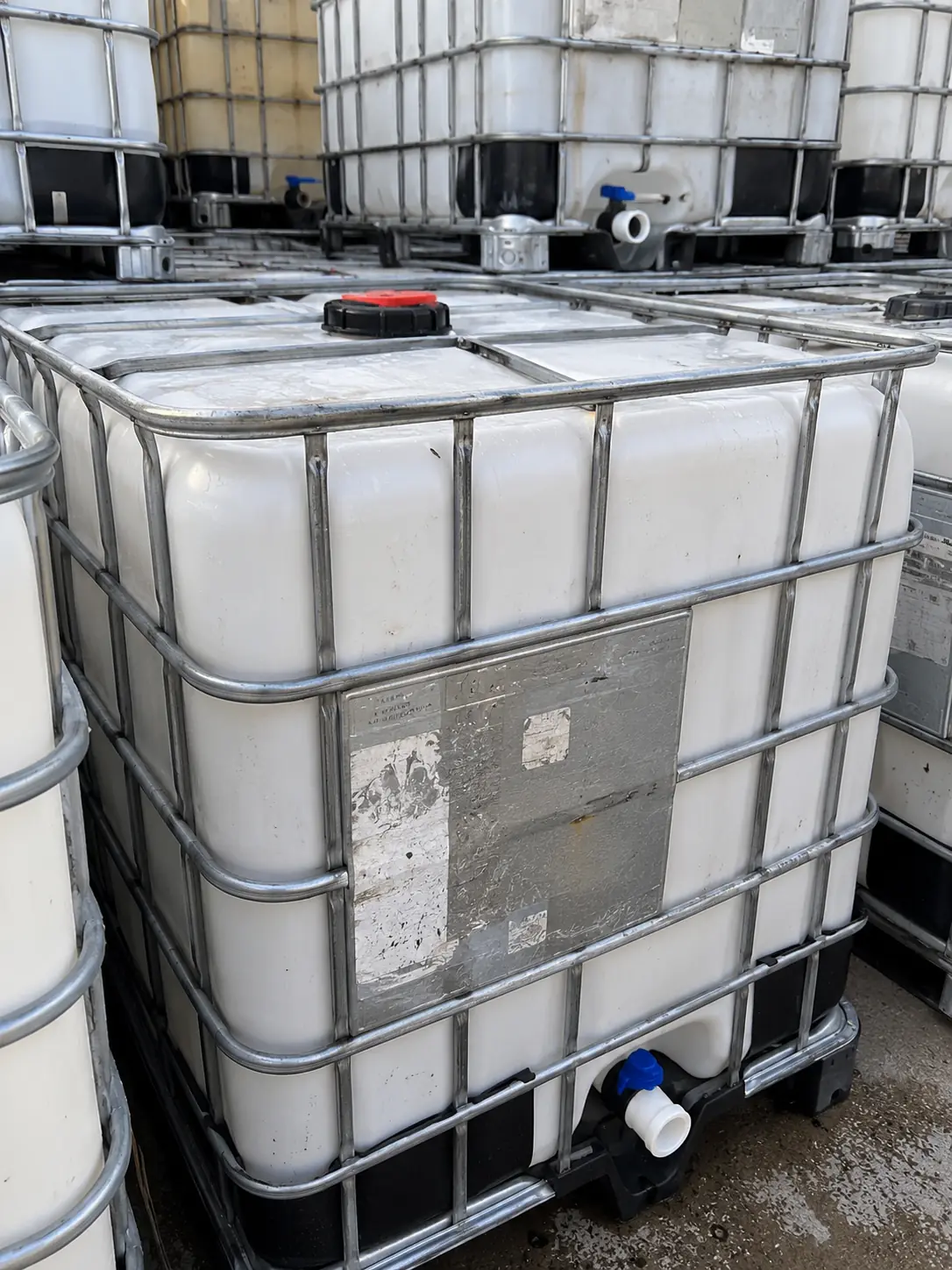
§ 03.1.1What you're buying
A container that has already proved it works.
A new tote has never held anything. A reconditioned tote has held a liquid, survived transport, been emptied, washed and tested again — which is a stronger evidence base than a factory certificate.
| Grade | Condition | Typical duty | Recert |
|---|---|---|---|
| A- | Washed, pressure tested, light cosmetic wear only | Product-facing industrial fills | Yes |
| B | Triple rinsed, tested, visible cosmetic wear | General industrial, non-critical | Usually |
| B- | Rinsed, tested, staining or scuffing | Water, brine, washdown, admixtures | Case by case |
Grade AA and A are covered under food-grade and rebottled respectively. Grade C is sold as-is without testing; grade R is scrap feedstock.
- Pressure and leak tested with a hold phase — 100% of units, no sampling
- Wash programme code printed on the unit label
- Cage geometry checked against a jig, straightened where needed
- New valve, cap and gasket fitted where the originals are chemically attacked
- Previous-contents chain supplied where the originating customer declared it
- UN/DOT 31HA1 recertification available on qualifying units
Why this is the right default
- New composite IBC315lb CO₂e
- Rebottled139lb CO₂e
- Reconditioned53lb CO₂e
Six times less embodied carbon than new, at a fraction of the price, with function that is identical for the overwhelming majority of industrial fills.
93.9%
Of our intake becomes this product
Almost everything that arrives here is good enough to go straight back out as a working container. That ratio is why reconditioned stock is both plentiful and cheap.
§ 03.1.2Specification
Dimensions, weights and load counts.
| Capacity | Footprint | Height | Tare | Fill opening | Discharge | Per trailer |
|---|---|---|---|---|---|---|
| 275 gal / 1,040 L | 48" × 40" | 53" | 125 lb | 6" buttress cap | 2" ball valve | 48 |
| 330 gal / 1,250 L | 48" × 40" | 62" | 148 lb | 6" buttress cap | 2" ball valve | 48 |
| 275 gal / 1,040 L | 48" × 40" | 53" | 132 lb | 6" buttress cap | 3" butterfly | 48 |
| 350 gal / 1,325 L | 48" × 42" | 66" | 165 lb | 6" buttress cap | 2" ball valve | 40 |
Tare weights are for HDPE bottles in galvanised steel cages on plastic pallets. Steel-pallet variants add roughly 28 lb; timber adds roughly 18 lb.
- Bottle material
- Blow-moulded HDPE, 38 lb nominal at 275 gal
- Cage
- Hot-dip galvanised steel tube, welded
- Pallet options
- Plastic (standard), steel, composite, timber
- Stack rating
- 2 high loaded, 4 high empty — cage condition permitting
- Temperature range
- -20 °F to 140 °F for HDPE bottle
- Design type
- 31HA1 — non-pressurised composite IBC for liquids
Previous contents we commonly stock
Knowing what a tote held is the single most useful piece of information when specifying a reconditioned unit. Our standing stock is dominated by:
- Surfactants and detergent concentrates
- Glycols and glycol ethers
- Mineral and vegetable oils
- Water treatment chemistry — polymers, coagulants
- Agricultural inputs — liquid fertiliser, adjuvants
- Latex and acrylic emulsions
- De-icing brines and concrete admixtures
§ 03.1.3From dock to dock
What happens between your order and your delivery.
- 01
Specification
You tell us the duty and the volume. We recommend a grade and a wash programme, and confirm whether recertification applies.
Same or next business day
- 02
Allocation and staging
Units are pulled from graded racking and staged as a lot. We photograph the actual staged units and send them to you before loading.
Photos before dispatch, always
- 03
Final inspection and manifest
A second check against the ordered grade, then the manifest is generated with the per-unit breakdown and wash codes.
Second-pair-of-eyes check
- 04
Load and deliver
48 units single-stacked on a 53-foot trailer, or a partial load on a lane we already run.
3–7 business days typical
§ 03.1.4Reconditioned, questioned
The objections, answered.
Will my product be contaminated by what was in it before?
Not if the wash programme matched the residue, and we record which programme ran on every unit. The real risk is not residue — it is permeation, where a previous content has absorbed into the HDPE wall and can leach back out.
Permeation is why we care so much about the previous-contents declaration. If you are filling something sensitive, tell us and we will restrict allocation to units with a compatible fill history, or move you to rebottled stock.
How old are these totes?
Typically two to eight years from manufacture. The bottle’s moulding date is stamped on it and we will tell you the range in a lot before you commit. Age matters less than fill history and test result, but it is a fair thing to ask about.
Can I use these for hazmat transport?
Qualifying units can be recertified to 31HA1 and used within that design type and packing group. Compatibility with your specific material remains your assessment — see certifications & compliance.
What does grade B- actually look like?
Structurally sound and pressure tested, with visible scuffing, cage scratching, and often permanent staining on the bottle from a previous dye or pigment. Completely fine for brine, washdown water or admixtures; wrong for anything a customer will photograph. Full criteria on the grading scale.
Do you have stock on the ground or is this made to order?
Stock on the ground, graded and racked. Standard 275 and 330 gallon reconditioned units in grades B and B- are almost always available immediately; grade A- moves fast and sometimes runs two weeks out.
Compare the alternatives
Not sure reconditioned is right for your fill?
Rebottled gives you a new bottle interior. Food-grade gives you a segregated path and paperwork. Both start from the same form.