§ 01.2Company / How We Work
Seven stations.
One building.
No hand-offs.
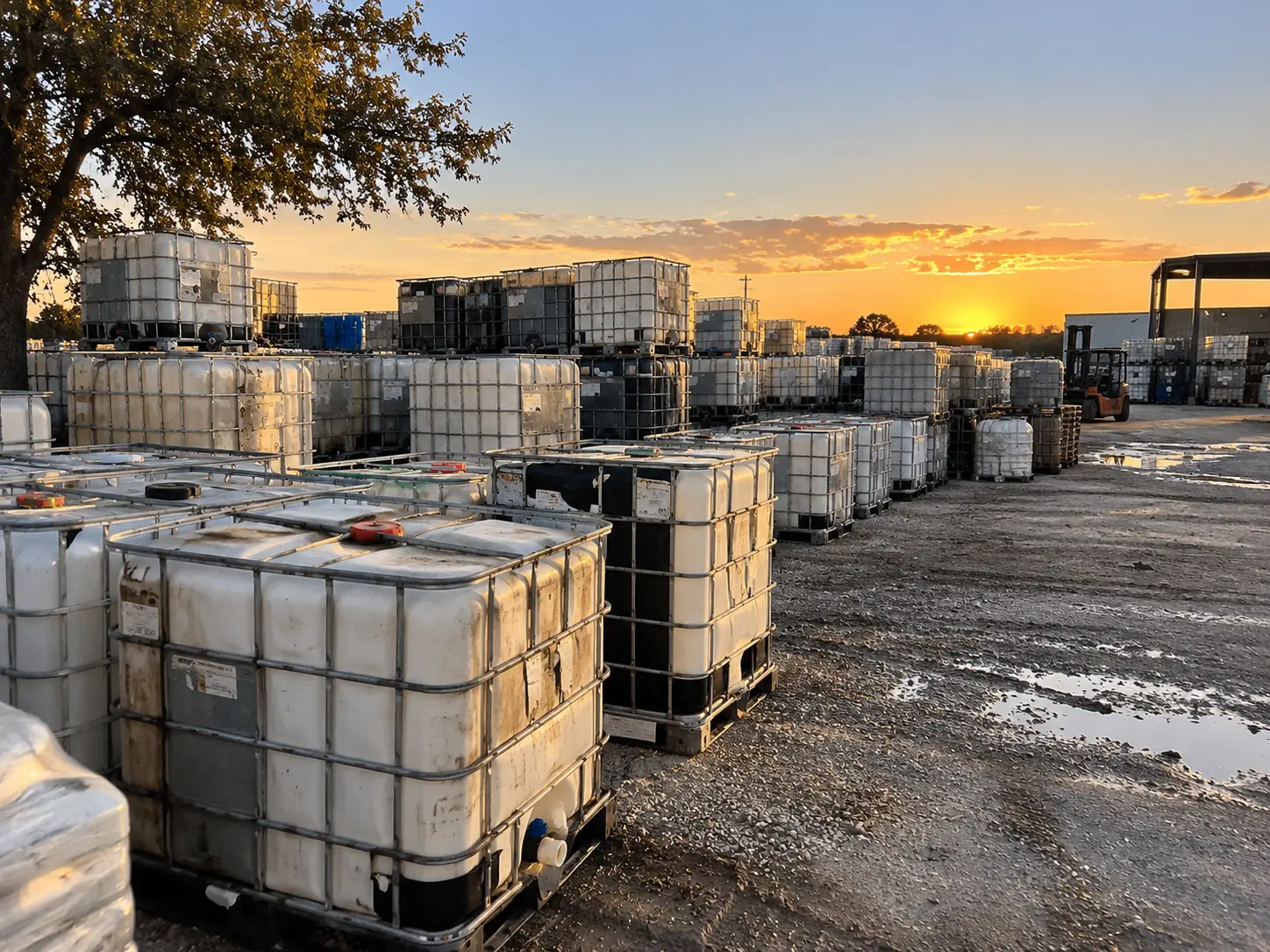
A tote arrives on our dock and does not leave the property until it is either back in service or back to resin. Every stage below happens at 16751 Lathrop Ave, which is the only reason we can tell you with certainty what came out of a bottle.
- Stations
- 7
- Throughput
- ~1,100 totes / week
- Wash cycle
- 11–26 min
- Test
- Pressure + leak, 100%
§ 01.2.1Station by station
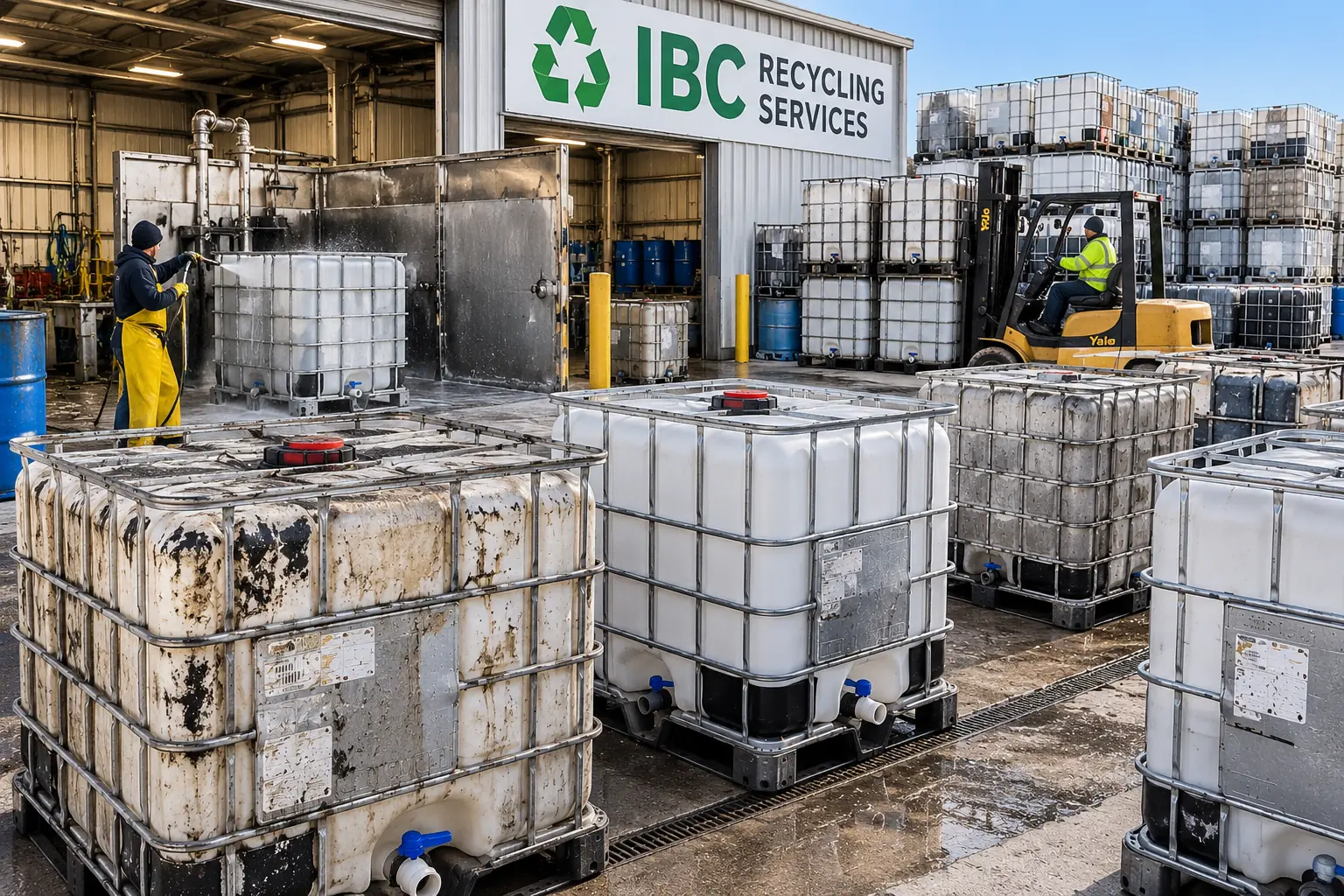
What actually happens to your tote.
Every stage has an exit decision. A unit that fails a stage does not get quietly waved through — it moves to the path that matches its real condition.
- 01
01 · Intake and weigh
Units come off the trailer, get counted against the manifest and are weighed as a lot. Anything leaking, bulging or carrying an unexpected label is quarantined on a sealed pad before it goes anywhere near the line.
Exit decision: accept / quarantine / reject
- 02
02 · Individual inspection and grade
One technician, one tote. Bottle walls checked for stress crazing, gouges and heat distortion. Cage geometry checked against a jig. Pallet feet, valve threads, cap seat and gasket condition all recorded. The previous-contents declaration is matched to residue evidence.
Exit decision: grade AA, A, A-, B, B-, C or R
- 03
03 · Residue capture and profiling
Heels are drained to dedicated totes by compatibility class, profiled, and consolidated for licensed disposal or recovery. Nothing goes to drain, and nothing gets mixed across incompatible classes.
RCRA-compliant handling throughout
- 04
04 · Wash
Triple rinse as standard. Caustic wash for oils, surfactants and food residues; solvent wash for resins and coatings; high-temperature cycle where a food-grade path is in play. Food-grade stock runs on separated water and separated racking with no shared path.
92% of wash water filtered and recirculated
- 05
05 · Pressure and leak test
Every reusable bottle is pressure tested and held. A unit that drops pressure does not get washed again and sold with an asterisk — it leaves the reuse path and enters rebottling or granulation.
100% tested, no sampling
- 06
06 · Rebottle, recertify, label
Passing units are reassembled, re-gasketed, fitted with new valves and caps where needed, and recertified to UN/DOT 31HA1 where the unit qualifies. Failed bottles are replaced inside their reclaimed cage. Each unit is labelled with its grade and previous-contents chain.
Exit decision: reuse / rebottle / reprocess
- 07
07 · Reprocess
Bottles that cannot return to service are granulated, hot-washed and pelletized into recycled HDPE with a traceable origin. Steel cages are straightened and reused or baled to mill grade. Timber pallets are repaired or chipped.
Zero landfill — every component has a next life
§ 01.2.2Wash programmes
Not every residue wants the same water.
Picking the wrong wash cycle is how a reconditioner ends up selling a tote that smells of the last customer's product. We match the programme to the residue class, and we record which programme ran.
| Programme | Typical residues | Cycle | Water temp | Exit grade |
|---|---|---|---|---|
| TR — Triple rinse | Water-miscible, non-hazardous | 11 min | Ambient | B / B- |
| CW — Caustic wash | Oils, surfactants, latex, food residues | 18 min | 150 °F | A- / B |
| SW — Solvent wash | Resins, coatings, inks, adhesives | 24 min | 120 °F | B |
| HT — High temperature | Food-contact prep, sanitising | 26 min | 185 °F | AA / A- |
| QN — Quarantine strip | Unknown or mixed declaration | 26 min + hold | 185 °F | C or R |
Programme codes appear on the unit label and on the paperwork that travels with the load, so a receiving QA team can see exactly what was run.
What disqualifies a bottle from reuse
We would rather lose the margin on a unit than send out one that fails in a customer’s plant. Any one of these moves a bottle out of the reuse path:
- Any pressure loss during the hold phase of the test cycle
- Stress crazing across a weld seam or around the valve boss
- Heat distortion from sun, steam or an overheated previous fill
- Permeation staining that survives the appropriate wash programme
- Previous contents that cannot be documented or profiled
- Any residue class we are not licensed to handle
- 100%
- Units individually graded
- 100%
- Reuse units pressure tested
- 6.1%
- Intake that fails to reuse
- 0
- Components landfilled
No lot-level grading, ever.
No statistical sampling.
Of which all is rebottled or reprocessed.
Since 2016, without exception.
Paperwork that travels
- Unit label
- Grade · wash programme · test date · lot
- Load manifest
- Per-unit grade breakdown and counts
- Previous contents
- Declared chain, per unit where available
- Recertification
- UN/DOT 31HA1 statement where applicable
§ 01.2.3Why one building matters
Every hand-off is a place for information to disappear.
The industry norm is to broker collection, subcontract washing and outsource grinding. Each boundary loses a little truth about what was in the bottle. We removed the boundaries.
- The person who graded your tote works forty feet from the person who washed it.
- A failed test result reaches the rebottling line the same hour.
- Residue profiling is done by the people who saw the bottle opened.
- Granulation happens on site, so nothing waits on a roll-off.
§ 01.2.4Process questions
The things people ask before their first load.
Do you need the totes cleaned before pickup?
No. Drain what drains easily, keep the caps on, and leave the rest to us — that is the entire point of a wash line. The only thing we genuinely need is an accurate previous-contents declaration.
What if a tote held something you can't handle?
We will tell you before the truck is booked. Our intake rules exclude a short list of residue classes we are not licensed for; if your declaration includes one of them we will say so upfront rather than quarantine it on arrival and send you an invoice.
Can I send my own totes through the line and get them back?
Yes — that is our reconditioning service. Your assets stay yours, get washed, tested and recertified, and come back on a scheduled return load. See washing & reconditioning.
How do I know a reconditioned tote is actually tested?
Every reuse unit carries a label with its test date and lot number, and the load manifest carries the per-unit breakdown. If a receiving QA team wants the test record for a specific serial, we can produce it.
What happens to the bottles that fail?
They are granulated, hot-washed and pelletized on site into recycled HDPE, or cut and fitted into upcycled builds. None of them are landfilled.
Book a slot
Tell us the count and the contents. We'll tell you the stage it starts at.
Reuse, rebottle or reprocess — the grade decides, and the grade comes from an inspection, not a guess.