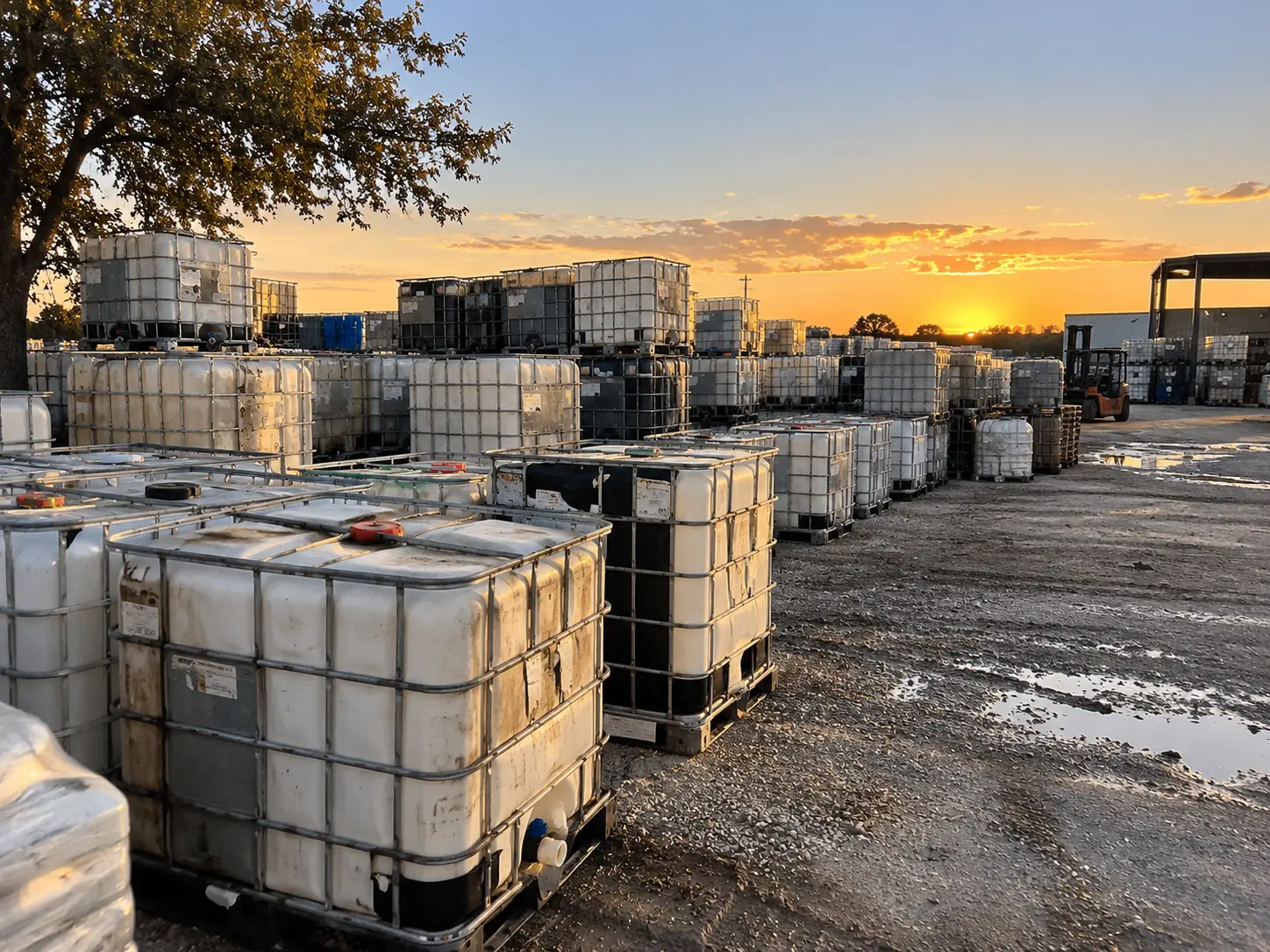
§ 05.2Size Guide / Materials & Resin Codes
Materials, resin
codes and the
permeation problem.
The wall material decides what a tote can hold, how hot it can get, how long it lasts and — crucially for reconditioned stock — what the previous contents may have left behind inside the polymer. This page covers all four.
- Resin code
- 2 — HDPE
- HDPE temp limit
- 140 °F
- Stainless temp limit
- 400 °F
- Food contact
- 21 CFR 177.1520
§ 05.2.1Material properties
Six wall materials you will encounter.
| Material | Resin code | Density | Temp range | UV resistance | Typical service lives |
|---|---|---|---|---|---|
| HDPE (high-density polyethylene) | 2 | 0.950–0.960 g/cm³ | -20 to 140 °F | Moderate — carbon black improves it | 6–14 |
| Fluorinated HDPE | 2 | 0.950–0.960 g/cm³ | -20 to 140 °F | Moderate | 4–9 |
| PP (polypropylene) | 5 | 0.900–0.910 g/cm³ | 32 to 180 °F | Poor without stabiliser | 6–12 |
| 316L stainless steel | — | 8.00 g/cm³ | -40 to 400 °F | Excellent | 100+ |
| 304 stainless steel | — | 8.00 g/cm³ | -40 to 400 °F | Excellent | 100+ |
| Carbon steel (lined) | — | 7.85 g/cm³ | -20 to 300 °F | Good with coating | 40+ |
Service lives are in our own observed experience for liquid transport duty, not manufacturer claims. PP's low-temperature limit is its real weakness — it becomes brittle and impact-sensitive below freezing.
| Media class | HDPE | Fluorinated HDPE | PP | 316L | Carbon steel |
|---|---|---|---|---|---|
| Water, brines, aqueous salts | Excellent | Excellent | Excellent | Good* | Poor |
| Dilute acids | Excellent | Excellent | Excellent | Good | Poor |
| Concentrated mineral acids | Fair | Good | Good | Varies | Poor |
| Caustics and bases | Excellent | Excellent | Excellent | Excellent | Good |
| Surfactants, detergents | Excellent | Excellent | Excellent | Excellent | Fair |
| Glycols | Excellent | Excellent | Excellent | Excellent | Good |
| Mineral oils, lubricants | Good | Excellent | Good | Excellent | Excellent |
| Aliphatic hydrocarbons | Fair | Excellent | Fair | Excellent | Excellent |
| Aromatic solvents | Poor | Good | Poor | Excellent | Excellent |
| Chlorinated solvents | Poor | Fair | Poor | Excellent | Good |
| Strong oxidisers | Poor | Poor | Fair | Good | Poor |
| Edible oils, food liquids | Excellent | Excellent | Excellent | Excellent | Not suitable |
*316L is vulnerable to chloride stress corrosion cracking in hot chloride-rich brines specifically — a well-known failure mode that catches people out because stainless is otherwise so robust. General guidance only; always verify against your own product data.
§ 05.2.2The thing nobody explains
Permeation: why a clean tote isn't always a clean tote.
This is the single most important concept in buying reconditioned containers, and the one most suppliers never mention. Understanding it will make you a much better buyer.
What permeation is
HDPE is not a perfect barrier. It is a semi-crystalline polymer with amorphous regions that small non-polar molecules can diffuse into and sit within. Over weeks of contact, certain substances absorb into the bottle wall itself rather than merely sitting on its surface.
A wash removes what is on the surface. It cannot remove what is inside the polymer. Over the following weeks and months, absorbed material slowly migrates back out — into whatever is in the tote next.
What permeates badly
- Aromatic hydrocarbons — toluene, xylene, and anything containing them
- Chlorinated solvents — notorious, and often detectable by smell years later
- Terpenes and essential oils — d-limonene is the classic offender
- Strong fragrances and flavour concentrates — a real problem in food applications
- Dyes and pigment carriers — these also stain, which at least makes them visible
What does not permeate meaningfully
- Water-based solutions of inorganic salts, acids and bases
- Glycols and glycol ethers
- Most surfactants and detergent systems
- Aqueous fertiliser solutions
- Mineral oils, to a limited degree
Why this matters for your order
It is why we care so much about the previous-contents declaration, and why staining is useful information rather than merely cosmetic. A stained bottle is telling you something permeated. A clean-looking bottle that held d-limonene is telling you nothing, which is worse.
If your product is sensitive — food, fragrance, pharmaceutical intermediate, anything where trace contamination matters — the answer is a new bottle, not a better wash.
How to protect yourself
- Always ask for the previous-contents chain — and be suspicious of a supplier who cannot provide it
- Treat staining as data, not as a cosmetic defect
- Specify rebottled or new stock for permeation-sensitive products
- Request a restricted allocation — units whose entire fill history is compatible with your product
- For food applications, insist on a segregated path and documentation, not a wash certificate
- Weeks
- Permeation timescale in
- Months
- Migration timescale out
- 0
- Washes that reverse it
- 1
- Real solution
Absorption builds over sustained contact.
Which is why it reaches the next fill.
Surface cleaning cannot reach absorbed material.
A new bottle, where it matters.
Fluorination: a partial answer
Fluorinated HDPE has had its inner surface treated with fluorine gas, replacing surface hydrogen atoms and creating a barrier layer that substantially reduces hydrocarbon permeation. It is a genuine improvement — and a surface treatment, not a bulk property. The layer is thin, not perfectly uniform, and degrades with repeated aggressive exposure. For long contact times or many reuse cycles, stainless is the durable answer.
§ 05.2.3Resin codes and markings
Reading what is moulded into the bottle.
| Marking | Meaning | Where to look |
|---|---|---|
| ♻ 2 / HDPE | Resin identification code — high-density polyethylene | Bottom or lower side wall |
| Capacity in L and gal | Nominal rated capacity | Upper side wall, moulded |
| Date wheel / clock | Month and year of manufacture | Bottom or near the fill neck |
| Manufacturer mark | Moulder identification | Bottom |
| Cavity number | Which mould cavity produced it | Bottom, small digits |
| Fill level line | Designed maximum fill | Moulded ridge on side wall |
| UN marking plate | Design type, test details, dates | Metal plate on the cage, not the bottle |
The date wheel is worth learning to read: an arrow or dot points to the month on a circular scale, with the year stamped in the centre. It tells you the bottle's true age independent of any paperwork.
- Food-contact resin standard
- FDA 21 CFR 177.1520 — olefin polymers
- Typical bottle wall thickness
- 0.08–0.12 inch at 275 gal
- Typical bottle mass, 275 gal
- 38 lb
- Cage material
- Hot-dip galvanised steel tube, typically 0.8–1.2 inch OD
- Cage mass, 275 gal
- 70 lb
- Galvanising
- Hot-dip, typically 50–85 µm coating
UV and weathering
Natural HDPE is translucent and moderately UV-resistant. Years of direct sun cause surface chalking and eventually embrittlement, which shows up as a pressure test failure rather than as visible damage. A tote that has sat outdoors uncovered for five years is a meaningfully worse bet than one stored inside, which is why we ask about storage conditions when buying.
Carbon-black-pigmented bottles resist UV far better but are opaque, so you cannot see the fill level — which is why most totes are natural despite the trade-off.
§ 05.2.4Material questions
Selection and compatibility.
Can I store my solvent in an HDPE tote for six months?
Short-term compatibility and long-term compatibility are different questions. Many solvents that are acceptable for a two-week transport will permeate significantly over six months of static storage, and some will soften the wall. Tell us the contact time as well as the product — it changes the answer.
How hot can I fill an HDPE tote?
140 °F is the practical upper limit, and that is a limit on the whole assembly rather than just the resin. Above it the bottle softens enough to deform under its own contents, which permanently distorts geometry. For hot fills, you want stainless.
Is a stained tote contaminated?
It depends on what stained it. A pigment that stained but did not permeate is cosmetic. A dye carrier or terpene that stained because it permeated is a genuine issue for sensitive products. We will tell you which we think it is based on the declared history — and if the answer matters, specify rebottled.
Does freezing damage an HDPE tote?
HDPE itself handles freeze-thaw well down to around -20 °F. What causes damage is the contents expanding on freezing, which bulges or splits the bottle. Drain or allow headspace before a hard freeze. PP is the material to avoid below freezing — it becomes impact-brittle.
What's the difference between 304 and 316L stainless for an IBC?
316L contains molybdenum, which substantially improves resistance to chlorides and many acids. For food and mild chemistry 304 is sufficient and cheaper; for aggressive chemistry 316L is worth the premium. Neither likes hot chloride-rich brine — that is a specific stress corrosion cracking risk for both.
Compatibility is your call, with our data
Send the product, the concentration, the temperature and the contact time.
With those four facts we can tell you which wall material and which grade actually suit — including when the answer is a new bottle.