§ 01.1Company / Our Story
It started with a
dumpster full of
perfectly good totes.
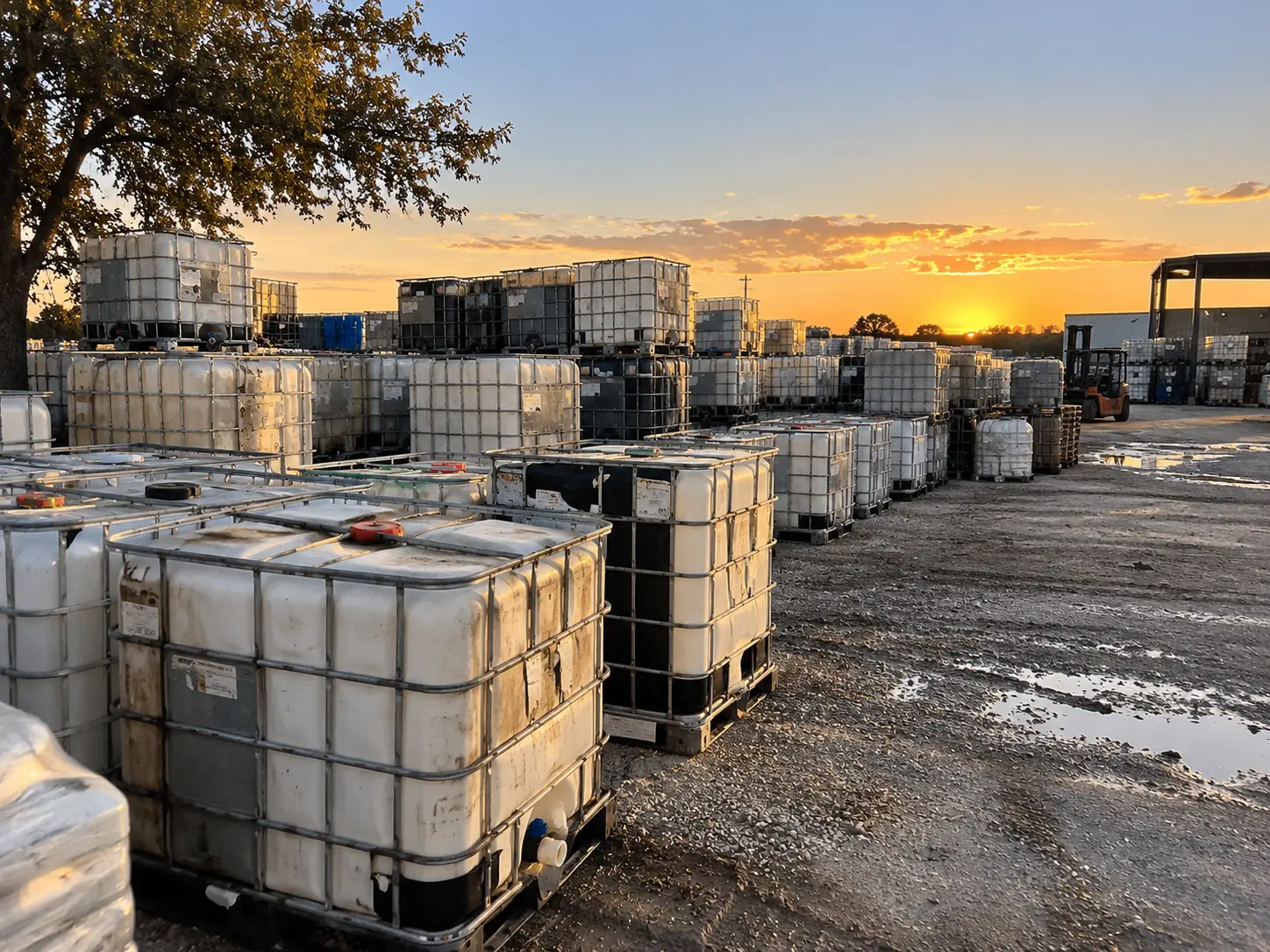
In the spring of 2009 our founder was hauling scrap out of a shuttered coatings plant outside Joliet and found forty-one IBC totes stacked behind the building, waiting for a roll-off. Thirty-eight of them held pressure. That was the whole business plan.
- Founded
- 2009
- First load
- 38 totes
- Employees
- 31
- Ownership
- Family-held
§ 01.1.1The argument that built the company
Nobody was arguing that a used tote was bad. They just weren't arguing at all.
In 2009 the industrial packaging world had two answers for an empty IBC: pay somebody to take it away, or buy a new one. Both answers assumed the container was finished. It almost never was.
A 275-gallon composite IBC is a remarkable object. A blow-moulded high-density polyethylene bottle, a galvanised steel cage welded from tube stock, a pallet base rated to four thousand pounds. Together they represent somewhere around 315 pounds of CO₂ equivalent before the first drop of liquid goes in.
What happens next decides whether that investment was worth it. A tote that gets filled, shipped, emptied and landfilled spent its entire carbon budget on a single one-way trip. A tote that gets filled, shipped, emptied, washed, tested and refilled twelve times spent one-twelfth of that budget per trip.
That is not an environmental argument bolted onto a commercial one. It is the same argument. The reason we can sell a reconditioned tote for a fraction of a new one is precisely that the expensive part already happened.
Every used tote is a container that somebody else already paid the carbon for. Throwing it away is throwing away their money and everyone’s air.
The 2009 math, unchanged
- One-way tote, landfilled315lb CO₂e
- Reused twice158lb CO₂e
- Reused six times53lb CO₂e
- Reused twelve times26lb CO₂e
Embodied carbon per trip, amortised across service lives. The curve is why reuse outperforms recycling by such a wide margin — recycling recovers the material, reuse recovers the manufacturing.
“I didn't set out to run a recycling company. I set out to stop watching people throw away hardware that still worked.”
§ 01.1.2Year by year
Sixteen years, one direction.
Every expansion below exists because a customer asked us for something we had to say no to. We dislike saying no.
- 2009
One flatbed, one pressure washer
Thirty-eight totes out of a shuttered coatings plant, rinsed in a rented bay in Blue Island and sold to a local soap blender. The flatbed was leased. The pressure washer was not new either.
- 2011
First real wash bay
A 4,000 sq ft leased space with a drain permit and a hot-water rig. We stopped renting bays and started turning around forty totes a week.
- 2013
Pressure testing in house
A customer in food manufacturing asked whether a tote had been leak tested. We said we eyeballed it. They declined the order. We bought a test rig that quarter and have never guessed since.
- 2015
Move to Harvey
16751 Lathrop Ave: rail-adjacent, interstate-adjacent, and large enough to put collection, wash, test and storage under one roof instead of three.
- 2016
Zero-landfill pledge
We ran the numbers on what we were still sending to the roll-off — failed bottles, mostly — and committed to grinding them instead. We have not landfilled a tote component since.
- 2017
Rebottling line
Scarred bottles were failing test while their cages were perfect. Rather than scrap good steel, we started dropping new bottles into reclaimed frames. Roughly 65% of each asset survives.
- 2019
Granulation and hot wash
Instead of selling failed bottles as mixed scrap, we began grinding and washing them ourselves into recycled HDPE flake with a known, traceable origin.
- 2020
Food-grade segregation
A fully separated intake, storage and wash path for food-contact stock — separate racking, separate wash water, separate paperwork, no crossover at any stage.
- 2021
48-state freight desk
We stopped treating distant pickups as favours and built a dispatch function around them. A tote in Oregon and a tote in Georgia now land on the same line economically.
- 2022
Upcycled builds
Bottles too scarred for chemicals still make excellent rain harvesters, aquaponics sumps and livestock waterers. We started cutting and fitting them properly instead of informally.
- 2023
Closed-loop water recovery
Filtration and recirculation brought wash-water consumption down by 92%. The wash line now draws less fresh water per tote than a domestic dishwasher cycle.
- 2024
The Reclaim Ledger
We got tired of sustainability claims nobody could check, so we published our per-tote factors and built a calculator that runs them in public, in real time, on this website.
- 2026
Where we are now
Thirty-one people, one building, seven stages, forty-eight states, and an operation that has never sent a tote component to a landfill in ten years.
§ 01.1.3Lot 001
We still have one of the original thirty-eight.
It sits by the dispatch door with a hand-painted number on the cage. It has been washed, tested and refilled nineteen times since 2009 and it still holds pressure. It is the single best sales argument we own.
19service lives
Lot 001, still in rotation
At 315 lb CO₂e of embodied carbon, nineteen lives works out to under 17 lb per trip. A brand-new tote on a one-way trip spends all 315.
Next chapter
Sixteen years in, the pitch hasn't changed.
Send us a count and a previous-contents note. We'll tell you what your empties are worth, or what your refills will cost. Usually both.