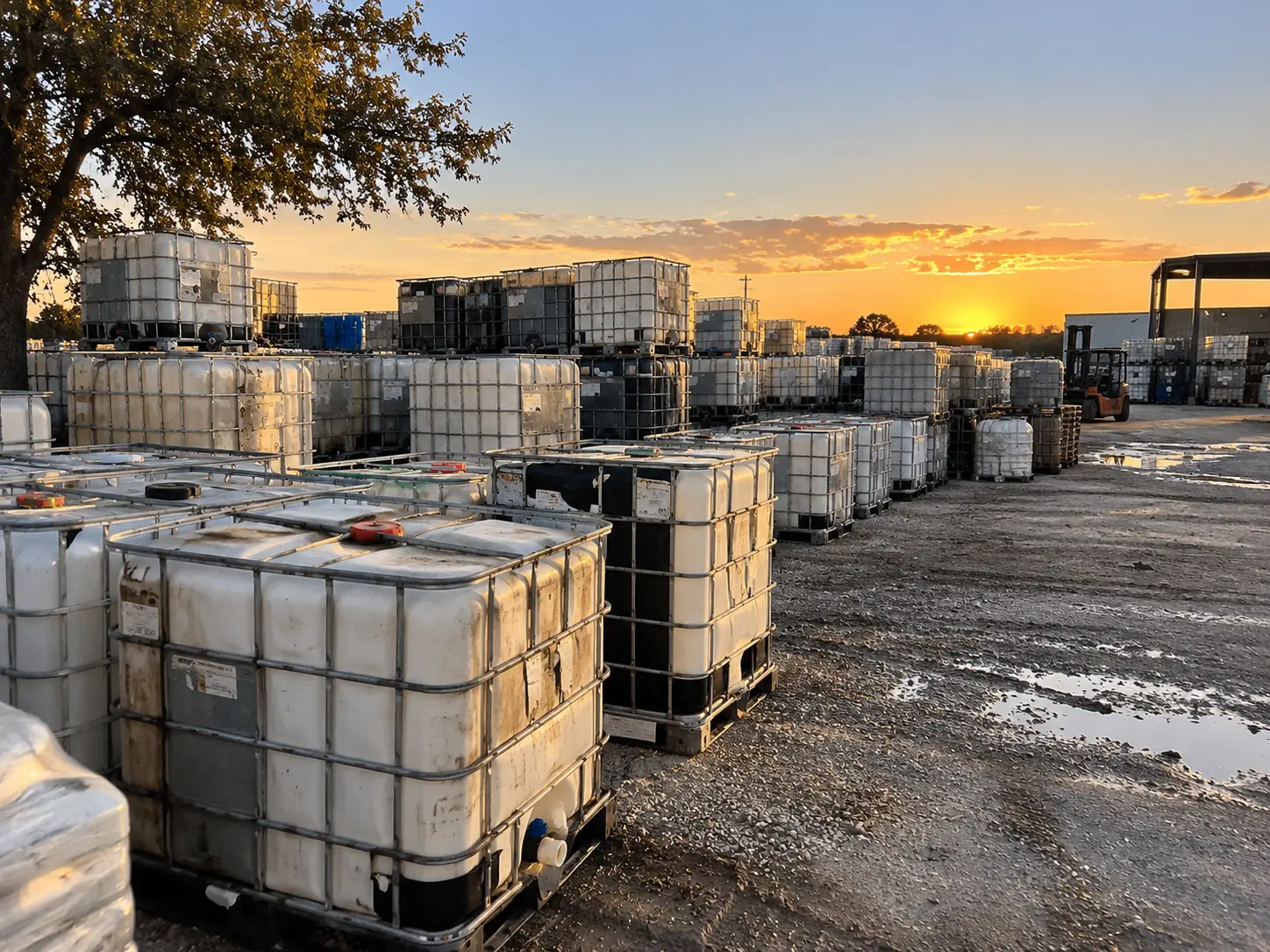
§ 02.2Sustainability / Circular Lifecycle
A tote doesn’t have
a lifespan. It has
a sequence of lives.
Most containers are treated as single-use objects with a disposal date. An IBC tote is better understood as an assembly of three components with independent lifespans — a bottle, a cage and a pallet — each of which can outlive the others and each of which has somewhere useful to go afterwards.
- Documented lives
- 7 stages
- Best observed
- 19 service lives
- Bottle lifespan
- 6–14 fills typical
- Cage lifespan
- 20+ years
§ 02.2.1Component lifespans
Three parts, three different clocks.
The single biggest mistake in tote disposal is treating the assembly as one object. The steel cage routinely outlives three bottles. Scrapping a perfect cage because its bottle failed is pure waste.
| Component | Material | Typical life | Limiting factor |
|---|---|---|---|
| Bottle | Blow-moulded HDPE | 6–14 fills | Stress crazing, permeation, UV embrittlement |
| Cage | Galvanised steel tube | 20+ years | Weld fatigue, impact deformation, galvanising loss |
| Plastic pallet | Injection-moulded HDPE/PP | 15+ years | Foot cracking, forklift impact |
| Steel pallet | Welded sheet & tube | 25+ years | Corrosion at weld joints |
| Timber pallet | Hardwood deck on bearers | 4–9 years | Rot, deck board fracture, nail pull |
| Valve & gasket | PP body, EPDM/Viton seal | 2–6 fills | Chemical attack on the seal |
Which is why our rebottling line exists: when the bottle hits its limit at fill eight, the cage is barely a third of the way through its own life.
3:1ratio
Bottles consumed per cage
Across our rebottling history, a single reclaimed steel cage typically carries three bottles through their full service lives before the cage itself retires.
Where the carbon sits, by component
- Galvanised steel cage132lb CO₂e
- HDPE bottle126lb CO₂e
- Pallet base35lb CO₂e
- Assembly & inbound freight22lb CO₂e
The cage is the single most carbon-intensive component and the longest-lived. It is also the one most often scrapped alongside a failed bottle. That is the biggest avoidable loss in this industry.
- Cage reuse rate
- 98.4% of intake cages return to service
- Pallet reuse rate
- 91.2% — timber is the weak link
- Bottle reuse rate
- 93.9% pass test and return as containers
- Valve replacement rate
- 61% get a new valve and gasket
§ 02.2.2The seven lives
One bottle, followed all the way through.
This is the actual documented path of a representative 275-gallon bottle through our operation — from the resin plant to the pellet silo, with roughly fourteen years in between.
- L1
First fill — virgin container
Moulded from virgin HDPE, caged, palletised and shipped to a filler. Carries 315 lb CO₂e of embodied impact. Holds a surfactant concentrate, ships to a distributor, is emptied, and becomes somebody's disposal problem.
- L2
First reconditioning — reuse
Collected, graded A-, caustic-washed, pressure-tested and recertified. Goes back out at a fraction of new cost to a janitorial blender. Embodied impact per trip drops to 158 lb.
- L3
Lives three to six — the workhorse years
Four more cycles of fill, empty, collect, wash, test, redeploy. This is where the economics and the carbon arithmetic both pay off hardest. Per-trip impact falls below 53 lb.
- L4
Downgrade — grade B service
Cosmetic wear and light permeation staining mean the unit no longer suits a customer who cares about appearance. It moves into non-critical duty: washdown water, concrete admixture, de-icing brine.
- L5
Bottle failure — the cage survives
At fill eleven the bottle drops pressure during the hold phase. It leaves the reuse path. The cage passes its geometry check and the pallet is sound, so both go to the rebottling line and carry a new bottle onward.
- L6
Upcycled build — a second category of usefulness
The failed bottle is still watertight at atmospheric pressure. Cut, fitted and finished, it becomes a rain-harvesting tank on a Wisconsin farm, where it will likely outlast its chemical service life by a decade.
- L7
Reprocessing — back to feedstock
When the harvester finally cracks, the bottle is granulated, hot-washed and pelletized into recycled HDPE with a traceable origin. That resin displaces virgin material in a new moulding — and the sequence starts again.
Cumulative outcome of the sequence above
14years
Total service span
11fills
As a transport container
26lb CO₂e
Embodied impact per trip
Against 315 lb CO₂e for a single-use container. The same object, used properly, delivered its service at roughly one-twelfth of the impact — and then became a rain tank and then became resin.
§ 02.2.3Downgrading done honestly
A grade B tote is not a failed tote.
One of the most useful things a reconditioner can do is find the right next job for a unit rather than forcing it into the wrong one. Cosmetic wear matters enormously to a consumer-facing filler and not at all to a concrete plant.
Permeation staining is the clearest example. A bottle that previously held a dye concentrate may be chemically clean, fully pressure-tight and completely unsuitable for anyone who will put it on a retail-adjacent loading dock. The same bottle is perfect for de-icing brine.
Matching the unit to the duty is how you get fourteen years out of an object the industry treats as disposable. It is also the part that cannot be automated — it needs a grader who knows both the tote and the customer.
Wherever yours are in the sequence
There is always a next stage. Never a final one.
Full, empty, clean, stained, cracked or crushed — tell us the condition and we will tell you which stage it belongs to.