§ 06.4Knowledge / Glossary
75 terms from
the reclaim floor,
defined properly.
Including the ones the industry uses loosely. Where a term is routinely misapplied — grade, food-grade, recertification — the definition says what it actually covers and what it does not.
- Terms
- 75
- Letters
- 19
- Cross-references
- Throughout
- Cost
- Free
- Adapter chain
- The sequence of fittings required to connect a tote outlet to a plant connection. Typically buttress to NPT, then NPT to camlock or hose tail. Each junction is a potential leak point and air path.
- Amortisation (of embodied carbon)
- Spreading a container's one-time manufacturing impact across its service lives. A tote at 315 lb CO₂e used twelve times carries 26 lb per trip.
- Aquaponics sump
- An upcycled build using a full-height retired bottle with side bulkheads for inlet and return. Fabricated only from bottles with a food-only declared history.
- Backhaul
- The return leg of a delivery trip. Because the tractor, driver and fuel are already committed, anything loaded onto a backhaul is carried at marginal cost — the cheapest freight in this trade.
- Baling
- Compressing scrap steel cages into dense bales for mill-grade recovery. A material downgrade from cage reuse, but not landfill.
- Blowdown
- Water withdrawn from a recirculating wash circuit along with concentrated filtered solids. One of three unavoidable losses in a closed-loop wash line.
- Bottle
- The blow-moulded HDPE vessel inside the cage. Roughly 38 lb and 126 lb CO₂e at 275 gallons, with a service life of six to fourteen fills.
- Brimful capacity
- The physical volume a bottle will hold, roughly 290 gallons on a 275-gallon unit. The difference is designed thermal expansion headspace and should never be filled.
- Buna-N
- A nitrile gasket compound with excellent resistance to petroleum products and mineral oils. Poor against oxidisers, ozone and aromatics.
- Buttress thread
- The coarse, shallow, asymmetric thread standard used on IBC fill openings and discharge outlets. Seals against a flat gasket on a seat face, not by thread interference — which is why thread sealant does nothing.
- Cage
- The welded, hot-dip galvanised steel tube frame surrounding the bottle. Roughly 70 lb and 132 lb CO₂e at 275 gallons — more embodied carbon than the bottle, and a 20+ year service life.
- Camlock
- A quick-connect coupling standard, lettered A through F plus DC and DP closures. Couplers mate with adapters; two couplers will not connect.
- Carry-out
- Water leaving a wash line on the unit itself — film on the bottle wall, water in the valve body, cage members and pallet. The largest single loss in a recirculating circuit.
- Cascade return
- Returning recovered wash water to an earlier, dirtier stage rather than a later, cleaner one. The technique that makes 90%+ water recovery achievable.
- Chloride stress corrosion cracking
- A failure mode in austenitic stainless requiring chlorides, elevated temperature and tensile stress simultaneously. Produces fine branching cracks with almost no visible corrosion — sudden rather than progressive.
- Composite IBC
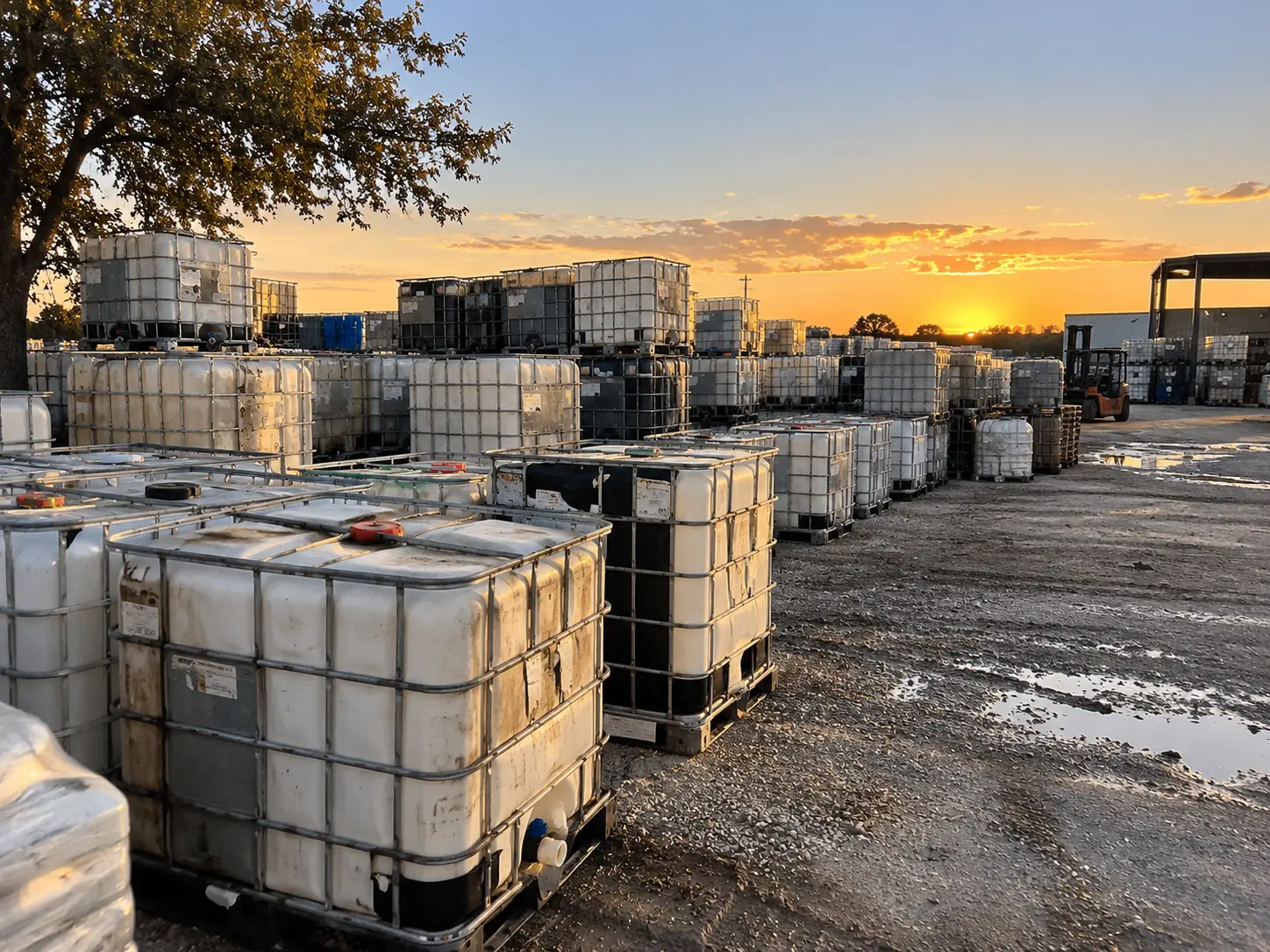
- A rigid IBC with a plastic inner receptacle in a separate outer frame. Design type 31HA1 for liquids with a steel outer. The standard caged tote.
- Compression set
- The permanent deformation a gasket takes after sustained clamping. The reason a reused gasket starts life having already spent its compliance.
- Crazing
- A fine network of surface fractures in polyethylene, most commonly around the valve boss or along a moulding weld line. The single most important bottle defect and a disqualifier from reuse.
- Date wheel
- The circular moulding-date marking on a bottle: an arrow or dot pointing to a month with the year in the centre. Gives a bottle's true age independent of paperwork.
- Design type
- The four-character code at the start of a UN marking — 31HA1 for a non-pressurised composite IBC for liquids with plastic inner and steel outer.
- Discharge valve
- The outlet valve at the base of the bottle. Typically a 2-inch polypropylene ball valve, or a 3-inch butterfly for viscous products. Replaced on 61% of our intake.
- Double-stacking
- Stacking empty units two high in a trailer to double return-load density. Requires sound cage geometry, and is only possible up to 275 gallons in a standard 110-inch interior.
- Duplex stainless
- A stainless grade with good resistance to chloride stress corrosion cracking. The usual answer for hot chloride duty where 316L is not sufficient.
- Dust cap
- A closure protecting a discharge outlet in transit. Cheap, routinely lost, and prevents debris in the seat face.
- Embodied carbon
- The greenhouse gas emissions from producing an object, before any use. Roughly 315 lb CO₂e for a new 275-gallon composite IBC, cradle to gate.
- EPDM
- The default gasket compound on most reconditioned units. Excellent for aqueous chemistry, caustics, surfactants and glycols; precisely wrong for oils, fuels and aromatic solvents.
- Fill cap
- The closure on the 6-inch buttress fill opening. Available solid, vented, tamper-evident or with pressure relief.
- Fill count
- The number of times a unit has been filled. The third-best predictor of condition, behind previous contents and storage conditions.
- Fluorination
- A surface treatment replacing hydrogen atoms with fluorine on the inner bottle wall, creating a hydrocarbon permeation barrier. A real improvement, but a thin surface layer that degrades with repeated exposure.
- Food-grade
- A container meeting four conditions together: compliant resin, a clean fill history, fully segregated handling and documented evidence. Compliant resin alone is the condition almost everyone meets and the least meaningful.
- Four-way entry
- A pallet base allowing forklift entry from any of four sides. Standard on plastic, steel and composite bases; not always on timber.
- Galvanising
- The hot-dip zinc coating on a steel cage, typically 50–85 µm. Surface wear is cosmetic; exposure through to bright metal starts corrosion and affects remaining life.
- Geometry jig
- The fixed frame against which a cage is checked in all three axes during grading. Out of tolerance in a recoverable way goes to the straightening press; beyond recovery goes to scrap.
- Grade
- A supplier's internal condition classification. There is no industry-standard IBC grading scale, so a grade letter means nothing without published criteria behind it.
- Grading drift
- The gradual loosening or tightening of a technician's internal standard across a shift. Addressed by a second independent check at staging.
- Granulation
- Grinding failed bottles into flake. Single-stream granulation from one product type with known contents produces materially more valuable output than mixed post-consumer feedstock.
- Grey-water settling tank
- An upcycled build with internal baffles and staged draw-off points at three heights, for separation duty. Explicitly non-potable.
- Gross mass (maximum)
- The marked limit on a loaded unit's total weight. Easy to breach with a dense product well before the tote is physically full.
- HDPE
- The resin used for IBC bottles. Resin code 2, service range roughly -20 to 140 °F, and permeable to small non-polar molecules.
- Headspace
- Designed volume above the working fill level, around 15 gallons on a 275-gallon unit, allowing thermal expansion. Not spare capacity.
- Heel
- Residual liquid left after normal discharge, typically half a gallon to three gallons. Heel volume drives residue handling cost.
- Hold phase
- The interval in a pressure test during which pressure is maintained and re-read. It is what distinguishes a test that catches slow leaks from one that does not — the failure mode that reaches a filling line.
- Hot wash
- Washing granulated flake at elevated temperature to remove residual product and label adhesive. The step that determines recycled resin odour and colour consistency, and the one cheap reprocessing skips.
- IBC
- A rigid or flexible container for bulk liquids or solids, between a drum and a tank. In common usage, the 275 or 330 gallon caged composite tote.
- ISPM-15
- The international standard requiring heat treatment or fumigation and marking of timber packaging crossing borders. Plastic, steel and composite pallet bases are exempt.
- Mis-grade
- A unit supplied in a condition below its stated grade. A supplier's process failure rather than a negotiation; ours runs at 0.4%.
- N11 code
- A three-digit dialling code of the form N11 — 211, 311, 911 and so on — reserved for services. Not valid as a telephone area code or exchange.
- NPT
- National Pipe Taper, the US tapered pipe thread standard. Not compatible with buttress thread; an adapter is required.
- Packing group
- A hazard classification, I (highest) through III. A UN marking's letter indicates the groups approved: X covers I–III, Y covers II and III, Z covers III only.
- Pallet base
- The platform the cage is mounted on — plastic, steel, composite or timber. Roughly 11% of a tote's embodied carbon and the component with our worst reuse rate when timber.
- Periodic inspection
- The mandated 30-month external and 60-month full inspection for IBCs in regulated transport service. A lapsed inspection makes a unit unusable for hazmat regardless of condition.
- Permeation
- Absorption of small non-polar molecules into the amorphous regions of a polyethylene wall, followed by slow migration back out. Not reachable by any wash. The mechanism behind most reconditioned-container complaints.
- Previous-contents declaration
- The seller's statement of what a unit held, ideally with chemical class, concentration, contact duration, fill count and heel volume. The most leveraged document in this trade.
- PTFE envelope
- A gasket construction with a PTFE jacket over a resilient core. The widest chemical resistance available and the least mechanically forgiving.
- Quarantine pad
- A sealed area where units that are leaking, bulging or carrying an unexpected declaration are held before entering the process.
- Rain harvester
- The most requested upcycled build. A top-cut bottle with a debris screen, overflow bulkhead and bottom draw-off, linkable in series.
- Rebottling
- Fitting a new bottle into a reclaimed, jig-checked and straightened cage and pallet. Keeps roughly 65% of the asset by mass and saves 176 lb CO₂e against a new unit.
- Recertification
- Re-marking a unit to a UN design type after inspection and test by a competent reconditioner. Covers transport suitability only, not chemical compatibility or food contact.
- Recirculation rate
- The proportion of wash water filtered and returned to the circuit. Ours is 92%, metered; the remaining 8% is carry-out, blowdown and evaporation.
- Reconditioning
- Washing, testing and recertifying a unit with its original bottle. Our highest-volume output and the lowest-carbon option at 53 lb CO₂e per unit.
- Reprocessing
- Granulation, hot wash and pelletizing at genuine end of life. Saves 53 lb CO₂e per unit — roughly one fifth of what reuse saves, which is why it is the last option.
- Residue class
- A compatibility grouping used to segregate drained heels so incompatible materials never share a consolidation container.
- Resin identification code
- The numeral in the recycling triangle moulded on a bottle. Code 2 is HDPE; code 5 is polypropylene.
- Restricted allocation
- Supplying only units whose entire declared fill history is compatible with a buyer's product. Costs nothing but lead time and solves most permeation concerns.
- Reuse rate
- The proportion of intake returning to service as a container rather than being rebottled or reprocessed. Ours is 93.9%.
- Seat face
- The flat surface a buttress closure's gasket presses against. Scoring, moulding flash or debris on a seat face causes leaks that tightening will not fix.
- Solution annealing
- Heat treatment relieving residual stress in welded stainless. Removes the most common initiation condition for chloride stress corrosion cracking.
- Specific gravity
- A product's density relative to water. Multiply water weight by it to find a loaded tote's gross mass — 2,294 lb at 275 gallons times your SG, plus tare.
- Stacking test load
- The marked limit on superimposed load a unit may carry when stacked. Separate from maximum gross mass.
- Tare
- The empty weight of a complete assembly as supplied, including valve, cap and pallet. 125 lb for a standard 275-gallon composite on a plastic pallet.
- Toll reconditioning
- Washing, testing and returning a customer's own units rather than exchanging them. Serials are recorded at collection and reported at return, preserving the asset register and the documentation chain.
- Triple rinse
- Three successive rinses, the baseline wash programme and a regulatory obligation for many agricultural products. Addresses residue, not permeation.
- Upcycled build
- A fabricated product made from a bottle that failed pressure testing but remains watertight at atmospheric pressure. Never for transport, regulated materials or pressure duty.
- Vented cap
- A fill closure admitting air without releasing liquid. Without one, a gravity-discharging tote forms a vacuum, stops flowing, and can deform permanently.
- Working maximum
- The designed fill level, equal to the nominal rated capacity. Distinct from brimful capacity by the headspace allowance.
also: Inner receptacle
also: NBR
also: Outer frame
also: Cam-and-groove
also: CSCC
also: Stress crazing
also: 2205
also: High-density polyethylene
also: Intermediate bulk container
§ 06.4.1Terms worth special care
Three words the industry uses loosely.
Each of these gets applied far more broadly than it should, and in each case the looseness costs a buyer money or compliance exposure.
Grade
There is no industry-standard IBC grading scale. A grade letter is a label on one supplier's internal classification and means nothing without published criteria. Compare the criteria, not the letters.
Our published criteria →Food-grade
Requires four conditions together: compliant resin, a clean fill history, segregated handling and documentation. Compliant resin alone describes essentially every tote in existence.
What it actually requires →Recertified
Covers suitability for transport within a design type. It says nothing about chemical compatibility, food contact, previous contents or whether the unit has been washed.
What a marking covers →Vocabulary into action
Now that we speak the same language, describe your duty.
Product, concentration, temperature, contact time and volume. Five facts and we can specify properly.