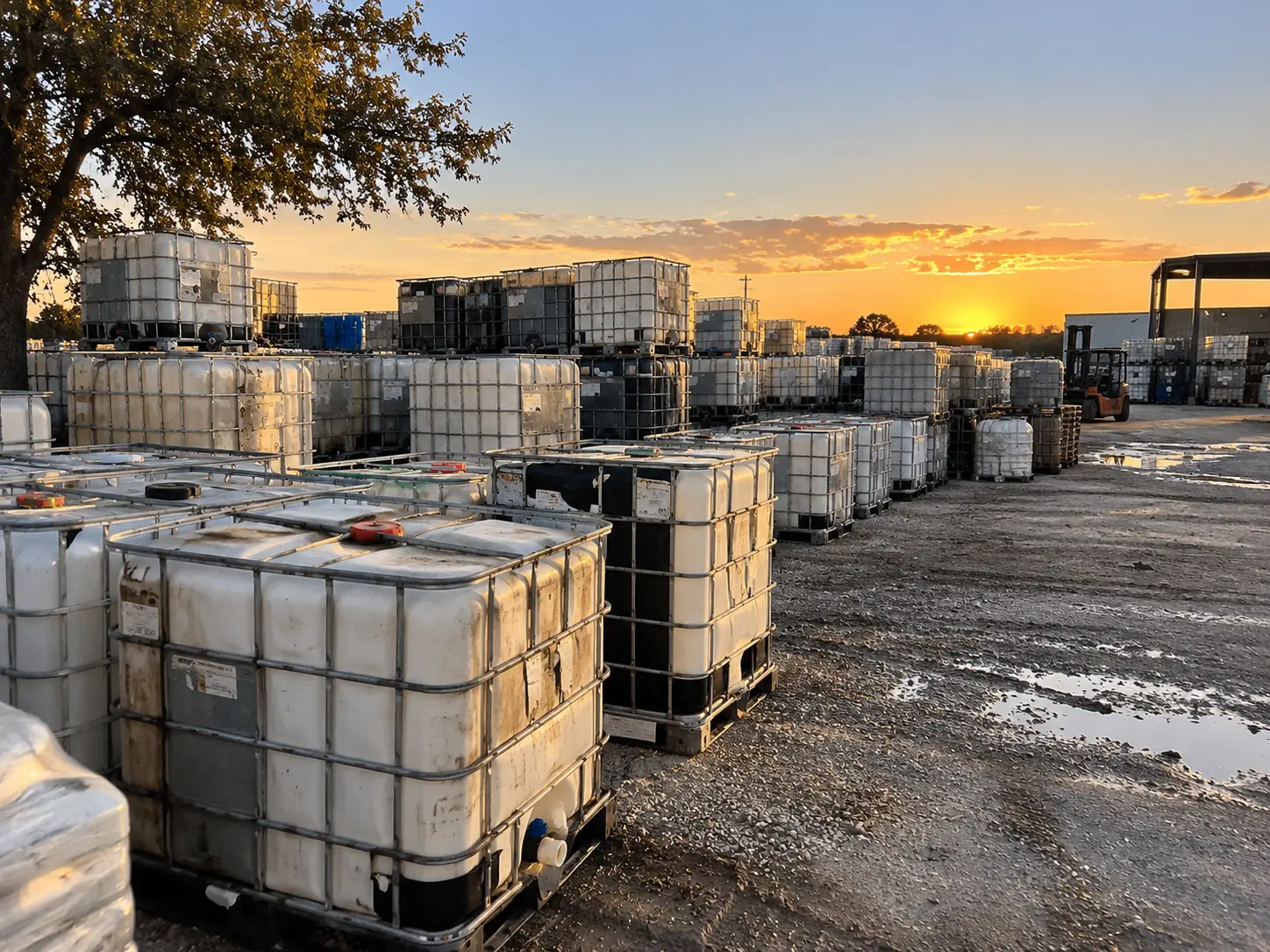
§ 02Sustainability
The greenest tote
on earth is the one
nobody had to make.
This is not a bolt-on values page. Reuse is the entire commercial model: we can undercut new totes precisely because the expensive, carbon-intensive part of making them already happened. Doing the right thing and doing the cheap thing are the same action here.
- Totes reclaimed
- 412,000
- Tons diverted
- 24,700
- CO₂e avoided
- 61,800 tons
- Landfilled
- 0 since 2016
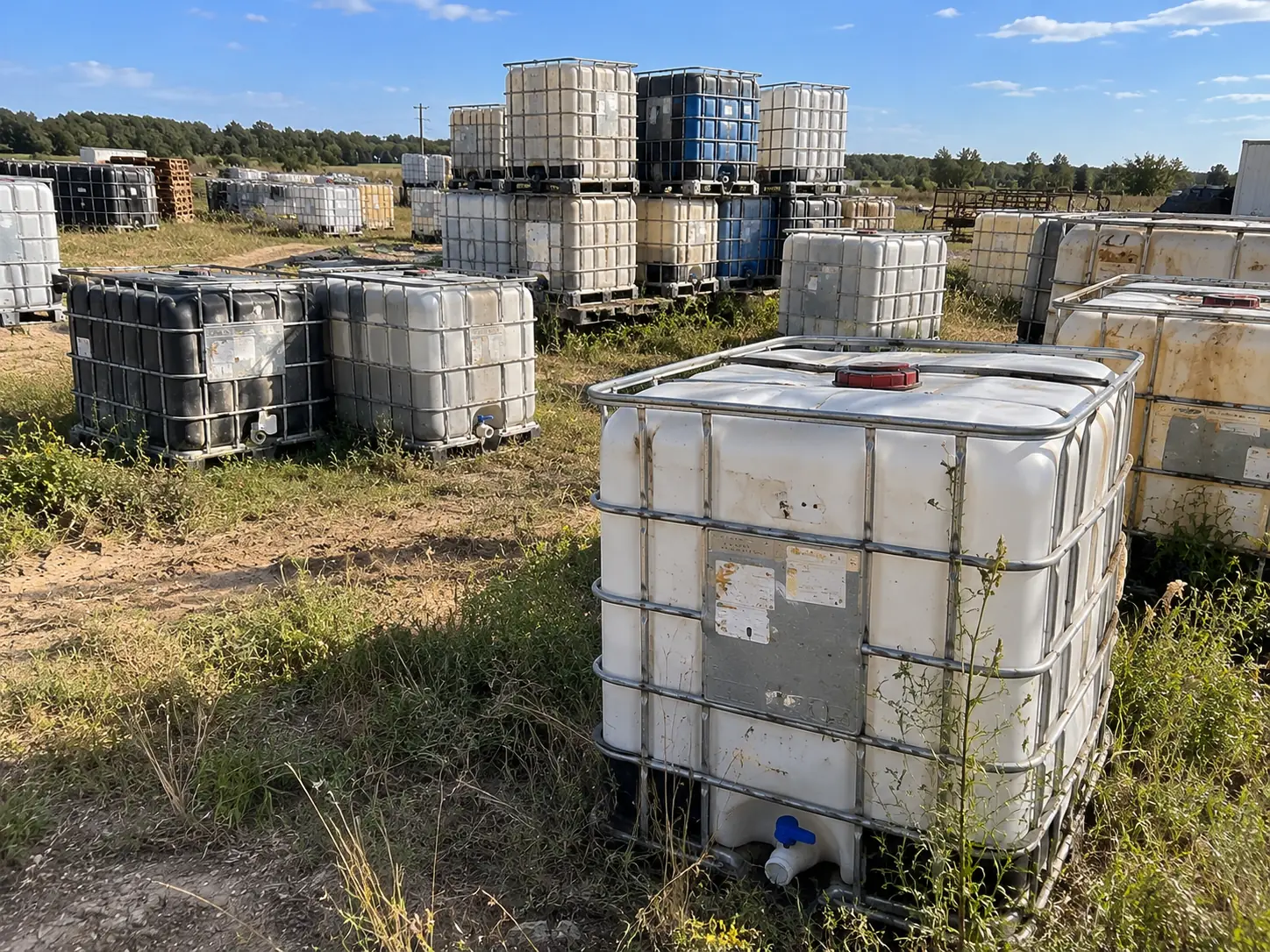
- Reduce · Reuse · Recondition · Reprocess — in that order
- Zero landfill since 2016
- 92% of wash water recirculated
- Every per-tote factor published
- No offsets, no credits, no accounting tricks
§ 02.1The hierarchy, applied properly
Recycling is the consolation prize.
The waste hierarchy is thirty years old and still routinely misread. Recycling a container recovers its material. Reusing a container recovers its material and its manufacturing — the moulding, the galvanising, the freight from the resin plant. That is where almost all the carbon lives.
Where the carbon actually is
A 275-gallon composite IBC carries roughly 315 lb CO₂e of embodied impact before its first fill. Break that down and the picture becomes obvious:
- HDPE bottle — about 38 lb of resin, polymerised, pelletized, shipped and blow-moulded. Roughly 40% of the total.
- Galvanised steel cage — tube stock drawn, cut, welded and hot-dip galvanised. Roughly 42% of the total.
- Pallet base — plastic, steel or timber depending on format. Roughly 11%.
- Assembly and inbound freight — the remaining 7%.
Now recycle that tote at end of life. You recover the resin — maybe 80% of it, at a quality penalty — and you recover the steel. But you have thrown away all of the moulding, all of the welding, all of the galvanising and all of the inbound freight, and you will have to spend it again on the replacement.
Reuse it instead and you spend nothing on any of those things. You spend a wash cycle: about 53 lb CO₂e including water heating, test, handling and outbound freight.
Recycling asks “can we recover the material?” Reuse asks “did we need to make anything at all?” Only one of those questions has a good answer.
So why does anyone recycle a tote?
Because sometimes they should. A bottle with stress crazing across a weld seam has no business holding a liquid under transport vibration. A bottle with permeation staining that survives a caustic wash cannot be honestly sold as clean. Those bottles need to become resin, and there is nothing wrong with that — it is the correct answer to a real condition.
What is wrong is reaching for the grinder, or the landfill, before anyone has checked. In our intake, 93.9% of units are good enough to go back into service as containers. That number is the whole argument.
lb CO₂e per 275-gal tote, cradle to gate
- Manufactured new from virgin315lb
- Rebottled (new bottle, reclaimed cage)139lb
- Recycled into resin, replaced new262lb
- Washed, tested and reused53lb
Note the third bar. Recycling a tote and buying a new one is only marginally better than buying a new one and landfilling the old — because the new tote still has to be made.
93.9%
Of intake goes back out as a container
Not as flake, not as scrap — as a working IBC tote. The remaining 6.1% is rebottled or reprocessed. None of it is landfilled.
§ 02.2Measured, not claimed
Our lifetime ledger.
These are cumulative figures since 2009, derived from our own intake records, wash-line metering and outbound manifests. The per-tote factors behind them are published on the Impact Report page so you can rebuild the arithmetic yourself.
- 412,000
- Totes reclaimed
- 24,700tons
- Material diverted
- 61,800tons
- CO₂e avoided
- 19.4Mgal
- Process water saved
Individually graded units taken out of the waste stream since 2009.
HDPE, galvanised steel and timber combined, measured at intake weigh pad.
Against the baseline of manufacturing equivalent new containers.
Virgin resin production water never drawn, net of our own wash consumption.
268kcu yd
Landfill volume diverted
Measured crushed, as a landfill would receive them.
92%
Wash water recirculated
Filtered and returned to the line in a closed loop.
0
Components landfilled
Since 2016, without exception.
0
Carbon offsets purchased
We reduce emissions rather than buy forgiveness for them.
§ 02.3Our unique instrument
We built a calculator
instead of a slogan.
Sustainability pages are full of numbers nobody can check. So here is ours, running live, with the factors published. Put your real volume in and see what it is worth.
Live instrument
The Reclaim Ledger
Set a quantity, choose what happens to the totes, and see exactly what staying in the loop is worth — measured against building the same totes new.
- Certificate
- RL-0IWB-LHO0
One truckload is roughly 48 totes. Drag to your real volume — or jump to a preset.
Reclaim path
31,440lb CO₂e
Emissions avoided
Same as taking 35,326 miles off the road.
94,320gallons
Process water saved
Equal to 5,484 eight-minute showers.
12,960lb
Virgin material displaced
HDPE resin plus steel cage and pallet stock never mined or moulded.
78.0cu yd
Landfill volume diverted
Measured crushed, as a landfill would actually receive them.
7,440kWh
Process energy avoided
Runs an average US home for 252 days.
655tree-years
Sequestration equivalent
What a stand of mature trees would absorb in a full year.
Against building new
120 totes, cradle to gate
- Manufactured new37,800lb CO₂e
- Through our reuse line6,360lb CO₂e
Baseline of 315 lb CO₂e per new 275-gallon composite IBC: virgin HDPE bottle, galvanised steel cage, pallet, moulding energy and inbound freight.
Your reclaim certificate
RL-0IWB-LHO0
Quote this number back to us and we can reproduce the exact calculation line by line — same quantity, same path, same factors.
- Quantity
- 120 totes
- Path
- Reuse
- Avoided
- 31,440 lb CO₂e
Figures are per-unit averages for 275-gallon composite IBCs, derived from our own 2024 wash-line metering, resin supplier EPDs and US EPA WARM factors. Totes larger than 275 gallons scale roughly linearly by bottle mass. Full methodology on the Impact Report page.
§ 02.4How we hold ourselves to it
Four commitments, each one checkable.
A commitment you cannot audit is a marketing line. Each of these produces a record that we publish or will show you on request.
- Zero landfill: no tote component leaves this site for a landfill. Our waste manifests are available on request.
- Closed-loop water: wash water is filtered and recirculated, metered at 92% recovery and reported annually.
- Published factors: every per-tote impact figure we quote is listed with its source on the Impact Report page.
- Reuse before reprocess: a bottle only goes to the grinder after it fails a documented test, never for convenience.
§ 02.5Go deeper
The whole environmental case, in four documents.
- E-01
The Reclaim Ledger
Our live impact instrument. Set a volume, pick a path, get a deterministic certificate number.
Interactive - E-02
Circular Lifecycle
The seven lives of an IBC tote, from first fill to recycled pellet, with what survives at each stage.
Lifecycle - E-03
Impact Report
Annual figures, per-tote factors, sources and the numbers that did not flatter us.
Data - E-04
Zero-Landfill Pledge
What the pledge actually commits us to, how we verify it, and what would count as breaking it.
Commitment
The simplest contribution you can make
Don't buy a new tote this quarter.
If your spec allows a reconditioned unit — and it usually does — that single decision saves around 262 lb of CO₂e per container. Multiply by your volume.