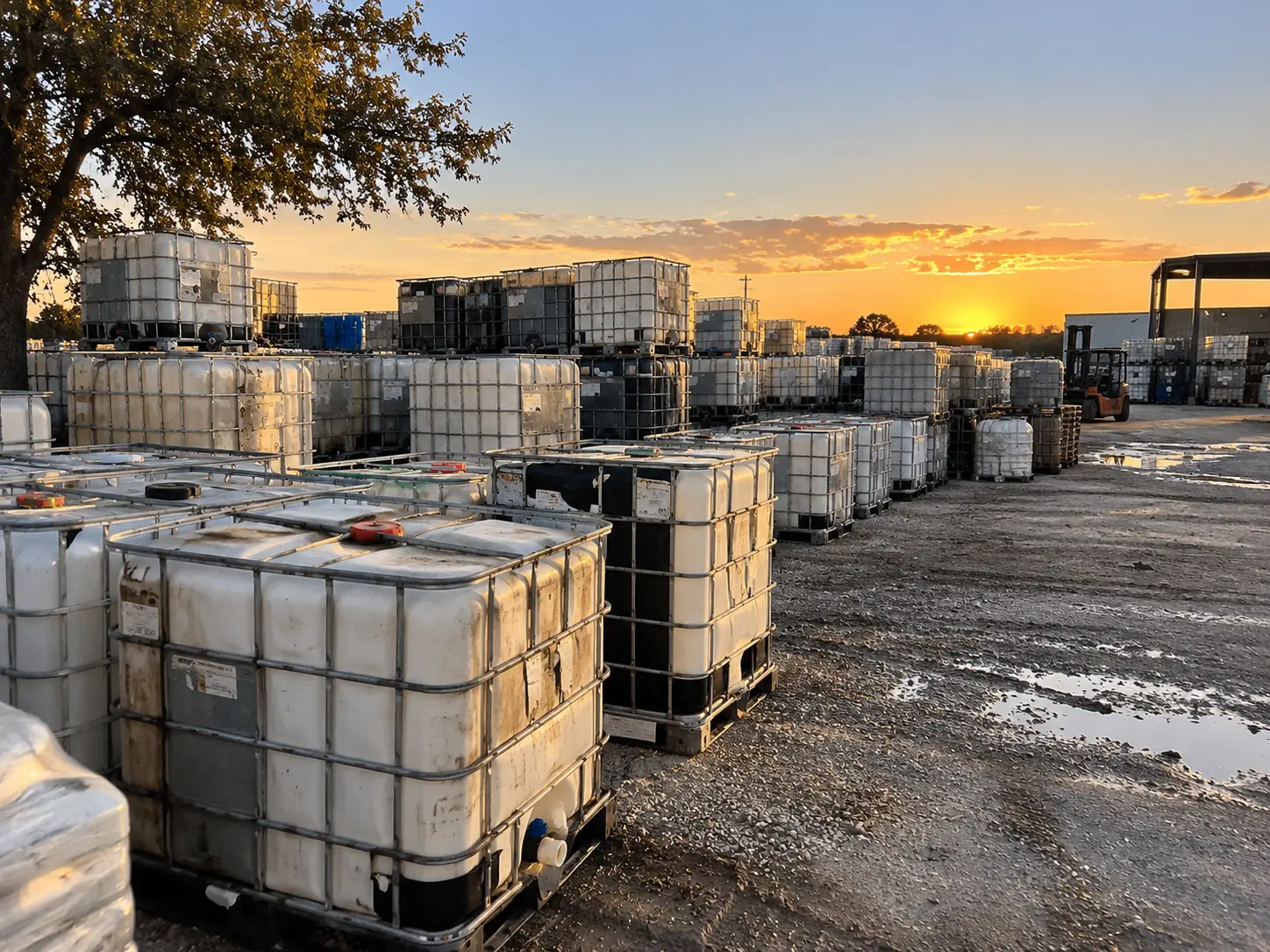
The material itself is not the problem. High-density polyethylene stays serviceable down to around -20 °F; it loses some impact toughness as it gets colder but it does not become brittle in the way polypropylene does. Galvanised steel cages are entirely indifferent to cold.
What splits bottles is water, expanding by roughly 9% as it freezes, inside a closed vessel with nowhere to go.
The three winter failure modes
One: product freeze expansion
An aqueous product left in a tote over a hard freeze expands against the bottle wall. The bottle bulges first — which is sometimes recoverable — and then splits, usually at a stress concentration near the valve boss or along a moulding weld line.
Designed headspace helps and is not sufficient. A 275-gallon tote has roughly 15 gallons of headspace, around 5% of volume, against a 9% expansion. If a tote is filled to its working level with an aqueous product, a full freeze will exceed the headspace.
Two: rainwater ingress, then freeze
This is the one that ruins empties. A unit stored outdoors with a missing cap collects rainwater over autumn, often several inches of it, and then freezes solid. The bottle splits exactly as it would with product in it — except nobody expected it, because the unit was recorded as empty.
- A single missing 6-inch cap can admit several inches of water over a wet autumn
- Nobody checks empties, so the water accumulates unobserved
- A frozen "empty" tote also becomes a freight problem — 2,300 lb instead of 125 lb
- The fix is a cap, or a sheet of plastic and a cable tie
Three: valve and fitting damage
Water trapped in a valve body or in the dead volume behind a closed valve freezes and cracks the housing. The bottle survives; the valve does not. Cheap to fix but easy to miss until the unit is filled and it weeps.
Gaskets suffer too. An elastomer at low temperature loses compliance and takes a compression set more readily, so a seal that was fine in October may weep in March even without visible damage.
Preparation that takes twenty minutes
- 01Walk the empties and check every cap. Fit what is missing, improvise where you cannot.
- 02Open every valve on empty units briefly to drain anything in the valve body, then close them.
- 03Tilt or drain any unit holding a heel — the heel is what freezes first and sits exactly where the stress concentration is.
- 04For units holding aqueous product over winter, either reduce the fill to around 85% or move them indoors.
- 05Unstack anything stacked. A split bottom bottle in a stack is a cascade failure, and cold cages are less forgiving of eccentric loading.
- 06Keep units off bare ground where you can. A pallet standing in a frozen puddle is harder to move and the base takes the stress.
If it has already frozen
| Condition | Action | Outcome |
|---|---|---|
| Frozen, no visible bulge | Thaw slowly at ambient; do not apply heat | Usually fine; test before reuse |
| Frozen with visible bulge | Thaw slowly; inspect geometry after | Often recoverable; may fail test |
| Split bottle, sound cage | Drain, declare, send for rebottling | Cage and pallet reclaimed |
| Split bottle, product inside | Contain immediately; treat as a spill | Residue handling required |
| Cracked valve only | Replace valve and gasket | Fully recoverable |
Never apply direct heat — a torch, a space heater at close range, or hot water above 140 °F — to thaw a tote. You will distort the bottle geometry, which converts a recoverable unit into a rebottling candidate.
A note on heated enclosures and band heaters
If you need product to stay pumpable through winter, band and blanket heaters exist and work. Two cautions worth stating plainly: respect the 140 °F ceiling for HDPE, because exceeding it softens the wall enough to deform under its own contents; and never run a heater on a unit whose contents have already frozen solid, because you will heat the wall against an incompressible mass.
Spring inspection
Whatever you overwintered, check it in March before you commit product to it.
- Bottle geometry — does it still sit square in its cage?
- Bulging, particularly on the lower third where hydrostatic pressure was highest
- Fine crazing around the valve boss and along moulding weld lines
- Valve body for cracks, and the gasket for compression set
- Pallet feet, which take the load unevenly on frozen uneven ground
- Cage geometry, if anything was stacked
Five minutes a unit. The alternative is finding out at the filling line, which costs considerably more than five minutes.