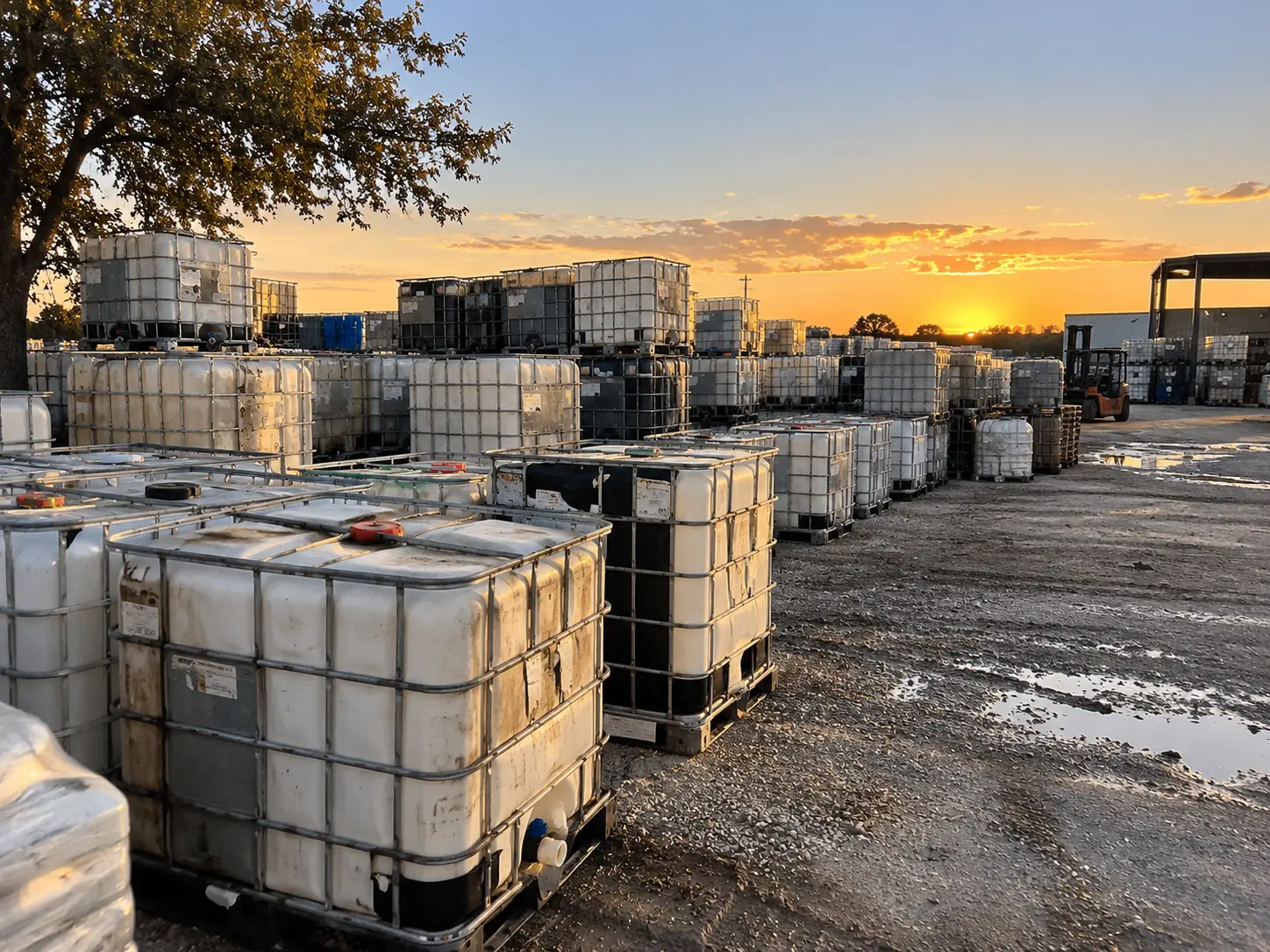
There is a well-meaning instinct to clean things before sending them away, and in the case of IBC totes it is almost always counterproductive. You will spend labour and water doing, badly, what a caustic wash circuit at 150 °F does properly in eighteen minutes. Worse, a partial clean can make the residue harder to characterise, which is the one thing a reclaim operation genuinely needs from you.
Do this: drain the heel as far as gravity takes it
The "heel" is the residual liquid left after normal discharge — typically half a gallon to three gallons in a 275-gallon unit, depending on viscosity and how level the tote was sitting. Getting most of it out is genuinely useful, because heel volume drives residue handling cost.
- 01Put the tote on a slight forward tilt — a wedge or a pallet corner is enough — so the heel runs toward the discharge valve.
- 02Crack the fill cap. A sealed tote will not drain; it forms a vacuum and the flow stops. This single step is the commonest drainage mistake.
- 03Open the valve fully and let it run until it stops rather than slows.
- 04Close the valve and refit the fill cap. Do not leave the unit open to the weather.
Do this: keep the caps and valves on
Caps and dust plugs cost almost nothing and prevent three expensive problems: rainwater ingress, which turns a 50-pound empty into a 2,300-pound full and changes the freight entirely; airborne debris in the bottle, which contaminates an otherwise clean wash; and insect or rodent nesting, which can disqualify a unit from a food-grade path permanently.
If caps have already gone missing, a sheet of plastic and a cable tie is a perfectly adequate field solution. The point is to close the opening, not to seal it to a specification.
Do this: segregate by previous contents
This is the single most valuable thing you can do and it costs nothing but a marker pen. Group the units by what was in them. Chalk or tape a code on each group. Even a rough segregation — "these twelve held the surfactant, these eight held the dye, these four we genuinely don't know" — transforms how efficiently a lot can be graded and priced.
| Declaration quality | What a buyer must assume | Effect on price |
|---|---|---|
| Per-unit fill history | Nothing — it is known | Best |
| Grouped by content class | Worst case within each group | Good |
| Single blanket declaration for the lot | Worst case across the whole lot | Moderate |
| "Various chemicals" | Worst case, plus quarantine handling | Poor |
| No declaration | Unknown — may be refused entirely | Lowest or refused |
Do this: separate out the genuine unknowns
Every yard has them: units whose labels weathered off, or which arrived with a contractor who left, or which have been behind the building since a plant reorganisation. Pull these out and count them separately. They are not a problem — they are a different problem, handled by field screening rather than by declaration — but they need to be visible in the quote request rather than discovered on arrival.
- Set unknowns aside as their own group, clearly marked
- Note anything you can observe: colour, viscosity, odour, any residual label fragment
- Do not attempt to identify them by mixing or testing yourself
- Never consolidate unknowns into one tote to save space — incompatible materials can react
Do not do this
- 01Do not pressure-wash the interior. You will not reach the permeated material, you will generate rinsate, and you will remove residue evidence that helps a grader match the declaration.
- 02Do not remove the UN marking plate. It identifies the unit, and a missing plate costs you value.
- 03Do not stack loaded or part-full units more than two high, and never stack a unit with any cage deformation.
- 04Do not store units upside down to drain them. The fill neck is not designed to carry the load and the cage geometry will deform.
- 05Do not mix incompatible heels. This is the one genuinely dangerous thing on this list.
- 06Do not leave units open to rain. A yard of rainwater-filled totes is a freight problem and a legitimate deduction.
A fifteen-minute preparation checklist
For a typical lot of forty to fifty units, the whole exercise should take one person a couple of hours at most, and most of that is walking and counting.
- Count the units and note the capacities from the moulded marking
- Group them by declared previous contents; mark each group
- Separate genuine unknowns into their own marked group
- Tilt and gravity-drain anything that still has a heel, with the fill cap cracked
- Refit all caps and dust plugs, or improvise closures
- Photograph: one wide shot, one representative unit, one marking plate, one of the access route
- Note your site conditions — dock height, forklift availability, surface, gate restrictions
That is it. Everything else — the washing, the testing, the residue profiling, the grading — is what a reclaim operation is for. Your job is to make the lot legible, not to make it clean.