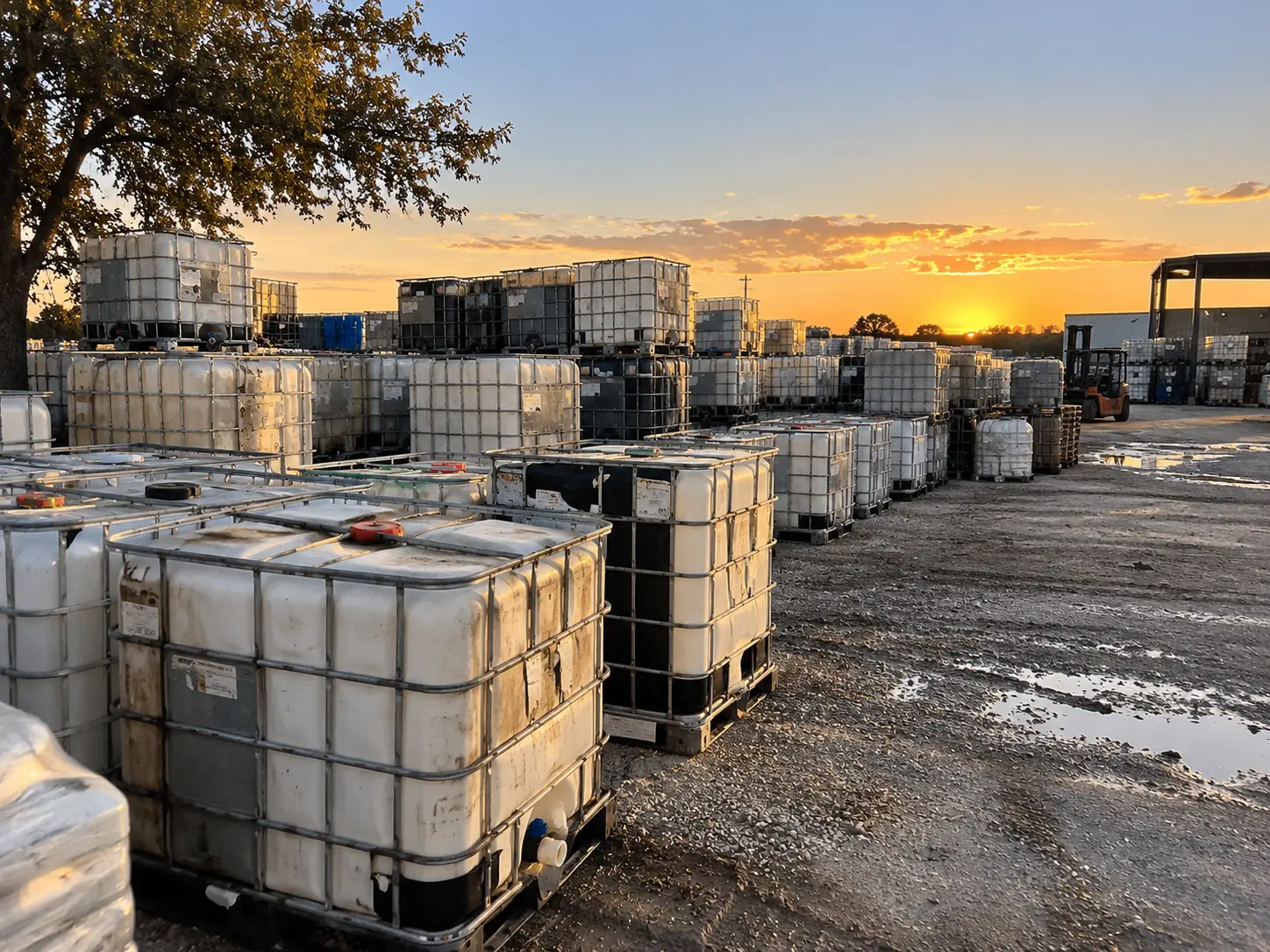
Most buying decisions in industrial packaging are made by inertia. Somebody specified new totes in 2014, the purchase order has been reissued forty times since, and nobody has revisited the question because nothing went wrong. That is a defensible way to run a procurement function and an expensive way to run a packaging budget.
So here is the comparison laid out properly, by the three things that should actually drive it.
Specification one: contact-surface history
A new bottle has never held anything. A reconditioned bottle has held something, been emptied, washed to a programme matched to that residue, and pressure tested. For the vast majority of industrial fills, these two states are functionally identical — the wash removes the residue and the test proves the integrity.
The exception is permeation. High-density polyethylene is a semi-crystalline polymer with amorphous regions that small non-polar molecules can diffuse into. Over sustained contact, certain substances absorb into the bottle wall rather than sitting on its surface, and no wash reaches them. Over subsequent weeks they migrate back out into whatever is in the tote next.
| Previous content | Permeates? | Detectable? | Implication for reuse |
|---|---|---|---|
| Aqueous inorganic solutions | No | — | Full reuse, any grade |
| Surfactants, detergents | Minimal | — | Full reuse, any grade |
| Glycols, glycol ethers | Minimal | — | Full reuse, any grade |
| Mineral oils | Limited | Sometimes by odour | Reuse for compatible duty |
| Terpenes, d-limonene | Yes, strongly | Yes, by odour | Restrict to compatible duty |
| Aromatic solvents | Yes | Often by odour | Restrict to compatible duty |
| Chlorinated solvents | Yes, strongly | Yes, for years | Restrict heavily |
| Dyes, pigment carriers | Yes | Yes, visibly | Cosmetic grades only |
| Flavour, fragrance concentrates | Yes | Yes, by odour | Never re-enters a food path |
A stained bottle is telling you something permeated, which is useful information. A visually clean bottle that held d-limonene is telling you nothing, which is worse.
Specification two: appearance
This one is legitimate and frequently dismissed as vanity, which is unfair. If your container arrives on a customer's loading dock, if it sits in a retail-adjacent space, or if your own QA release process includes a visual inspection against a photographic standard, then cosmetic condition is a real specification rather than a preference.
What is worth knowing is that this specification has a middle answer. A rebottled unit — a brand-new bottle fitted into a reclaimed, straightened steel cage — gives you a pristine bottle inside and out at roughly 44% of the embodied carbon of a fully new unit and a correspondingly lower price. Most customers who ask for new because of appearance actually want rebottled.
- 315lb CO₂e
- New composite IBC
- 139lb CO₂e
- Rebottled
- 53lb CO₂e
- Reconditioned
Specification three: regulatory first-fill requirements
A small number of applications genuinely mandate a virgin container: certain pharmaceutical intermediates, some regulated agrochemicals, and occasionally a packing group I material at the upper limit of the composite IBC design type where any service history is a risk you cannot justify documenting.
If you are in one of those categories you already know it, because it will be written into a specification somewhere. If you are not, and somebody tells you the regulations require new totes, ask which regulation. The answer is often that a customer contract requires it, which is a commercial requirement rather than a legal one — and commercial requirements can be renegotiated with data.
The arguments against reconditioned that do not survive scrutiny
"They're not as strong"
A reconditioned composite IBC retains its original cage, which carries the structural load, and its original bottle, which has been pressure tested with a hold phase. A new tote has been tested as a design type; a reconditioned tote has been tested as an individual unit. The evidence base for the used one is arguably better.
"They won't pass an audit"
Properly reconditioned units carry a valid UN/DOT marking with a current periodic inspection date, a wash programme code, a test date and a previous-contents chain. We have customers who are audited annually by their own clients on exactly this documentation. What fails audits is missing paperwork, not reconditioning.
"We can't risk a leak"
Neither can we, which is why 100% of reuse stock is pressure tested rather than statistically sampled. The failure mode you should actually worry about is not the container — it is the gasket, and that is a question of specifying the right compound for your chemistry, which applies equally to a new unit.
"It's a false economy — they don't last"
A composite bottle has a service life of roughly six to fourteen fills. A reconditioned unit bought at fill four has eight or so left in it. If you are buying it at a fraction of new cost, the arithmetic is comfortably in your favour even on a shortened life — and in practice the limiting factor on most fleets is loss and non-return, not bottle failure.
A decision table you can actually use
| Your situation | Buy | Why |
|---|---|---|
| General industrial chemistry, appearance irrelevant | Reconditioned, grade B | Identical function, lowest cost and carbon |
| Industrial chemistry, appearance matters | Reconditioned, grade A- | Washed and tested with light cosmetic wear only |
| Customer-visible or retail-adjacent | Rebottled | New bottle inside and out at 44% of new carbon |
| Permeation-sensitive product | Rebottled | Unused contact surface; no fill history to manage |
| Food, beverage, flavour | Food-grade, segregated path | Requires separation and documentation, not just resin |
| Regulated first-fill requirement | New | The specification genuinely requires it |
| Aggressive solvent, repeated cycles | Stainless | Wall material is the constraint, not condition |
| Water, brine, washdown, admixtures | Reconditioned, grade B- | Cosmetic condition entirely irrelevant |
The question to ask your supplier
Not "what grade is it?" — grade letters mean nothing without published criteria, and most suppliers do not publish any. Ask instead: what wash programme did this unit run, what was in it before, when was it pressure tested, and can I have those three facts per unit on the manifest?
A supplier who can answer those three questions per unit is selling you a documented container. A supplier who answers "grade A" is selling you a letter.
If the answers come back clean, reconditioned is almost always the right buy. If they do not, that tells you something more useful than any brochure.