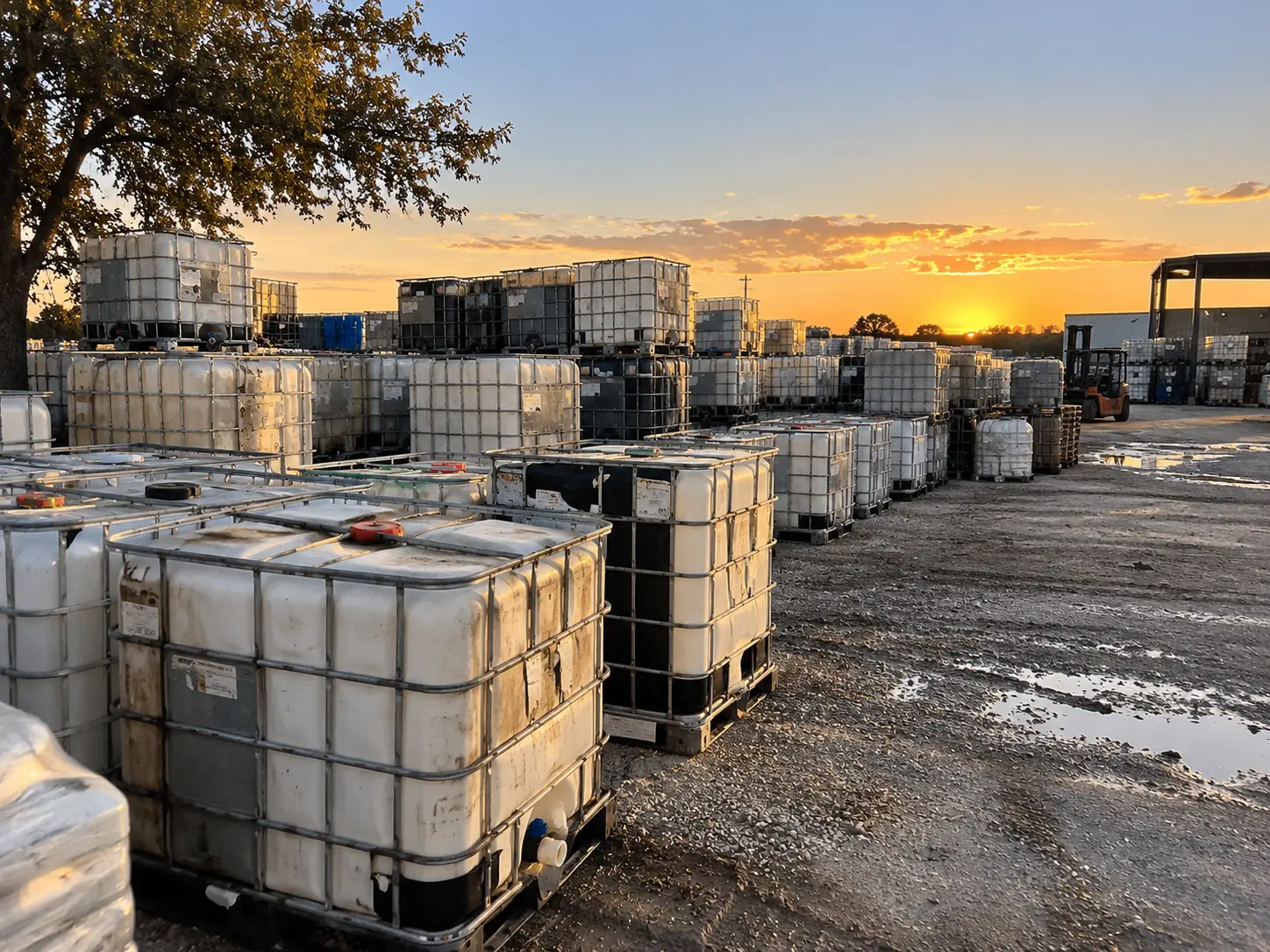
Start with the fact that makes this whole article necessary: there is no industry-standard grading scale for IBC totes. No regulator defines one, no trade body enforces one, and every reconditioner uses their own letters with their own meanings.
Which means a grade letter, on its own, carries no information. It is a label on a supplier's internal classification, and internal classifications vary enormously.
The four questions
These replace "what grade is it?" and they work on any supplier, including us.
- 01What wash programme did this unit run, and is the code recorded on the unit?
- 02What were the previous contents, per unit or per lot, and will that chain travel with the load?
- 03When was it pressure tested, is every unit tested or a sample, and does the test include a hold phase?
- 04Are the criteria for this grade published, and can I see them?
What the answers reveal
| Question | Good answer | Warning sign |
|---|---|---|
| Wash programme | A specific programme, coded on the unit | "Washed" or "cleaned" |
| Previous contents | Per unit, chain carried forward | "Various" or not available |
| Testing | 100% of units, with hold phase | "Spot checked" or sampled |
| Published criteria | A document you can read | "Industry standard" (there isn't one) |
That bottom-right cell is worth dwelling on. Any supplier who tells you their grades follow an industry standard is either confused or counting on you not knowing that no such standard exists.
Testing: the distinction that matters most
Of the four, testing is where the practical risk concentrates, and there are three meaningfully different things a supplier might mean by "tested."
- Visual inspection only. Somebody looked at it. Catches gross defects and misses slow leaks entirely.
- Pressure test without a hold phase. The unit is pressurised and the gauge is read. Catches fast leaks and misses slow ones.
- Pressure test with a hold phase. The unit is pressurised and held, and the gauge is read again after a defined interval. This is the one that catches slow pressure loss — which is the failure mode that reaches a customer's filling line.
And separately: every unit, or a sample? Sampling is defensible for a process in statistical control producing identical items. A reclaimed population is not that — each unit has a different history, so each unit needs testing.
Why the same letter costs different amounts
Three legitimate reasons a grade A from one supplier costs 30% more than a grade A from another. None of them involves anybody being dishonest.
- 01The criteria genuinely differ. One supplier's grade A permits light permeation staining; another's does not. Both are internally consistent and they are not the same product.
- 02The testing differs. 100% hold-phase pressure testing costs real money per unit. A supplier who samples can price lower and is selling you a different risk profile.
- 03The documentation differs. Carrying a previous-contents chain forward per unit requires record-keeping discipline. A supplier who does not carry it is cheaper and has broken the chain permanently.
When comparing quotes, compare the criteria rather than the letters. If one supplier publishes criteria and the other does not, you are not comparing like with like at all.
What a published scale should actually specify
If a supplier hands you their criteria, these are the dimensions worth checking it covers. A scale that only describes appearance is describing the least important variable.
| Dimension | Why it matters |
|---|---|
| Bottle origin — new, original, or food-only history | Determines the permeation question entirely |
| Wash programme | Determines whether the residue was actually addressed |
| Test type and coverage | Determines integrity confidence |
| Permitted staining | The main cosmetic variable, and a permeation signal |
| Cage geometry tolerance | Determines stackability and handling safety |
| Galvanising condition | Determines remaining service life |
| Fittings — new or reclaimed | A reclaimed valve carries its own unknown history |
| UN/DOT recertification status | Determines regulated-transport eligibility |
A practical procurement approach
Rather than specifying a grade letter in a purchase order, specify the attributes you actually need and let suppliers tell you which of their grades meets them.
- "Pressure tested with a hold phase, 100% of units, test date on the unit label"
- "No unit whose declared history includes a terpene, aromatic or chlorinated solvent"
- "Previous-contents chain supplied per unit"
- "New valve and gasket, compound to suit [your chemistry]"
- "Cage geometry within tolerance for two-high stacking"
- "UN/DOT recertification current, with the inspection date marked"
Six attribute lines instead of one letter. It is harder to write once and considerably easier to enforce, and it makes two quotes genuinely comparable for the first time.
And the remedy clause
One more line worth having: what happens if a unit arrives below its graded condition. The answer should be replacement or credit at your choice, without argument, because a mis-grade is a supplier's process failure rather than a negotiation.
Ask what a supplier's mis-grade rate is. If they do not measure it, they are not managing it. Ours is 0.4%, which exists because every wholesale load is re-checked at staging by a second technician — and we publish the number precisely so it can be held against us.