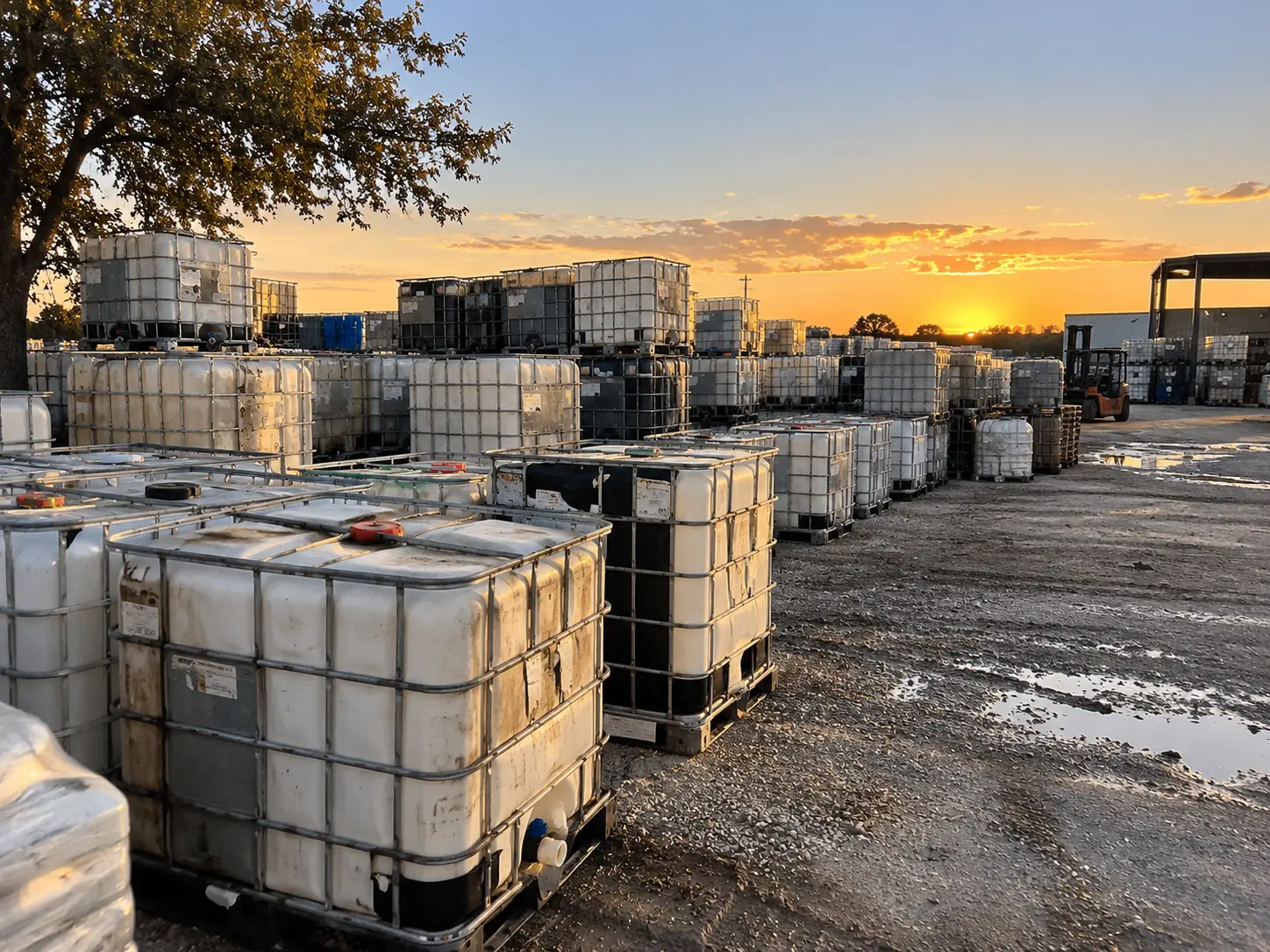
Here is the fact that reorganises how you think about a tote. In a 275-gallon composite IBC, the galvanised steel cage carries roughly 132 lb CO₂e of embodied impact and the HDPE bottle carries roughly 126 lb. The steel is the bigger number.
And the cage lasts far longer. In our observed history, a single reclaimed cage carries three bottles through their full service lives before the cage itself retires.
- 132lb CO₂e
- Steel cage
- 126lb CO₂e
- HDPE bottle
- 3:1
- Bottles per cage
- 98.4%
- Of intake cages we reuse
Why bottles fail while cages do not
The failure modes are completely unrelated, which is the whole reason the components have different lifespans.
| Component | Primary failure | Driver | Typical life |
|---|---|---|---|
| HDPE bottle | Stress crazing at valve boss | Cyclic loading, chemical attack | 6–14 fills |
| HDPE bottle | Permeation staining | Sustained contact with solvents, dyes | Varies |
| HDPE bottle | Heat distortion | Sun exposure, hot fills | Varies |
| HDPE bottle | UV embrittlement | Years of outdoor storage | 8–15 years |
| Steel cage | Weld fatigue cracking | Repeated impact and flex | 20+ years |
| Steel cage | Galvanising loss | Abrasion, chemical exposure | 20+ years |
| Steel cage | Impact deformation | Forklift and handling damage | Event-driven |
A bottle fails at fill eleven because of what was in it and how the plastic responded. The cage around it has taken eleven cycles of handling, which for drawn and welded steel tube is barely a third of its working life.
What the industry does instead
Scraps the assembly. The unit fails a pressure test, the whole thing goes to a grinder and a baler, and roughly 167 lb CO₂e of cage and pallet is discarded to avoid the inconvenience of separating them.
The biggest avoidable loss in this industry is not landfilled plastic. It is perfectly sound galvanised steel being scrapped because the bottle inside it failed.
The rebottling line, step by step
- 01Disassembly. The failed bottle comes out of its cage. The cage and pallet go one way; the bottle goes to granulation or, if watertight at atmospheric pressure, to an upcycled build.
- 02Geometry jig. The cage is checked in all three axes against a fixed jig. Out of tolerance in a recoverable way goes to the straightening press; out of tolerance beyond recovery goes to mill-grade scrap.
- 03Hydraulic straightening. Frames that are bent but sound are pressed back to jig geometry. This is a skilled operation — over-correcting work-hardens the steel at the bend.
- 04Weld inspection. Every joint, after straightening rather than before, because straightening is exactly the operation most likely to reveal a marginal weld.
- 05Galvanising assessment. Surface wear is acceptable; exposure through to bright metal over a significant area is not, because corrosion will start from there.
- 06Pallet assessment. Feet, deck, bearers and the cage-to-pallet attachment. Replaced where needed rather than rejected.
- 07New bottle drop-in. A virgin blow-moulded bottle, never filled, seated into the reclaimed frame.
- 08Fitting. New valve, new gasket, new fill cap and seal. No reclaimed fittings on a rebottled unit.
- 09Test. Pressure and leak tested with a hold phase, like everything else that leaves as a container.
- 10Marking. Fresh UN/DOT 31HA1/Y marking applied and recorded against the unit.
Cage acceptance criteria
A cage enters the rebottling line only if it passes all five. Failures are baled to mill-grade scrap steel, which is a real recovery but a material downgrade.
- Geometry within tolerance on the jig in all three axes, after straightening
- No fatigue cracking at any weld joint under inspection
- No deformation preventing stacking or four-way forklift entry
- Galvanising intact enough to resist corrosion through a further service life
- Base frame to pallet attachment sound
What a rebottled unit is, precisely
This matters because the category is easy to oversell and easy to undersell. A rebottled unit has a brand-new bottle that has never held anything, inside a reclaimed cage and pallet that have been inspected, straightened and refitted.
| Component | New or reclaimed | Treatment |
|---|---|---|
| HDPE bottle | New | Virgin, never filled |
| Steel cage | Reclaimed | Jig check, straightening, weld inspection |
| Pallet base | Reclaimed or new | Inspected; replaced if cracked |
| Discharge valve | New | To specification |
| Valve gasket | New | Compound to suit the buyer's chemistry |
| Fill cap and seal | New | Vented or solid as specified |
| Marking | New | Fresh 31HA1/Y, recorded |
Dimensionally it is identical to a new unit, because the cage is the original cage. It will drop into existing racking without adjustment.
Who it is right for
Rebottled is the answer to a specific question: I need an unused contact surface, but I do not need a certificate that the whole assembly is virgin.
- Permeation-sensitive products where fill history is the concern
- Customer-visible or retail-adjacent containers where appearance matters
- Food applications, on a segregated path — the bottle has never held anything, so the usual history question does not arise
- Regulated fills needing full UN/DOT marking without questions about bottle age
And who it is not right for: the large majority of industrial fills, where a properly washed and tested original bottle performs identically for materially less money and materially less carbon. We say so, because selling somebody a rebottled unit when a reconditioned one would do is the same mistake as selling them a new one.
The number that justifies the line
A rebottled unit carries 139 lb CO₂e against 315 for a new one — a saving of 176 lb per unit. The bottle's carbon is spent again; the cage's and the pallet's are saved.
Across a year of rebottling that is a large number, and it exists entirely because somebody bothered to separate two components with different lifespans instead of treating the assembly as a single object. Which is, in a sentence, the whole argument for doing any of this.