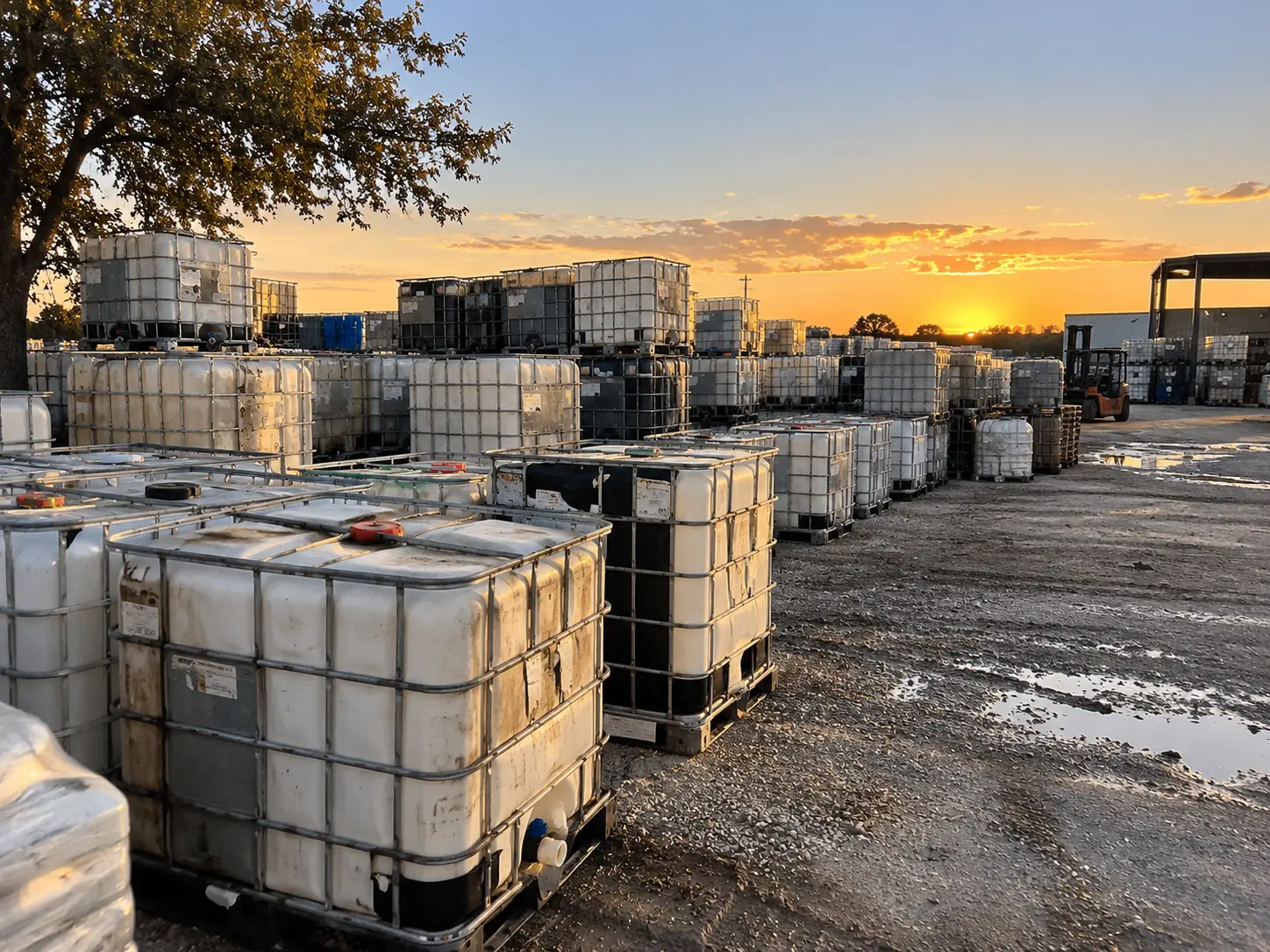
Everything a reclaim operation does downstream depends on knowing what was in the bottle. The wash programme, the test path, the achievable grade, the customers it can be sold to and whether it can enter a food path at all — all decided by one piece of information the seller controls.
Which makes the declaration the most leveraged document in this trade, and the one most often filled in with two words.
The five fields that matter
One: the chemical identity, by class
A trade name is better than nothing and a chemical class is much better than a trade name. "Surfactant blend, non-ionic" tells a reconditioner which wash circuit to use. "Brightwash 400" tells them to go looking for a safety data sheet that may or may not exist.
If you can supply both — trade name plus class — that is ideal, and the class is the part that matters.
Two: the concentration
The same chemical at 2% and at 60% are different residue problems, different compatibility questions and sometimes different regulatory categories. A concentration range is fine; an order of magnitude is not.
Three: the contact duration
This is the field almost nobody includes and it is the one that predicts permeation. A tote that held a solvent for four days in transit is a far better reuse prospect than one that held the same solvent for eight months in a yard, because absorption into the polymer wall builds with sustained contact.
Four: the fill count or service history
Did this unit hold one product once, or has it been through five different fills? A tote with a single, documented, compatible history can go places a tote with five partially-remembered fills cannot — particularly any food or sensory-sensitive application.
If you genuinely do not know, say so. An honest "unknown beyond the last fill" is far more useful than an optimistic guess, because it routes the unit correctly rather than causing a problem three weeks after somebody else's fill.
Five: whether anything is still in it
Heel volume and whether it is the declared product or something else. An undeclared part-full unit discovered at an intake weigh pad is the thing most likely to turn a smooth transaction into an awkward one, and it is entirely avoidable.
A format that works
| Lot | Units | Product | Class | Conc. | Contact | Heel | Fill count |
|---|---|---|---|---|---|---|---|
| A | 24 | Brightwash 400 | Non-ionic surfactant | 40% | 2 weeks | < 1 gal | 1 |
| B | 12 | Glycol blend | Glycol ether | 100% | 3 months | ~2 gal | 1 |
| C | 8 | Tint base 7 | Solvent dye carrier | 100% | 6 months | < 1 gal | 2 |
| D | 4 | Unknown | Unknown — amber, low odour | — | — | ~15 gal | Unknown |
Four lines, two minutes, and it transforms what a reconditioner can do with the lot. Lot C will be restricted to cosmetic grades because of the dye carrier; lot D will be field screened. Both decisions get made before a truck is booked rather than after it arrives.
What vagueness costs you
A buyer facing an ambiguous declaration has to assume the worst case within the ambiguity, because they are the ones who will own the consequence.
| Declaration | Buyer must assume | Effect |
|---|---|---|
| Per-unit, five fields complete | Nothing — it is known | Best price, fastest turnaround |
| Per-lot, five fields complete | Worst case within each lot | Good price |
| Per-lot, product name only | Worst plausible interpretation | Moderate; questions before booking |
| "Various chemicals" | Worst case across everything | Poor; quarantine handling likely |
| None | Unknown | May be refused, or priced as unknown |
Honesty about awkward contents is priced better than vagueness about ordinary ones. Vagueness forces a buyer to price the worst case, and the worst case is always worse than your actual situation.
Exclusions: tell us before the truck is booked
Every reclaim operation has residue classes it is not licensed to accept. Ours are published, and the reason they are published is so that a declaration can be checked against them in advance rather than at an intake pad.
- Acutely toxic and P-listed materials
- Radiological and biohazardous residues
- Unstabilised reactive monomers
- Polychlorinated biphenyls
- Any undocumented fill history where the unit is intended for a food-grade path
If something on that list appears in a declaration, we say so immediately and recommend a specialist handler. If it appears without a declaration, the unit gets quarantined on arrival and the conversation is considerably less pleasant for everyone.
What a buyer should give you back
A declaration is one half of a chain. The other half is what travels with the unit when it leaves — and if you are the one buying reconditioned stock, this is what you should expect.
- 01The declared previous contents, per unit where available, carried forward from the originating customer
- 02The wash programme code that ran on each unit
- 03The pressure and leak test date and result, per unit
- 04The assigned grade, against published criteria
- 05The UN/DOT recertification status where applicable
If a supplier cannot carry the previous-contents chain forward, they have broken it — which means nobody downstream of them can make an informed permeation assessment ever again. That is a bigger deal than it sounds, and it is worth asking about before you commit to a supplier rather than after.
A two-minute template
Copy this into an email and fill it in per lot. It is genuinely all that is needed.
- Lot reference and unit count
- Product name and chemical class
- Concentration or range
- Approximate contact duration
- Heel volume per unit, approximate
- Number of prior fills, or "unknown beyond last fill"
- Anything else you know: staining, odour, storage conditions, how long since emptied
Seven lines. It will get you a better price, a faster turnaround and no awkward phone calls about something found at an intake pad. There is no part of this trade with a better return on two minutes of effort.