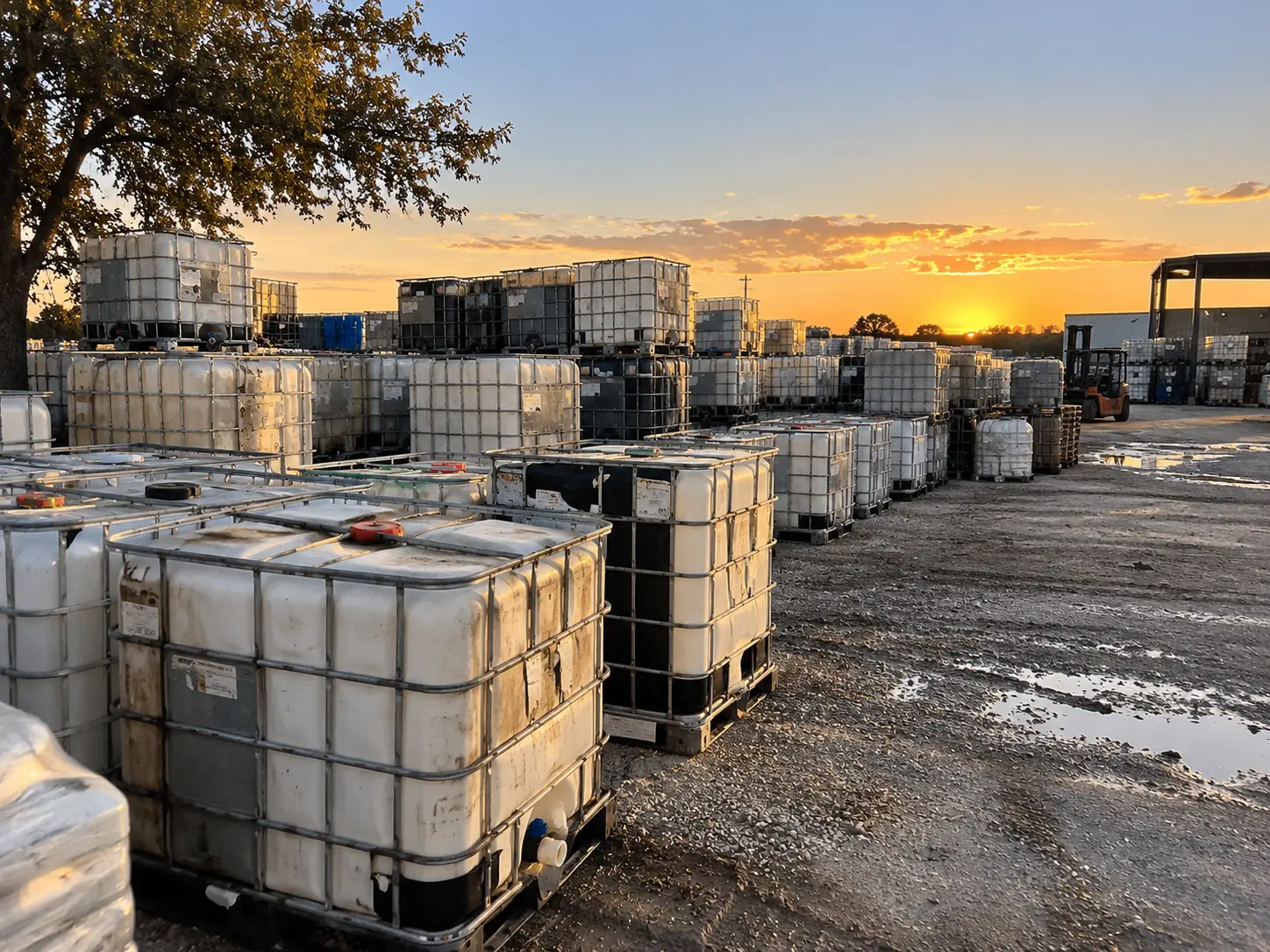
The commitment was simple to state and considerably more involved to keep: no component of any IBC tote entering this yard leaves it for a landfill. Not a bottle, not a cage, not a pallet board, not a cracked valve body.
Ten years on, the breach count is zero. That is not because it was easy; it is because closing the disposal account removed the option.
What it required
Four capital and operational commitments, in the order we had to make them.
- 01On-site granulation. Before 2016 failed bottles went to a roll-off. A granulator was the single largest capital item the commitment required, and without it the pledge was unkeepable rather than merely difficult.
- 02Hot wash and dewatering. Granulating alone produces low-value flake with variable odour. Hot washing is what makes the output worth selling, which is what makes granulation economically sustainable rather than a cost centre.
- 03Stream separation at disassembly. Five separated streams instead of one mixed skip: HDPE, steel, timber, polypropylene fittings, and rubber seals. This was mostly a floor-layout and discipline problem rather than a capital one.
- 04Outbound destinations for every stream. A named, permitted receiving facility for each. The rubber seal stream took eighteen months to find a home for, and it is a tiny volume.
Where everything actually goes
| Component | Condition | Destination | Share |
|---|---|---|---|
| HDPE bottle | Passes pressure test | Reuse — washed, recertified, resold | 93.9% |
| HDPE bottle | Fails test, watertight | Upcycled build | 2.4% |
| HDPE bottle | Fails test, not watertight | On-site granulation to pellet | 3.7% |
| Steel cage | Passes geometry jig | Reuse — straightened, reassembled | 98.4% |
| Steel cage | Weld fatigue or deformation | Baled, mill-grade scrap steel | 1.6% |
| Plastic pallet | Sound | Reuse | 96.1% |
| Plastic pallet | Cracked feet | Granulated with the bottle stream | 3.9% |
| Steel pallet | Any | Reuse or mill-grade scrap | 100% |
| Timber pallet | Sound or repairable | Reuse after repair | 71.0% |
| Timber pallet | Deck fracture or rot | Chipped — animal bedding, mulch | 29.0% |
| Valve body and cap | Sound | Reuse after inspection | 39.0% |
| Valve body and cap | Chemically attacked | Polypropylene recycling stream | 61.0% |
| Gaskets and seals | Any | Rubber recovery stream | 100% |
| Labels and strapping | Any | Separated to paper and PET recycling | 100% |
The stream it does not cover
Liquid residues. Heels drained from inbound totes are captured, profiled by compatibility class and sent to licensed processors for recovery, treatment or compliant disposal. Some of that material is genuinely destroyed, and a small fraction of treatment residue does ultimately reach a landfill as stabilised solids.
We could have scoped residues out of the headline silently. We would rather state it: the pledge is about tote components, and liquid residue handling is a separate, regulated process described separately.
The containers never get buried. The chemicals somebody else put in them are handled lawfully by people licensed to handle them. Those are two different claims and conflating them would be dishonest.
What it cost
Three honest costs, two of which were larger than we modelled.
- Capital. The granulator, the hot wash tank, the dewatering and pelletizing line. The largest single investment in the building after the wash line.
- Floor space. Five separated streams need five places to put them, plus baling and consolidation areas. In a constrained building, racking space is the binding constraint on everything, and this took some of it.
- Administrative overhead. A named permitted destination per stream, manifests for every movement, and a monthly reconciliation comparing intake weight against declared outbound destinations. This was the cost we underestimated.
What it returned
Two things we expected and one we did not.
- 01Expected: the granulation output became a product rather than a cost. Single-stream, hot-washed, traceable recycled HDPE sells into applications that will not accept generic post-industrial resin.
- 02Expected: a defensible claim. Zero is a number customers can check against manifests, and several of our larger accounts audit it.
- 03Unexpected: better grading. Having a real destination for every condition category removed the incentive to be optimistic about marginal units. When the alternative to reuse is a granulator you own rather than a skip you pay for, there is no pressure to wave a doubtful bottle through.
That third one is the most interesting outcome of the whole decade. A commitment made for environmental reasons improved our product quality, by removing a perverse incentive nobody had noticed.
What would count as breaking it
Naming the failure conditions is the only way to make the claim meaningful. If any of these happened, we would report it in the impact report rather than quietly adjusting the wording.
- Any solid tote component leaving this site under a landfill manifest
- Opening a landfill disposal account for solid waste of any kind
- An unreconciled variance between intake weight and declared outbound destinations exceeding 0.5% in any month
- Sending failed bottles to a third party without a named, permitted recovery destination
- Chipping timber pallets that were economically repairable, purely to clear yard space
- 0
- Breaches in ten years
- 0.21%
- Largest monthly variance
- 310kunits
- Processed under the pledge
- 7years
- Manifest retention
Would we do it again
Yes, and earlier. The capital was recovered through the granulation product within a timeframe we would have found acceptable in advance, and the quality effect was free.
The advice we would give anyone considering a similar commitment is the unglamorous part: close the account. Every other control in this structure depends on somebody's discipline on a difficult day. That one does not.