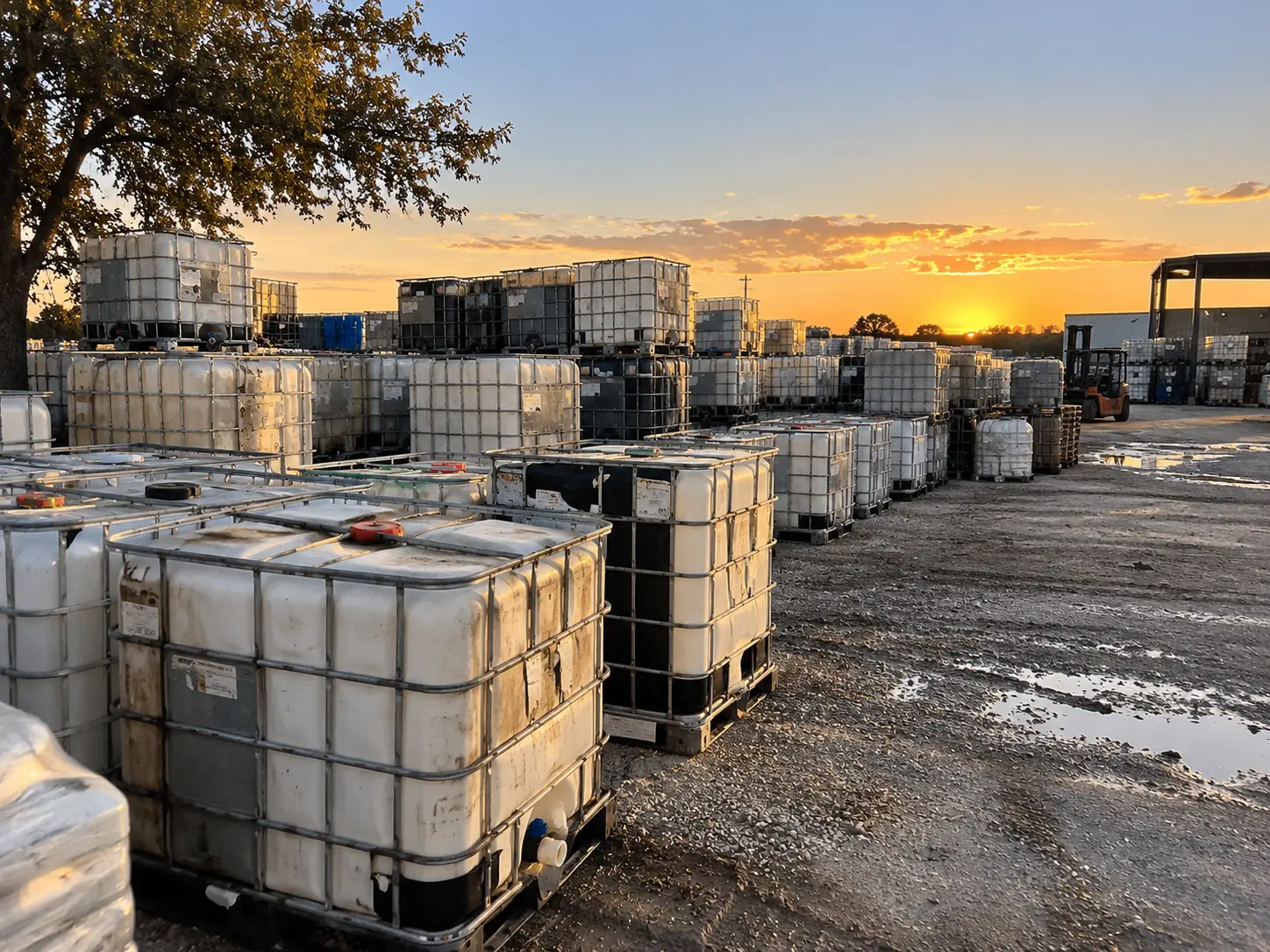
Ask most people what the responsible thing to do with an empty IBC tote is, and they will say recycle it. Ask the same question about a glass bottle or an aluminium can and they would be right. For a 140-pound composite assembly, the answer is wrong by a factor of about five.
What recycling throws away
Recycling recovers material. For a tote that means the HDPE, at a quality penalty, and the steel. What it does not recover is everything that was done to that material to turn it into a container.
- Blow moulding the bottle, including the scrap rate at the moulder
- Drawing and cutting the steel tube stock
- Welding the cage, joint by joint
- Hot-dip galvanising the finished frame
- Moulding or assembling the pallet base
- Assembly, fitting and labelling
- Inbound freight from the resin plant and the steel mill
Add those up and they are roughly 60% of the container's embodied carbon. Recycling discards all of it, and then you have to spend it again on the replacement.
| Path | Material recovered | Manufacturing recovered | Net saving |
|---|---|---|---|
| Landfill | None | None | 0 lb CO₂e |
| Recycle, buy new | Most of it | None | 53 lb CO₂e |
| Rebottle | Cage and pallet | Cage and pallet | 176 lb CO₂e |
| Wash, test, reuse | All of it | All of it | 262 lb CO₂e |
Recycling asks "can we recover the material?" Reuse asks "did we need to make anything at all?" Only one of those questions has a good answer.
The row that should give people pause
Look again at the second row of that table. Recycling a tote and buying a new one saves 53 lb CO₂e against landfilling it and buying a new one. That is a real saving and it is a small fraction of what reuse delivers, because in both cases a new container still has to be manufactured.
A company that diligently recycles every empty tote and buys new ones to replace them is doing roughly one fifth as well as a company that simply washes and refills the ones it has.
When recycling is genuinely correct
It would be dishonest to leave it there, because reprocessing is the right answer for a real and specific population of containers. A bottle reaches our granulator when it meets one of five conditions, all of them documented rather than assumed.
- 01It loses pressure during the hold phase of the test cycle.
- 02It shows stress crazing across a weld seam or around the valve boss.
- 03It carries permeation staining that survives the appropriate wash programme and cannot be honestly sold as clean.
- 04It has heat distortion sufficient to compromise its geometry in the cage.
- 05Its fill history cannot be documented to the standard the next duty requires.
Those conditions account for 3.7% of our intake. Reaching for a grinder before anyone has checked is what turns a correct answer into the wrong one.
- 93.9%
- Of intake reused as containers
- 2.4%
- Diverted to upcycled builds
- 3.7%
- Reprocessed into resin
- 0%
- Landfilled
Why the market still defaults to recycling
Three reasons, and none of them is that anyone has done the arithmetic and concluded recycling is better.
It is operationally simpler
Grinding takes no judgement. You do not need a grading bay, a wash line, a test rig or a technician who can read permeation staining against a declaration. You need a granulator and a weighbridge. The economics of grinding are simpler and that simplicity is seductive.
It is easier to claim
"100% recycled" is a clean sentence. "93.9% reused as containers, 2.4% diverted to secondary products, 3.7% reprocessed into resin, 0% landfilled" is a better outcome and a worse slogan.
Reuse requires trust
A buyer purchasing recycled resin is buying a commodity with a specification. A buyer purchasing a reconditioned container is trusting a supplier's wash records, test records and fill history documentation. That trust has to be earned, and the industry has not always earned it — which is why we publish our grading criteria rather than asking anyone to take a letter on faith.
What good reprocessing looks like
If a bottle genuinely has to be reprocessed, the quality of that reprocessing matters considerably. Most recycled HDPE is a mystery mixture of unrelated packaging, which limits what it can be used for and therefore how much virgin resin it actually displaces.
- Single-stream: one product type with known previous contents, not mixed post-consumer packaging
- Hot-washed rather than cold-rinsed — this is the step that determines odour and colour consistency
- Separated by colour, because natural flake can be pigmented and mixed flake cannot
- Tested per lot for melt index, density, moisture and contamination, with a certificate
- Sold domestically, so the diversion claim does not depend on a container ship and an optimistic assumption
The hierarchy, correctly ordered
| Rank | Action | Saving | When |
|---|---|---|---|
| 1 | Reuse the container as a container | 262 lb CO₂e | Whenever it passes a test — 93.9% of intake |
| 2 | Rebottle: new bottle, reclaimed cage | 176 lb CO₂e | Bottle failed, cage sound |
| 3 | Second life as a static tank | ~126 lb CO₂e deferred | Bottle watertight at atmospheric pressure |
| 4 | Reprocess into resin | 53 lb CO₂e | Genuine end of life |
| 5 | Landfill | 0 lb CO₂e | Never |
That ordering is not controversial and it is not new. It is the waste hierarchy applied to a specific object, with the numbers filled in. The only surprising part is how often step one gets skipped on the way to step four.