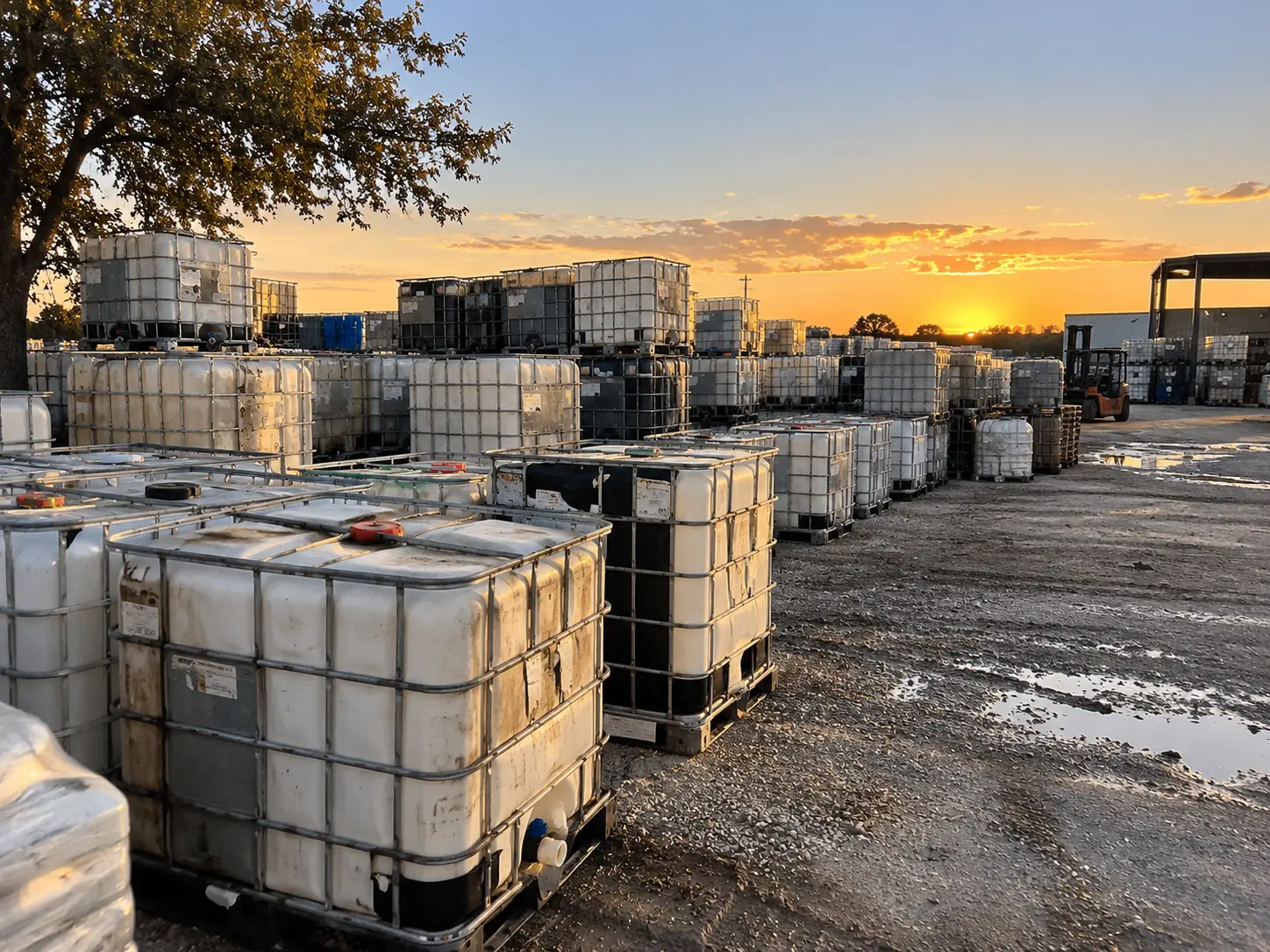
An IBC tote is an awkward freight unit: a 48-by-40-inch footprint carrying a tall, top-heavy, part-weathered object. A general carrier quoting it without context prices the awkwardness. A carrier who moves them daily prices the lane.
Between those two quotes there is usually more money than there is between two suppliers' unit prices. So it is worth understanding the arithmetic.
The base numbers
A 53-foot dry van has roughly 100 inches of interior width, 636 inches of interior length and 110 inches of interior height. Those three figures determine everything.
| Capacity | Footprint | Across | Rows | Single-stacked | Double-stacked empty |
|---|---|---|---|---|---|
| 120 gal | 40" × 32" | 3 | 15 | 45 | 90 |
| 240–330 gal | 48" × 40" | 2 | 24 | 48 | 96 (275 gal only) |
| 350 gal | 48" × 42" | 2 | 20 | 40 | 80 |
| 396 gal | 48" × 44" | 2 | 18 | 36 | 72 |
| 450 gal | 54" × 44" | 2 | 16 | 32 | 64 |
| 550 gal | 60" × 48" | 2 | 13 | 26 | 52 |
The 48 figure for 240 through 330 gallon units is the number worth memorising. It is why those capacities dominate the market — 48 × 40 inches is the North American standard pallet footprint and it fills a trailer with no wasted width.
The double-stacking rule people get wrong
Empty composite IBCs with sound cages stack two high. But trailer interior height is around 110 inches, and that constrains which capacities can actually do it.
- 275 gal at 53 inches cage height: two high is 106 inches. Fits, with four inches to spare.
- 330 gal at 62 inches: two high is 124 inches. Does not fit in a standard van.
- 240 gal at 46 inches: two high is 92 inches. Comfortable.
- Add 1.5 inches per unit if the fill caps protrude, which they do.
So a backhaul of empty 275-gallon units carries 96; the same backhaul of 330s carries 48. If you are generating empties and have a choice of capacity, that is a material consideration in favour of the shorter unit.
Why freight swings harder than price
Per-unit freight is the lane cost divided by the units on the trailer. Both the numerator and the denominator move, which gives the result a wide range.
| Scenario | Units on trailer | Relative per-unit freight |
|---|---|---|
| Full trailer, 275 gal, running lane | 48 | Baseline |
| Full trailer, 275 gal, dedicated lane | 48 | ~1.6× baseline |
| Half trailer, 275 gal, dedicated | 24 | ~3.2× baseline |
| Quarter trailer, mixed capacities | 12 | ~6× baseline |
| Empty backhaul, double-stacked 275s | 96 | ~0.3× baseline |
| Six units, distant band, dedicated | 6 | ~12× baseline |
Indicative ratios, not quotes. The point is the span: a factor of forty between the best and worst case on the same physical object.
No unit price negotiation covers a span like that. Which is why the most useful question you can ask a supplier is not "what is your best price?" but "is a lane running past us, and when?"
Clearance checks before the truck arrives
| Movement | 275 gal | 330 gal | Note |
|---|---|---|---|
| Doorway upright | 56" × 50" | 65" × 50" | Includes cap height plus handling margin |
| Trailer door loaded | 58" clear | 67" clear | Standard trailer door is 110" — fine |
| Double-stacked in trailer | 110" clear | Not possible | The 330 limitation |
| Racking bay, single | 58" × 50" × 44" | 67" × 50" × 44" | Add 4" vertical for fork entry |
| Fork spread | 27" min | 27" min | Four-way pallet entry |
Equipment, and what it buys
- 53-foot dry van — 48 units, weather protection, needs a dock or a liftgate
- 48-foot flatbed — 40 units, side-loadable from any angle, works in any yard
- 53-foot curtainside — 48 units, side-loadable plus weather cover
- 26-foot box truck with liftgate — 14 units, suits tight urban sites and small counts
- Flatbed with onboard forklift — 32 units, and it turns an impossible pickup into a routine one
That last option is worth knowing about if your site has no dock, no forklift and no yard equipment. It costs more per unit and it is the difference between a collection happening and not happening.
Four things that reduce your freight cost
- 01Accumulate to a full trailer. Forty-eight units cost very little more to move than twenty-four.
- 02Offer a date window rather than a date. A two-week window lets a carrier slot you onto a movement that was already happening.
- 03Ask about backhauls explicitly. Empty return legs are the cheapest freight in this industry and nobody volunteers them.
- 04Combine directions. One trailer delivering stock and collecting empties removes a freight leg entirely.
The cheapest freight is the trailer that was already going past you. Four words — "is a lane running?" — are worth more than an afternoon of price negotiation.
The honest counterpoint
Freight is also the one place where a reclaim model costs the environment something real. Collecting a tote in Oregon and washing it in Illinois involves diesel, and extending into longer lanes raised our own outbound freight intensity by 4% between 2022 and 2025.
Even at the furthest bands, the freight carbon of moving a tote is a small fraction of the 262 lb CO₂e saved by not manufacturing a replacement. But small is not zero, and full-trailer loading and backhaul capture are the main levers on both the cost and the carbon at once — which is a rare case of the commercial and environmental incentives pointing the same way.