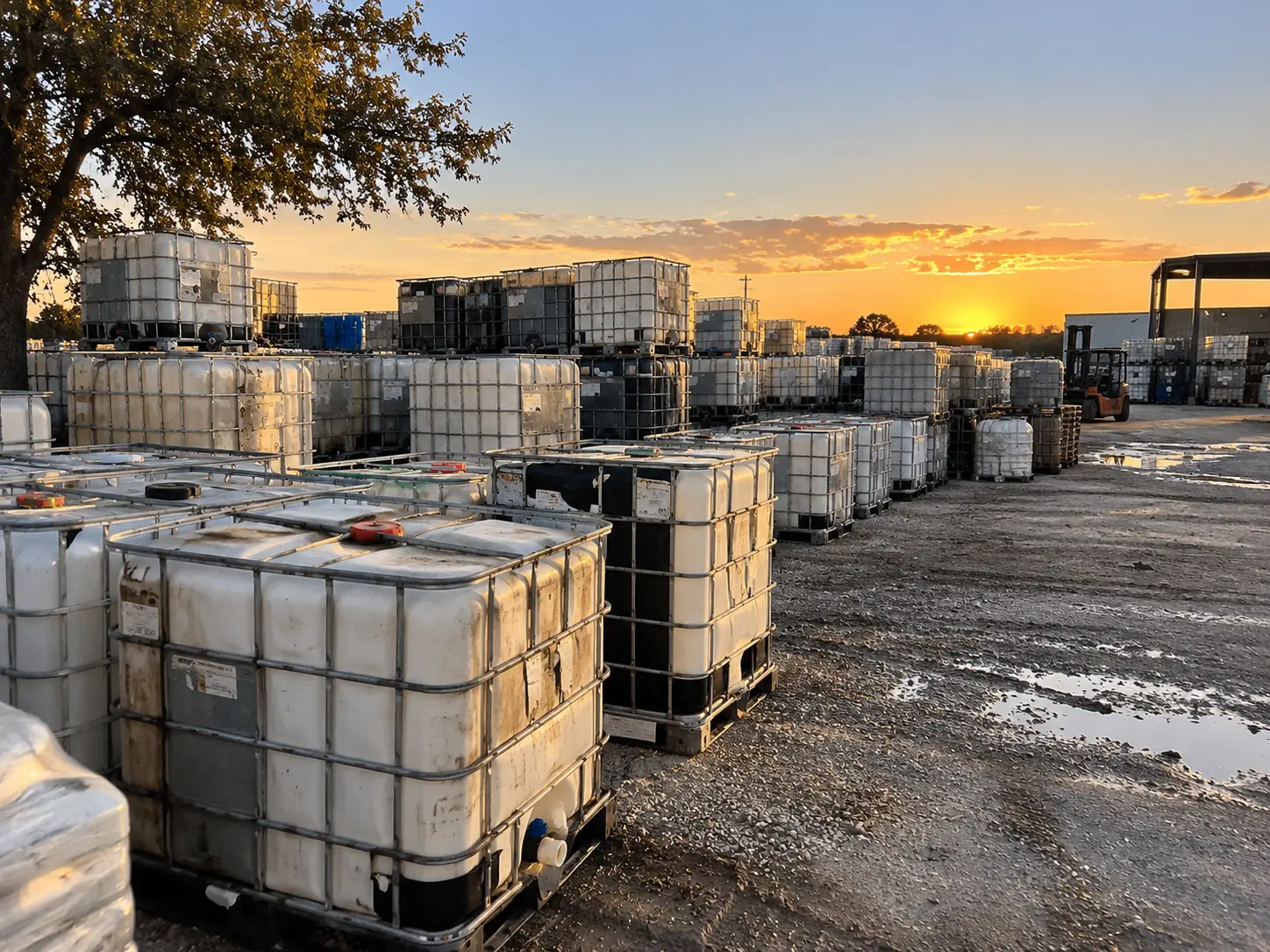
A yard of accumulated totes is not one problem. It is four overlapping problems, and most contractors can only solve one of them — which is exactly why nothing happens for a decade.
The four problems
- 01Nobody knows what is in them. Labels weather off. Records leave with staff. A part-full unit with no declaration is a disposal liability of unknown size, and that uncertainty alone is enough to stop a project.
- 02They are mixed. Six capacities, four pallet types, two stainless units, some cages with no bottles, three full of rainwater. A scrap merchant wants one of those categories and will not take the rest.
- 03Access is bad. Stacked four deep in a corner, behind a fence, on gravel, with a forklift that has not run since 2019.
- 04Nobody knows whether it costs or pays. If the answer might be a large bill, it is easier not to ask. So the pile grows another year.
The fourth one is the real blocker. It is a decision-making problem rather than a physical one, and it is solved by a free assessment.
What is actually in a typical cleanout
| Category | Typical share | Disposition | Cost or credit |
|---|---|---|---|
| Empty, sound, reusable | 28% | Wash, test, back into service | Credit |
| Empty, cosmetically poor | 24% | Grade B / B- service | Credit |
| Empty, failed bottle, sound cage | 19% | Rebottling line | Credit at cage value |
| Cages and pallets, no bottles | 11% | Reuse or mill-grade scrap | Credit |
| Rainwater-filled | 8% | Drained on site, then as above | Credit |
| Part-full, declarable product | 7% | Residue profiled | Quoted case by case |
| Part-full, unknown product | 3% | Field screened, profiled | Quoted |
Only the last two rows can carry a cost. Everything above them is a credit — which is why roughly three quarters of cleanouts settle in the customer's favour.
Handling the unknowns
The unlabelled part-full tote is the thing that stops most cleanouts, so it is worth being specific about how it is handled.
- 01Field screening on site — pH, appearance, odour, simple compatibility indicators. Enough to classify, not enough to characterise fully.
- 02Classification into a compatibility class, which determines what it can safely be consolidated with.
- 03Segregated handling so that incompatible unknowns never share a container. This is the genuinely important safety step.
- 04Lab characterisation, quoted separately, where screening is inconclusive.
- 05A clear statement upfront of what the worst case costs, so the decision can be made with a number rather than a fear.
What we will not do is take an unknown and work it out later. If field screening suggests something on a declared exclusion list — acutely toxic or P-listed material, radiological or biohazardous residue, an unstabilised reactive monomer, PCBs — we stop, say what it appears to be, and recommend a specialist handler.
How a clearing visit runs
Most yards clear in a single day. Very large accumulations take two or three. The sequence is the same either way.
- Photo assessment first, remotely. A few angles, a rough count, anything known about contents. Indicative figure back within a day or two.
- Site visit where the job is large or uncertain. We walk the pile, sample-check unknowns, assess access and equipment needs, and give a firm number. Also free.
- Residue profiling plan agreed before anything is moved.
- The clearing visit. Equipment sized to the access. Units pulled, counted, sorted by disposition, loaded.
- Grading at our yard, individually, with a per-unit breakdown sent back showing what was reusable, rebottled or reprocessed.
- Settlement within five business days of collection, against that breakdown.
Why these jobs get commissioned
Almost never because somebody decided to tidy up. In our experience there are five triggers, and all of them are deadline-driven.
| Trigger | Typical urgency | Documentation needed |
|---|---|---|
| Plant closure or decommissioning | Fixed date | Full manifests and destination records |
| Lease exit | Hard deadline | Evidence of clearance |
| Environmental compliance finding | Regulator-driven | Documented disposition by stream |
| New EHS manager inheriting the pile | Discretionary | Baseline inventory and plan |
| Acquisition revealing a surprise | Varies | Full assessment and liability picture |
The fourth row is the most satisfying to work on. Somebody inherits an accumulation they did not create, discovers it is worth money rather than costing money, and gets to deliver that news upward.
What you get at the end
- Waste manifests for anything that went to licensed disposal, naming the receiving facility and its permit
- Destination records by material stream — bottles, cages, pallets, fittings
- A per-unit grading breakdown with counts by disposition
- Settlement against that breakdown
- A Reclaim Ledger certificate covering the diverted volume, for an ESG report or a compliance file
The documentation is usually why the job was commissioned. The credit is usually the surprise.
If you are looking at a pile right now
Three photographs and a rough count will get you an indicative number within a day or two, at no cost and with no obligation. One wide shot of the stack, one of a representative unit, one of the access route.
You do not need to count precisely, clean anything, identify the unknowns or move anything first. Those are all our job. Your job is to ask.