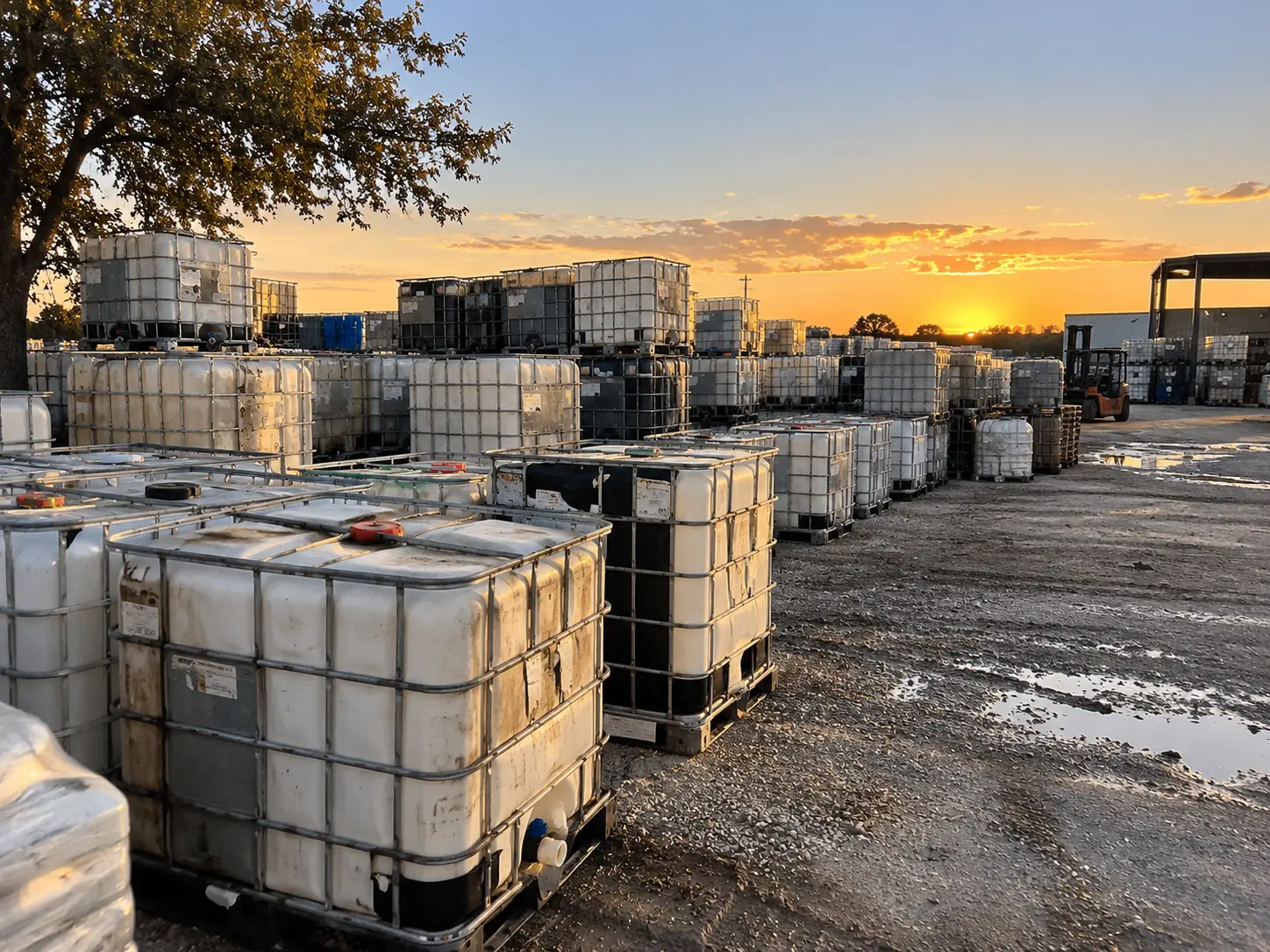
Washing a 275-gallon container properly takes a lot of water. A triple rinse plus a caustic circuit plus a final rinse, done to a standard where the next customer's product is not affected, runs to roughly 148 gallons per unit if every drop is fresh.
At a thousand units a week that is around 148,000 gallons, which is an indefensible draw for a business whose entire premise is resource efficiency. So the line recirculates.
How recovery works
The architecture is straightforward in principle and fiddly in practice. Water leaving a wash stage is captured, settled, filtered in stages, and returned to an appropriate point in the circuit — not necessarily the stage it came from.
- 01Capture. Every stage drains to a collection sump rather than to the site drain. This is the part that has to be designed in; retrofitting it is expensive.
- 02Settling. Gravity separation removes solids and, where relevant, floating oil phases. Residence time is the main variable and the main constraint on throughput.
- 03Coarse filtration. Bag and cartridge stages remove suspended solids down to a level the finer stages can handle without clogging constantly.
- 04Fine filtration. Removes remaining particulate and some dissolved load depending on the circuit.
- 05Cascade return. Recovered water returns to an earlier, dirtier stage rather than a later, cleaner one. First rinse water does not need to be as clean as final rinse water, and respecting that hierarchy is what makes high recovery possible.
Where the 8% goes
Three losses, in descending order of size, and none of them is recoverable without disproportionate effort.
Loss one: carry-out on the unit
A washed tote leaves the line wet. There is a film on the interior wall, water in the valve body, water in the cage members and water in the pallet. Some of it drains in staging and is recaptured; a meaningful fraction evaporates or leaves with the unit.
You could reduce this with forced-air drying, which costs energy. We looked at the trade and the carbon arithmetic does not favour it: the electricity to dry a unit exceeds the embodied impact of the water saved by a wide margin.
Loss two: filter blowdown and sludge
Filtration concentrates what it removes. At some point filters are backwashed or changed, and the settled sludge from the separation stage has to be withdrawn. Both streams are water-bearing, and both go to licensed treatment rather than back into the circuit.
This loss scales with how dirty the intake is. A month heavy in viscous or high-solids residues produces more blowdown than a month of light aqueous work.
Loss three: evaporation from the hot circuit
The caustic circuit runs at 150 °F and the food-grade sanitising circuit at 185 °F. Hot water in an open sump evaporates. Covering sumps helps and we do; eliminating it would require a sealed, pressurised system that is not proportionate at our scale.
| Stream | Gallons | Share | Disposition |
|---|---|---|---|
| Gross circuit demand | 148.0 | 100% | — |
| Recovered and recirculated | 136.2 | 92.0% | Returned via cascade |
| Carry-out on the unit | 6.6 | 4.5% | Partly recaptured in staging |
| Filter blowdown and sludge | 3.4 | 2.3% | Licensed treatment |
| Evaporation, hot circuits | 1.8 | 1.2% | Unrecoverable |
| Net fresh water draw | 11.8 | 8.0% | Make-up |
Putting 11.8 gallons in context
The number worth comparing it against is not zero. It is the water that would have been used to make a replacement container. Virgin HDPE production carries roughly 49 gallons of process water per pound of resin, and a 275-gallon bottle is 38 lb of resin.
- 1,862gal
- Water to produce a new bottle
- 11.8gal
- Our net draw per wash
- 92%
- Recirculation rate
- 158:1
- Ratio, make vs. wash
So washing a tote uses roughly one one-hundred-and-fifty-eighth of the process water required to make a new one. That ratio, not the absolute figure, is the reason the wash line exists.
Why we do not chase 100%
Every increment above 92% costs more energy, more filtration media and more equipment than the water it saves is worth — measured in carbon, not just in dollars. Forced-air drying is the clearest example: it would recover most of the carry-out loss and would increase our total impact per unit.
A closed loop optimised for one metric usually gets worse at another. Water recovery past the cascade limit buys itself with electricity, and electricity has a carbon price.
There is one genuine improvement left on our list: better sump covering on the hot circuits, which would reduce the evaporation loss at effectively no energy cost. It is on the capital plan. It is worth about 0.6 percentage points, which tells you how incremental this gets.
What to ask a reconditioner about water
- Is the wash circuit recirculating, or single-pass to drain?
- What is the metered net draw per unit, and is it metered or estimated?
- Is the food-grade circuit genuinely separate water, or the same water with a different programme?
- Where does filter blowdown and sludge go, and under whose permit?
The second question is the revealing one. A supplier who can give you a metered figure is measuring. A supplier who gives you a percentage without a denominator is estimating, and estimates in this area are generous.