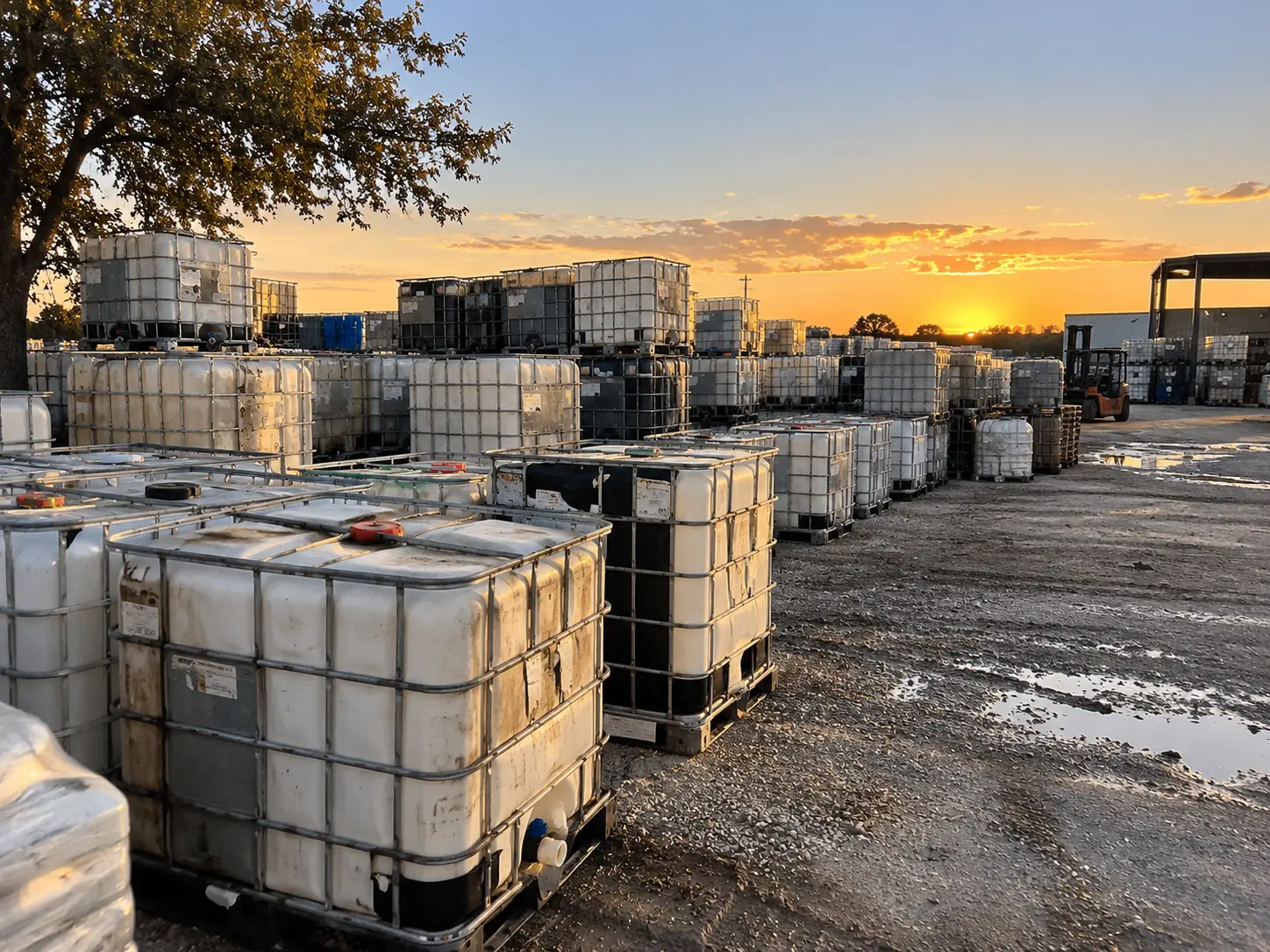
Everything downstream of grading depends on grading. The wash programme, the test path, the price, the customer it gets sold to, and whether the unit goes back out as a container at all — all of it is decided in a few minutes by one person looking at one tote.
So the sequence is fixed, and it is ordered cheapest-disqualifier-first. There is no point profiling the residue in a bottle whose cage has a cracked weld.
The sequence
- 01Gross condition and safety. Is anything leaking, bulging, under evident pressure, or carrying a label that does not match the manifest? Any of these and the unit goes to the sealed quarantine pad before it moves another inch.
- 02Cage geometry on the jig. The frame goes against a fixed jig and is checked in all three axes. Out of tolerance, and the unit's path is already decided before anyone looks at the bottle.
- 03Weld inspection. Every joint, visually, for fatigue cracking. This is the check that most often ends a cage's service life, and it is non-negotiable because the cage carries the structural load.
- 04Galvanising condition. Bare steel means corrosion will start. Surface wear is cosmetic and affects grade; exposure through to bright metal affects remaining life.
- 05Pallet base. Feet, deck, bearers, and the cage-to-pallet attachment. A cracked foot is a replacement, not a rejection — but it has to be seen.
- 06Bottle walls under light. Held against a work light, looking for stress crazing, particularly around the valve boss and along any weld line. Crazing shows as a fine network of surface fractures and it is the single most important bottle defect.
- 07Heat distortion. Does the bottle still sit square in its cage? A unit that spent a summer in direct sun in a southern yard may be geometrically wrong without any single visible defect.
- 08Permeation staining. What colour is the inside, and does it tell a story consistent with the declared contents? Staining is information rather than a defect.
- 09Residue evidence against declaration. Does what is actually in the bottle match what the paperwork says was in it? A mismatch here is the most serious finding in the whole sequence.
- 10Valve, cap and gasket. Threads, seat faces, seal condition. Mostly a cost item rather than a grade determinant, but a chemically attacked gasket is evidence about the residue.
- 11Fill opening and neck. The neck carries the cap load and is a stress concentration. Cracks here are less common than at the valve boss and more serious.
Why the order matters
Three checks — cage geometry, weld inspection and bottle crazing — account for the large majority of disqualifications. Putting them early means a unit that will not make reuse gets routed to rebottling or reprocessing after two or three minutes rather than six.
Across a thousand units a week, that ordering is the difference between a grading bay that keeps up with the dock and one that does not.
- 11
- Fixed assessment points
- 3–6min
- Per unit
- 2
- Independent checks per unit
- 0.4%
- Mis-grade rate, FY2025
The judgement that cannot be written down
Nine of the eleven checks are effectively binary and could be taught in an afternoon. Two are not, and they are the reason this job takes a year to get good at.
Reading staining against declaration
A blue-stained bottle declared as having held a surfactant is a question, not necessarily a problem — plenty of surfactant blends are dyed. The same stain declared as having held deionised water is a different matter. The skill is in knowing which combinations are plausible, and that is accumulated pattern recognition rather than a rule.
Matching the unit to the right next duty
This is the part that creates most of the value. A bottle with permanent pigment staining is wrong for a customer whose containers sit on a retail-adjacent dock and perfect for a concrete plant dosing admixture. Downgrading a unit is not a failure; placing it badly is.
The useful question is not "what grade is this?" It is "whose problem does this solve?" Those two questions have different answers surprisingly often.
The second check
Every wholesale load is re-checked at staging against the ordered grade, by a different technician. This is the single intervention that moved our mis-grade rate from the low single-digit percentages that are normal in this industry to 0.4%.
It works because the failure mode in grading is not carelessness, it is drift. A technician working through four hundred units develops a slightly looser or tighter internal standard across a shift. A fresh pair of eyes at staging resets it.
What moves a unit down
| Finding | Typical effect | Note |
|---|---|---|
| Permeation staining surviving wash | A- → B | Cosmetic for most duties |
| Heavy pigment or dye staining | B → B- | Function unaffected |
| Galvanising loss to bare steel | One grade | Affects remaining service life |
| Any cage deformation within tolerance | One grade | Stacking still permitted |
| Cage deformation out of tolerance | Out of reuse | To rebottling if bottle sound |
| Stress crazing at the valve boss | Out of reuse | To rebottling or granulation |
| Pressure loss during hold phase | Out of reuse | Non-negotiable |
| Declaration mismatch | Quarantine | Investigated before anything else |
Why we publish our grade criteria
Grade letters without published criteria are worthless, because a supplier's grade A can mean whatever that week's intake happened to look like. Publishing the criteria means a customer can quote them back at us when a unit does not match, and that accountability is the only thing that keeps a grading standard honest over years.
It also makes comparison possible. When you are weighing two quotes, compare the criteria rather than the letters. If one supplier publishes criteria and the other does not, you are not comparing like with like at all.