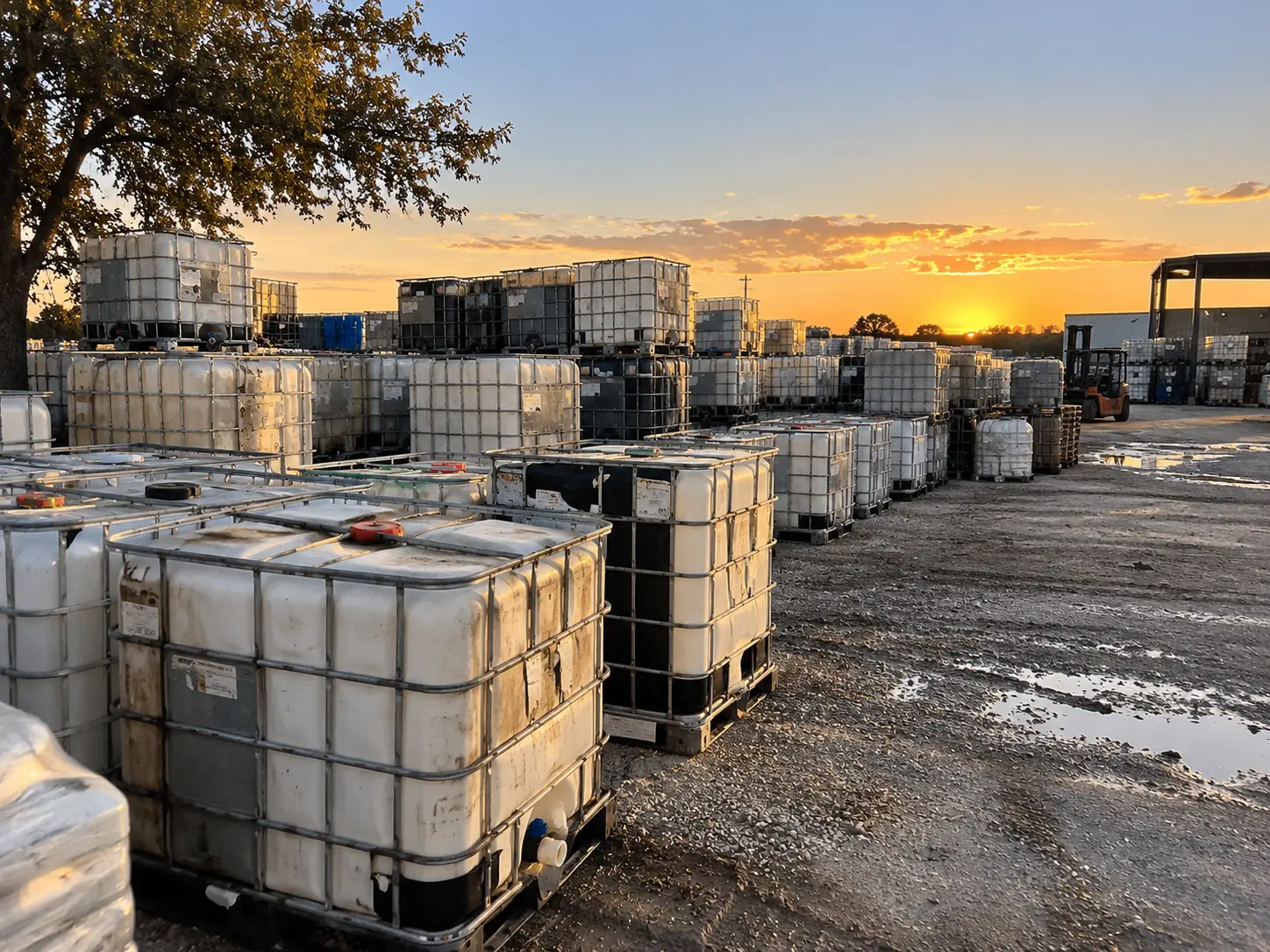
We publish component reuse rates because a zero-landfill claim is meaningless without them. Anyone can divert material from landfill by sending it somewhere worse. The rates show where material actually goes, and one row is conspicuously bad.
| Component | Reuse rate | Non-reuse destination |
|---|---|---|
| Steel pallet | 100% | Mill-grade scrap steel |
| Plastic pallet | 96.1% | Granulated with the bottle stream |
| Composite pallet | 94.8% | Granulated and separated |
| Steel cage | 98.4% | Baled to mill-grade scrap |
| HDPE bottle | 93.9% | Rebottling, upcycled builds, granulation |
| Timber pallet | 71.0% | Chipped — animal bedding and mulch |
Why timber fails where plastic does not
A plastic pallet base fails in a visible, gradual, predictable way: a foot cracks from forklift impact, and you can see it. The base either passes inspection or it does not, and when it does not, the material goes into the same granulation stream as a failed bottle, which means its end-of-life is a genuine material recovery.
A timber base fails differently. Hardwood deck boards fracture under load, nails pull out of bearers, and both failures can be invisible until the moment they matter. Rot develops from the inside after sustained moisture exposure. The failure mode is sudden rather than progressive, which means the inspection threshold has to be conservative.
- Deck board fracture — often not visible before failure
- Nail pull from repeated flex at the bearer joint
- Rot from sustained moisture, developing internally
- Splintering, which disqualifies the base from any hygienic application
- Dimensional drift as boards warp, which affects cage seating
Why we chip rather than repair the remaining 29%
It is an economic threshold rather than a technical impossibility. A timber base with one fractured deck board and sound bearers is repairable, and we repair those. A base with multiple fractures, pulled nails and warped boards needs enough replacement timber and labour that the repair costs more than a replacement plastic base — and produces a pallet with a shorter remaining life.
At that point the choices are: repair it uneconomically, fit a replacement base and chip the timber, or fit a replacement base and landfill the timber. We do the middle one.
Four things we have tried
Repairing more aggressively
We lowered the repair threshold for a period and tracked what came back. Repaired timber bases returned to us at a materially higher failure rate on their next cycle than unrepaired ones, which told us the threshold had been roughly right. We moved it back.
Sourcing replacement timber decks
Rebuilding a base with new hardwood deck boards works technically. It also introduces new virgin timber into the loop, which undercuts the point, and the labour is substantial. We do this only where a customer specifically requires a timber base, usually for an existing racking or handling constraint.
Converting units to plastic bases at intake
This is now our default and it is the main reason the number is 71% rather than lower. A unit arriving on a marginal timber base gets a reclaimed plastic base and continues its service life. The timber is chipped, but the tote keeps going — which is where most of the carbon is anyway.
Declining timber-palletised units
We considered this and rejected it as absurd. The bottle and the cage are the valuable, carbon-intensive components and they are entirely unaffected by what they are standing on. Refusing a whole unit because of its base would mean rejecting 167 lb of recoverable CO₂e over a 35 lb problem.
What this means if you are buying
Pallet type is cheap to specify at purchase and expensive to change later. Four considerations actually matter:
| If you need | Choose | Reason |
|---|---|---|
| Lowest purchase cost | Timber | Cheapest base, shortest life |
| General industrial default | Plastic | Best balance of weight, life and reuse |
| Washdown or hygienic duty | Plastic | Non-porous, no splinters, no harbourage |
| Heaviest products | Steel | Highest static and dynamic ratings |
| Longest life | Steel | 25+ years, essentially always reusable |
| International export | Plastic or steel | Avoids ISPM-15 heat treatment entirely |
That last row is worth flagging. Timber crossing international borders requires ISPM-15 heat treatment or fumigation plus marking. Plastic, steel and composite bases are exempt. Specifying non-timber at purchase is far cheaper than dealing with it at a port.
Why publish a bad number
Because a sustainability report with no bad news in it is advertising, and because the 71% figure is the single most useful piece of evidence that our other figures are not being massaged. If we were willing to round this one up, you would have no reason to trust the 98.4% on cages.
It is also a live problem rather than a settled one. If somebody has solved economically viable hardwood deck repair at scale, we would genuinely like to hear about it.