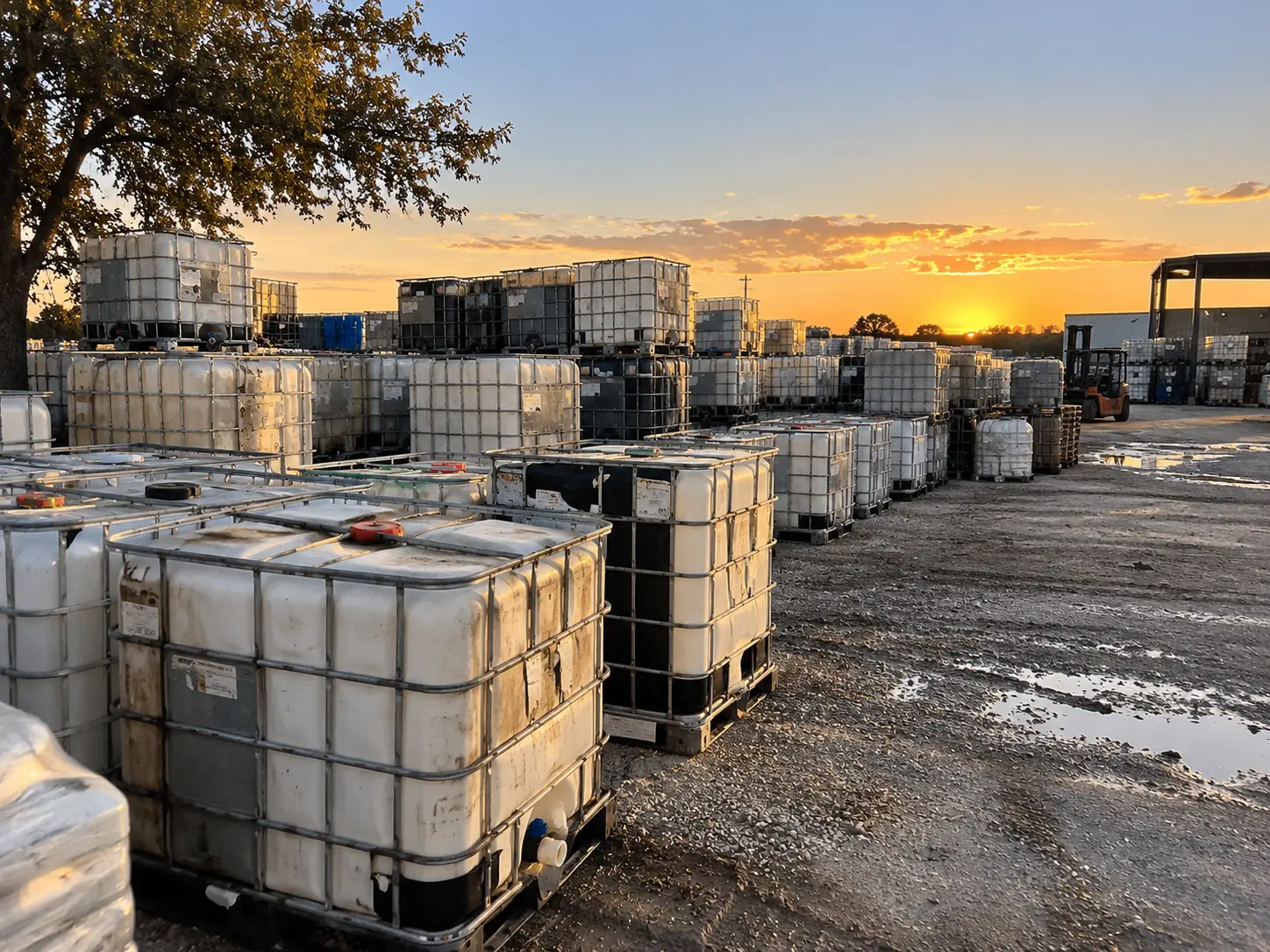
Comparing a 316L stainless IBC to a composite one on unit price is meaningless, because they are not the same kind of purchase. A composite tote is a consumable with a service life measured in single-digit fills. A stainless IBC is a capital asset with a service life measured in decades. The only honest comparison is per trip.
The embodied carbon comparison
Start with the uncomfortable number: a 316L stainless IBC carries roughly 1,900 lb CO₂e of embodied impact, against 315 lb for a composite. On a single-use basis, stainless is six times worse. Nobody uses a stainless IBC once.
| Container | Embodied | Service lives | Embodied per trip |
|---|---|---|---|
| Composite, one-way | 315 lb | 1 | 315 lb |
| Composite, reconditioned | 315 lb | 6 | 53 lb |
| Composite, well-managed pool | 315 lb | 12 | 26 lb |
| 316L stainless | 1,900 lb | 100 | 19 lb |
| 316L stainless, poorly managed | 1,900 lb | 8 | 238 lb |
Note the last row. A stainless IBC that is lost, abandoned or scrapped after a handful of cycles is one of the worst environmental outcomes available in this product category.
The most expensive tote can be the greenest one. It can also be the worst, and the only variable is whether you get it back.
What stainless actually buys you
Beyond longevity, there are four capabilities a composite IBC simply does not have, and if you need any of them the comparison is settled before economics enters it.
- Temperature. Stainless handles -40 °F to 400 °F; HDPE stops being structurally dependable around 140 °F. Hot fills and steam cleaning are stainless-only territory.
- Chemical range. Aromatic and chlorinated solvents, strong oxidisers and concentrated acids that attack or permeate polyethylene are routine duty for appropriately specified stainless.
- Zero permeation. There is no absorption into a steel wall, so fill history carries no carryover risk at all.
- Clean-in-place. Spray-ball fittings and sanitary connections make validated cleaning possible, which matters enormously in food and pharmaceutical service.
What stainless costs you beyond the purchase
The unit price is the visible cost. Three less visible ones decide whether a stainless programme works.
- 01Weight. A stainless IBC is substantially heavier empty, which reduces payload on a weight-limited lane and increases handling requirements.
- 02Tracking. A composite tote that goes missing is an annoyance. A stainless IBC that goes missing is a capital loss, which means you need a real asset register rather than a spreadsheet of good intentions.
- 03Inspection regime. Pressure-rated variants carry their own periodic inspection requirements, which is an ongoing administrative obligation rather than a one-time purchase decision.
The one condition
Stainless works when you control the return. That is the whole test. Specifically:
| Return rate | Effective service lives | Verdict |
|---|---|---|
| 98%+ (internal site-to-site) | 100+ | Stainless is clearly right |
| 95% (contracted return, deposit) | 40–60 | Stainless is strongly favoured |
| 90% (invoice line item) | 15–25 | Marginal — model it carefully |
| 80% (goodwill) | 5–8 | Composite is better, economically and environmentally |
| One-way shipment | 1 | Composite, reconditioned. Never stainless. |
A middle option people forget
Reconditioned stainless exists and is substantially cheaper than new stainless. Because the service life is so long, a stainless IBC that has already done twenty cycles has the overwhelming majority of its life ahead of it — which makes used stainless one of the best value propositions in the entire container market, and one of the least shopped.
- 100+
- Stainless service lives
- 19lb CO₂e
- Per trip, well managed
- 400°F
- Upper temperature limit
- 0
- Permeation risk
Material selection within stainless
Two grades dominate and the difference matters. 304 is adequate for food and mild chemistry and cheaper. 316L contains molybdenum, which substantially improves resistance to chlorides and many acids.
The failure mode to know about affects both: chloride stress corrosion cracking. Hot, chloride-rich brines will crack austenitic stainless over time, and it catches people out precisely because stainless is otherwise so robust that nobody expects it to fail. If your product is a hot chloride solution, neither grade is the easy answer and the specification needs proper attention.
A decision sequence
- 01Does your product require temperatures above 140 °F, or steam cleaning? If yes, stainless. Stop here.
- 02Does your product attack or permeate HDPE in sustained contact? If yes, stainless or fluorinated HDPE depending on contact time.
- 03Do you need validated clean-in-place? If yes, stainless.
- 04Otherwise: can you guarantee 90%+ return? If no, reconditioned composite.
- 05If yes, model per-trip cost across your realistic service-life count — and consider reconditioned stainless rather than new.
Four of those five questions have nothing to do with price, which is appropriate. Price only becomes the deciding factor once the capability questions are settled, and by then the answer is usually obvious.