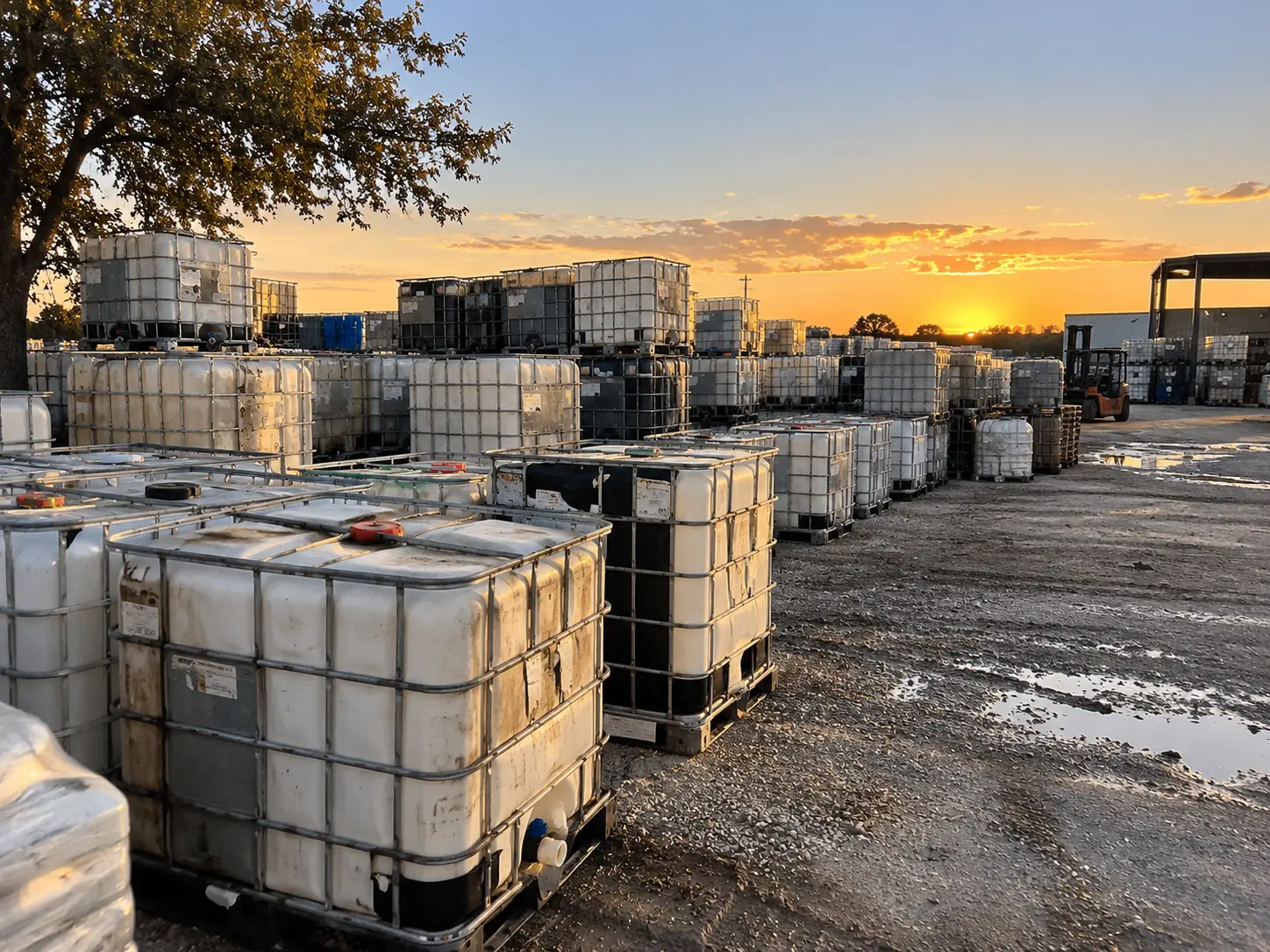
An empty IBC tote sits in an awkward spot organisationally. Procurement bought it as packaging. Operations emptied it. EHS owns whatever is left inside it. Facilities owns the yard it is now standing in. And because four functions each own a slice, nobody owns the arithmetic.
Loss one: paying for disposal of a saleable asset
This is the big one and it is startlingly common. A waste contractor collects empty totes under a general industrial waste line item, at a cost per unit or per pull. Meanwhile the same units, graded, are worth a positive number to a reclaim operation.
The swing between those two states is the full span from a disposal charge to a collection credit, on the same object, in the same week. Across a yard of forty units it is rarely a trivial sum, and it recurs every time the yard fills up.
| Treatment | Freight | Handling | Container value | Net position |
|---|---|---|---|---|
| General waste pull | You pay | You pay | Zero | Cost |
| Scrap merchant | Often you pay | You pay | Material weight only | Small credit at best |
| Reclaim operation | Usually included | Theirs | Container value | Credit |
Loss two: buying new when the specification does not require it
Most specifications that call for new totes were written by somebody solving a different problem, often a long time ago. The three legitimate reasons to require new — a regulatory first-fill mandate, a contractual customer requirement, and a packing group at the edge of the design type — cover a small minority of actual purchases.
Everything else is habit, and habit here carries a large premium per unit plus a 315 lb CO₂e charge against whatever sustainability target your company has published.
Loss three: paying freight twice
If you buy containers and dispose of containers, you are quite possibly paying for two separate freight movements in each direction — inbound delivery of new stock, outbound removal of empties, on different trucks, from different vendors, on different days.
A reclaim operation that both sells and buys can do these as a single movement: the trailer arrives loaded and departs loaded. One freight leg disappears from your cost base entirely, and the buy-back is netted against the supply invoice.
- One trailer, two directions, one freight charge
- Buy-back credited against the purchase, so one invoice rather than two transactions
- Your retired cages feed the rebottling line that supplies your next order
- One fewer vendor relationship and one fewer set of site inductions
Loss four: the yard that becomes a cleanout
Totes accumulate quietly. Four units behind the building becomes twelve becomes forty, and at some point the cost structure changes: it stops being a pickup and becomes a cleanout, with field screening for unknowns, access equipment and a multi-day visit.
The crossover is not primarily about count. It is about information decay. A unit sitting for six years loses its label, loses the person who knew what was in it, and fills with rainwater. The same unit collected within six months of being emptied is a straightforward graded pickup.
| Time since emptied | Fill history | Condition | Treatment |
|---|---|---|---|
| 0–6 months | Known | Good | Routine graded pickup, best value |
| 6–24 months | Usually known | Weathering starts | Routine pickup, minor deductions |
| 2–5 years | Patchy | UV, rainwater ingress | Pickup with screening |
| 5 years+ | Often lost | Significant weathering | Cleanout with field screening |
The physical condition degrades slowly. The documentation degrades fast, and documentation is what sets the price.
Loss five: one-way shipping of your own containers
If you ship product out in totes and the containers do not come back, you are buying a new container with every order and your customer is paying somebody to dispose of it. At any meaningful volume this is the largest packaging inefficiency most fillers have, and it is invisible because it shows up as a routine consumable purchase rather than as a loss.
The fix is a returnable pool, with one hard caveat: it only works if the containers actually come back. Below roughly 90% return, the tracking and collection cost on units that never return makes a pool worse than simply buying reconditioned one-way stock.
- 01Establish the commercial mechanism first — a container deposit, an invoice line item, or a contract clause. This is the step that decides success.
- 02Size the pool as weekly shipments multiplied by cycle weeks multiplied by a buffer of about 1.3.
- 03Expect your first two cycles to reveal that cycle time is longer than anyone estimated. Recalibrate against observed reality.
- 04If your return discipline cannot reach 90%, buy reconditioned one-way instead — it is still a 262 lb CO₂e saving per shipment.
A one-hour audit
You can establish your own exposure to all five of these in about an hour, without a consultant.
- Pull the last twelve months of waste invoices and find the line items that include IBC totes
- Pull the last twelve months of packaging purchases and total the new-tote spend
- Walk the yard and count what is standing there, noting how long it has been there
- Ask whoever owns the tote specification where the new-only requirement is written down
- If you ship out in totes, calculate what fraction came back last year
Those five numbers together are the whole picture, and it is a picture almost nobody has looked at. In our experience the yard walk is the one that produces the most surprise — partly at the count, and partly at how long some of it has been there.