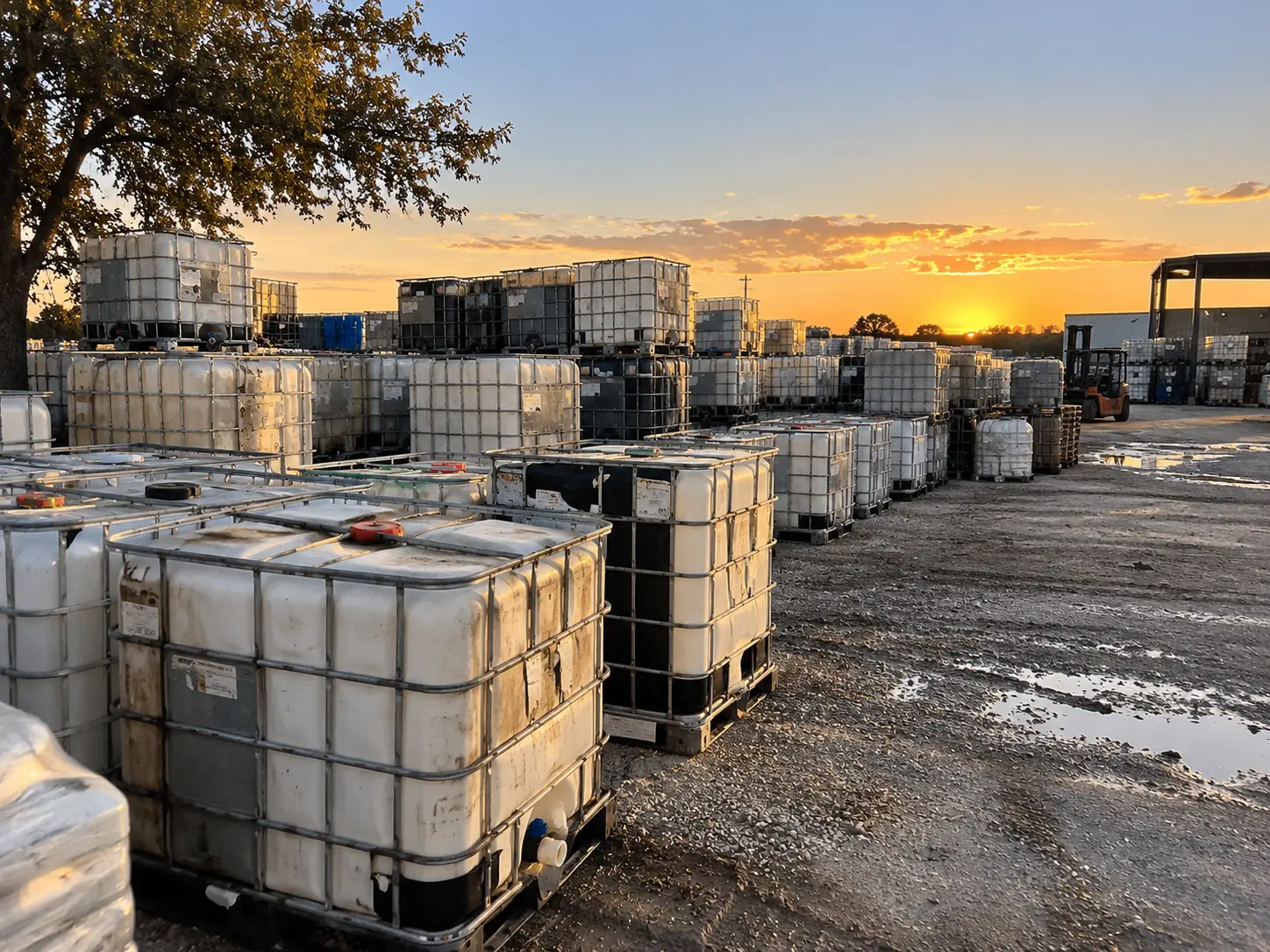
If you divert containers from disposal and reuse reconditioned stock, you have a genuine environmental story. The risk is in how it gets told, because the gap between a defensible number and a challengeable one is mostly about disclosure rather than about arithmetic.
Start with what you can count
Counted quantities beat modelled ones every time. Two things are directly countable from your own records and they should anchor everything else.
- 01Units diverted. How many containers you sent for reclaim rather than disposal, from collection manifests.
- 02Units avoided. How many new containers you did not buy because you bought reconditioned instead, from purchase records.
Both of those are facts about your own operation. Neither requires a model, and neither can be challenged on methodology. Build outward from there.
Then apply published factors, and cite them
The modelled part is the impact per unit, and this is where you need your supplier's factors and their boundary. A supplier who gives you a headline number without a boundary has given you something unusable.
| Item | Why | Red flag if missing |
|---|---|---|
| Saving per unit, by path | The multiplier for your counted quantities | A single blended figure |
| The baseline it is measured against | Determines what the saving means | "Compared to disposal" without detail |
| System boundary | What is in and out of the calculation | No boundary stated at all |
| Factor sources | Lets a reviewer check the inputs | "Industry data" |
| Known weaknesses | Lets you discount appropriately | No weaknesses acknowledged |
| An attestation of your quantities | Independent-ish support for the counted part | Unwilling to produce one |
The four shortcuts that get challenged
One: claiming the whole lifecycle for one cycle
A reconditioned tote you bought may go on to serve six more lives after yours. Those savings are real and they are not yours — they belong to whoever uses it next, or they are shared, and the accounting conventions for this are genuinely unsettled.
Claim the cycle you were responsible for. If you want to mention the rest, mention it as context rather than counting it.
Two: double-counting diversion and avoidance
If you sent a tote for reclaim and separately bought a reconditioned tote, those are two distinct actions with two distinct savings. If you sent a tote for reclaim and received the same tote back, that is one action and one saving. Mixing the two models inflates the figure and it is the easiest thing for a reviewer to spot.
Three: counting avoided landfill as a carbon saving
Avoided landfill is a real benefit, it is well documented, and it is highly site-specific. It is also not the same thing as avoided manufacturing, and lumping them together produces a number nobody can decompose. Report tonnage diverted as tonnage diverted, and report CO₂e separately.
Four: not mentioning your own freight
Collecting containers involves trucks. A reclaim programme that extends across several states has a real freight carbon cost. If your supplier's per-unit figures are net of freight, say so; if they are not, your figure is gross and should be described that way.
A worked example
Suppose over a year you sent 320 units for reclaim and bought 280 reconditioned units instead of new. Here is a defensible way to present that.
| Metric | Quantity | Basis | Source |
|---|---|---|---|
| Containers diverted from disposal | 320 units | Counted | Collection manifests |
| Material diverted | 22.4 tons | Counted | Supplier weigh tickets |
| New containers avoided | 280 units | Counted | Purchase records |
| CO₂e avoided, purchasing | 73,360 lb | Modelled — 262 lb/unit | Supplier factors, boundary stated |
| Landfill volume diverted | 208 cu yd | Modelled — 0.65 cu yd/unit | Supplier factors |
Note what is not in this table: any claim about subsequent service lives, any avoided-landfill carbon credit, and any blended single headline number. Those omissions are what make it defensible.
Alongside it, a short methodology note: the baseline, the boundary, the factor source, and one sentence acknowledging that the modelled rows carry more uncertainty than the counted ones.
Say what you do not know
The single most credibility-enhancing thing in any impact disclosure is a limitations paragraph. Three sentences, naming the real uncertainties, does more for a figure's believability than any amount of confident presentation.
- Which rows are counted and which are modelled
- What the modelled rows exclude — in our factors, avoided disposal freight and avoided landfill methane, both of which work against the figure
- The one assumption most likely to be challenged, and how a conservative reader should discount it
A number with its weaknesses stated is a number somebody can use. A number presented as certain is one a reviewer has to go looking for problems in.
And on offsets
A diversion programme is an avoided emission, not an offset. It belongs in a different part of a report and it is a stronger claim. If your organisation also buys offsets, keep the two separate — blending an avoided emission with a purchased credit makes the honest half look like the dubious half.
We buy no offsets at all, for exactly this reason. Every figure we publish is an emission that did not happen rather than one that happened and was paid for elsewhere. It is a narrower claim and a sturdier one.