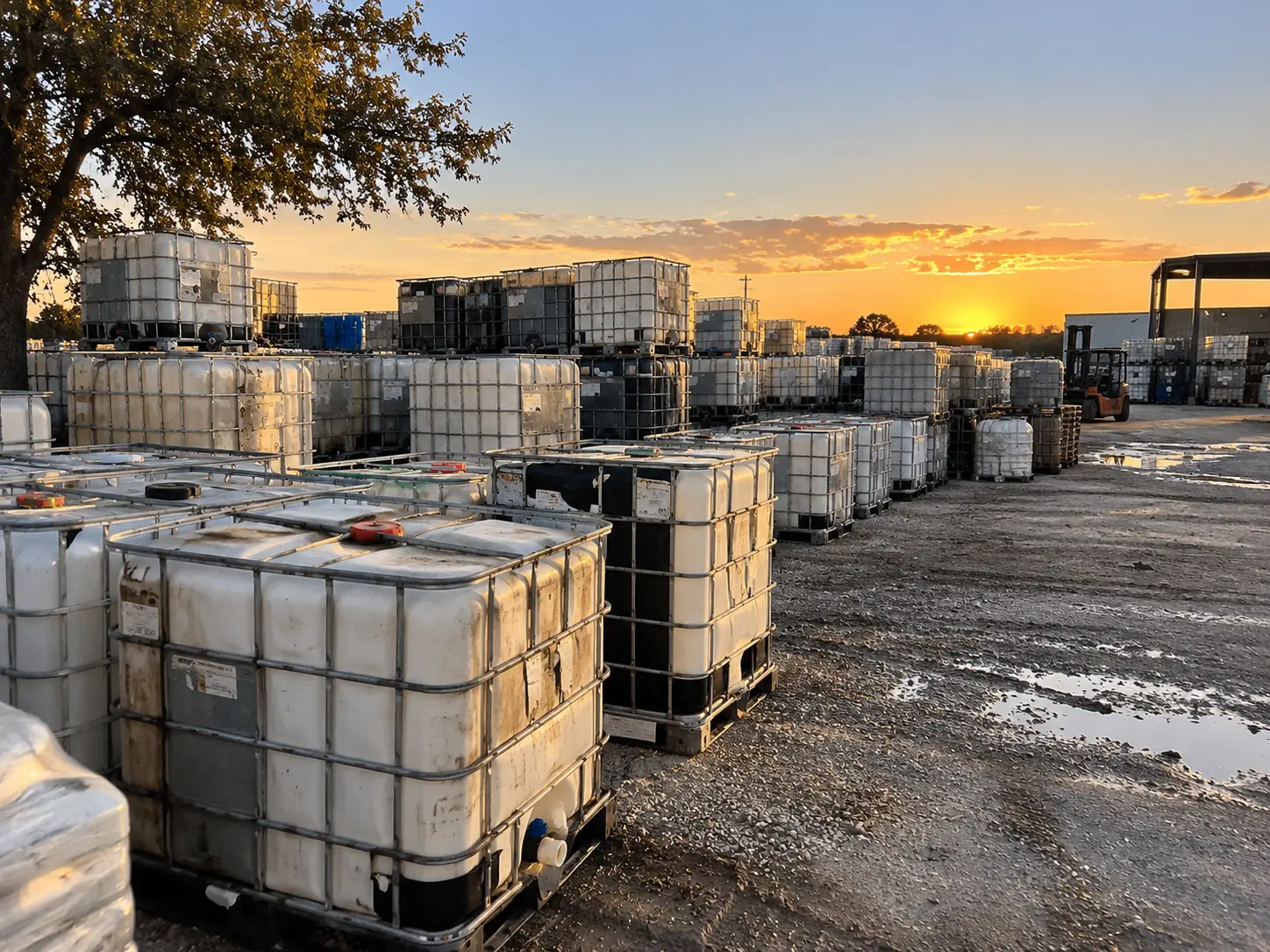
The economics are almost embarrassingly simple. A trailer delivering 48 reconditioned totes to a customer in Ohio has to get back to Illinois. The tractor, the driver, the fuel and the hours are all committed whether that trailer comes home full or empty.
So anything that goes into it on the return leg is carried at the marginal cost of loading it, which is a fraction of what a dedicated movement costs.
What that does to per-unit freight
| Movement type | Units | Relative per-unit freight |
|---|---|---|
| Empty backhaul, double-stacked 275s | 96 | ~0.3× |
| Empty backhaul, single-stacked | 48 | ~0.6× |
| Full trailer on an existing lane | 48 | 1.0× (baseline) |
| Full trailer, dedicated movement | 48 | ~1.6× |
| Half trailer, dedicated | 24 | ~3.2× |
| Six units, distant band, dedicated | 6 | ~12× |
Indicative ratios. The span between the top and bottom rows is a factor of around forty on the same tote — no unit price negotiation covers that.
Which is why "is a lane running past us?" is a more valuable question than "what is your best price?" The first can move the number by more than the second ever will.
Why backhauls are not advertised
Three honest reasons, none of them sinister.
- 01They are unpredictable. A lane exists because a delivery was booked, and that delivery was booked by somebody else, last week. We cannot publish a schedule because we do not have one more than a couple of weeks out.
- 02They are geographically specific. A lane to Columbus does nothing for a seller in Memphis, so there is no general offer to make.
- 03They need flexibility from the seller. A backhaul happens on the day the outbound delivery happens, which may not be the day you wanted.
How to get onto a lane
- 01Register the lot before you need it moved. A declared, counted, photographed lot sitting on file is what gets matched against an outbound delivery.
- 02Give a window rather than a date. Two weeks is good; four is better. The window is what creates the match.
- 03Be loadable with minimal notice. If your site needs three days of induction paperwork, you will miss most lanes.
- 04Accumulate to a trailer where you can. 48 units fills the return leg; 12 units means it comes home part-empty and the economics are weaker.
- 05Say you are flexible, explicitly. It is the single most useful sentence in a quote request and it is rarely written down.
The best version: two directions, one trailer
If you both buy containers and dispose of containers, the strongest arrangement is a single trailer that arrives loaded and departs loaded. One freight leg disappears from your cost base entirely.
- One freight charge instead of two
- Buy-back credited against the supply invoice, so one transaction rather than two
- One site visit, one induction, one set of paperwork
- Your retired cages feed the rebottling line that supplies your next order
- A single Reclaim Ledger certificate covering both directions
This is our most common wholesale arrangement and it is almost always available where a customer is buying at any regular volume. It requires nothing more complicated than mentioning that you have empties when you place an order.
Double-stacking, and when it applies
Empty composite IBCs with sound cages stack two high, which doubles the density of a return load. Two constraints govern it.
| Capacity | Cage height | Two-high | Fits 110" trailer? |
|---|---|---|---|
| 240 gal | 46" | 92" | Yes, comfortably |
| 264 gal | 50" | 100" | Yes |
| 275 gal | 53" | 106" | Yes, with margin for caps |
| 330 gal | 62" | 124" | No |
| 350 gal | 66" | 132" | No |
And the second constraint: sound cage geometry on the bottom layer, at the carrier's discretion. Weathered units with any deformation ship single-stacked regardless of the arithmetic.
If you are generating empties and have a choice of capacity, the 275 is materially better than the 330 on return freight for exactly this reason.
The carbon side
Backhaul capture is one of the rare cases where the commercial and environmental incentives point in exactly the same direction. A tote carried on an empty return leg has almost no marginal freight carbon, because the truck was making the trip regardless.
- 96units
- Double-stacked empty backhaul
- ~0.3×
- Relative per-unit freight
- 0
- Additional truck miles
- 4%
- Our freight intensity rise, 2022–25
That last figure is the honest counterweight. Extending into longer lanes raised our outbound freight intensity, which is good for diversion tonnage and bad for freight emissions per unit. Backhaul capture offsets some of it and not all of it, and we report it rather than omitting it.
The one sentence worth sending
"We have 40 units of 275 gallon totes, previously held non-ionic surfactant, available to load any time in the next three weeks — is a lane running past us?"
Count, capacity, contents, flexibility, and the question. That is a quote request that gets the best available number, and it takes thirty seconds to write.