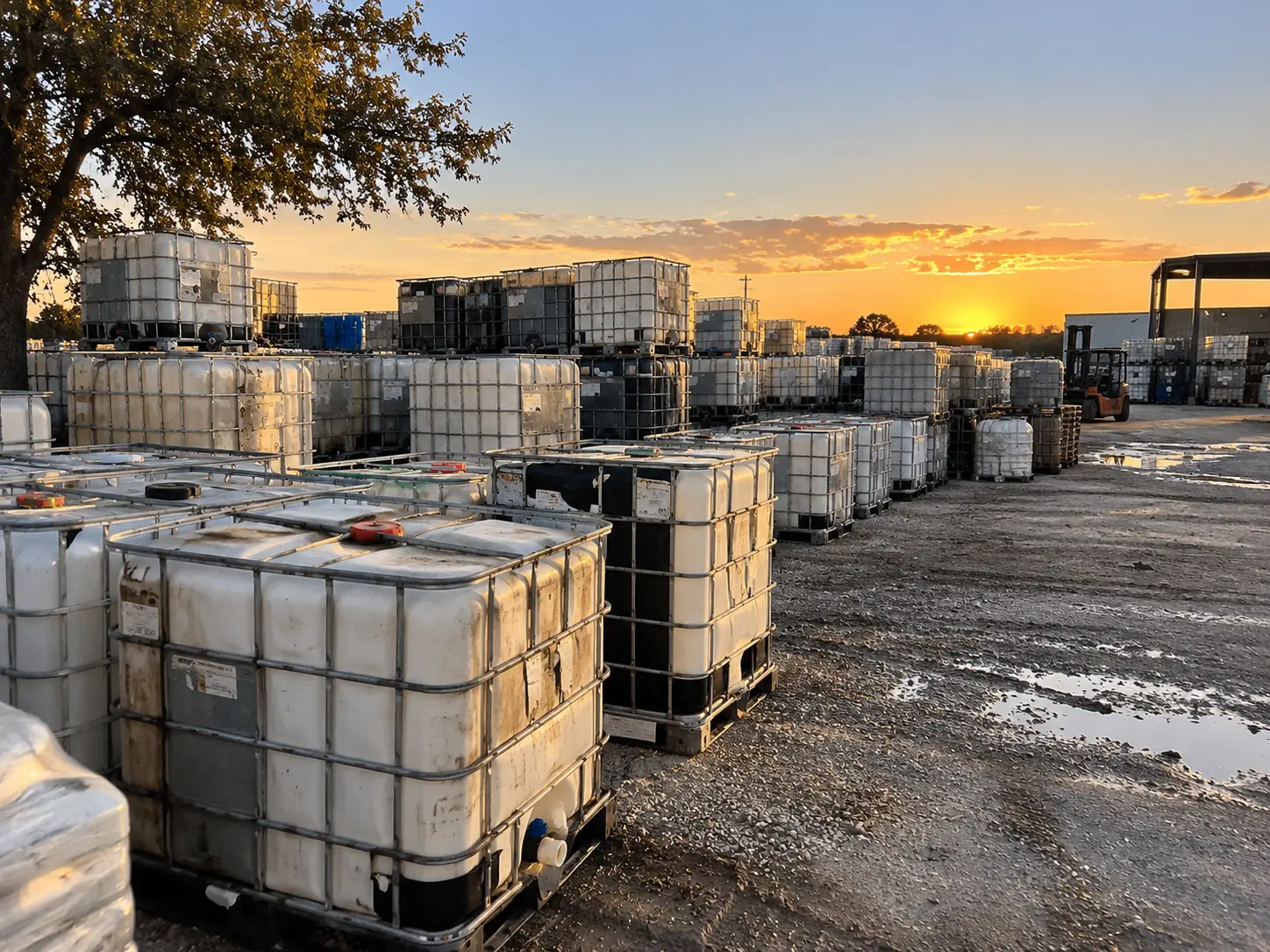
If you ship product out in IBC totes and the containers do not return, you buy a new container with every order and your customer pays somebody to dispose of it. At volume this is the single largest packaging inefficiency most fillers have, and it hides in plain sight because it appears as a routine consumable purchase rather than as a loss.
A managed pool fixes it, under one condition. We will deal with the condition first, because everything else is wasted effort without it.
The condition: return discipline
A pool with a 60% return rate is worse than one-way purchasing. You are paying for tracking, collection scheduling and administration on units that never come back, and you are still buying replacements. The break-even is high.
| Return rate | Effective lives per unit | Verdict |
|---|---|---|
| 98% — internal site-to-site | 50+ | Pool is clearly right |
| 95% — contractual, with deposit | 20 | Pool strongly favoured |
| 90% — invoice line item | 10 | Pool works; model it |
| 85% — reminders and goodwill | 6.7 | Marginal |
| 80% — goodwill only | 5 | One-way reconditioned is better |
| Below 80% | Under 5 | Do not build a pool |
Effective lives are simply 1/(1 − return rate) as a first approximation, ignoring physical wear. Physical wear becomes the binding constraint only above about 90% return.
Sizing the pool
Three inputs, one formula. The formula is trivial; getting the inputs right is where the work is.
Pool size equals weekly shipments multiplied by cycle time in weeks, multiplied by a buffer factor of around 1.3.
- 01Weekly shipments. Use your peak-month average rather than your annual average, or you will be short exactly when it hurts.
- 02Cycle time in weeks. Dispatch to back on your filling line, washed and tested. This is the number everyone underestimates — see below.
- 03Buffer factor. 1.3 is a reasonable default for stable demand. Seasonal businesses need 1.5 or more.
A filler shipping 40 units a week on a 5-week cycle with a 1.3 buffer needs roughly 260 units in the pool. If the real cycle turns out to be 7 weeks, that becomes 364 — a 40% increase in capital from a two-week estimation error.
Why cycle time is always longer than you think
In our experience, first-pass cycle time estimates are short by a factor of around 1.4. The missing time is almost never in transport; it is in dwell.
| Stage | Typical duration | Controllable? |
|---|---|---|
| Transit outbound to customer | 3–6 days | Partly |
| Dwell at customer before use | 5–14 days | No |
| In use / discharging | 1–5 days | No |
| Dwell at customer after emptying | 7–21 days | Yes — this is the lever |
| Collection scheduling and transit | 4–8 days | Yes |
| Wash, test, recertify | 3–6 days | Yes |
| Return transit to your line | 3–6 days | Partly |
Post-emptying dwell at the customer is the largest single component and the most compressible. It is also entirely a communication problem rather than a logistics one.
Shortening cycle time is the cheapest way to shrink a pool, and the lever is almost always a collection trigger: a threshold agreement where collection is initiated at a certain count rather than when somebody remembers to call.
Three ownership models
| Model | Owner | You pay | Suits |
|---|---|---|---|
| Customer-owned, managed | You | Per-cycle service fee | Fillers with an existing fleet |
| Provider-owned, leased | The reclaim operation | Per-cycle rental plus service | Getting it off the balance sheet |
| Hybrid | Shared | Blended rate | Phased transition, growing volume |
Most programmes start customer-owned-and-managed, because most fillers already have totes in circulation and the first win is simply tracking and recovering what they have. Converting to a leased model later is straightforward; starting there often means buying a pool before you know what size it should be.
Tracking: what is enough
RFID is frequently proposed and rarely necessary. A disciplined serial-and-lot process, recorded at every touchpoint, outperforms a badly implemented RFID system by a wide margin — and a badly implemented RFID system is the most likely kind, because it requires readers at your customers' sites.
- Serial recorded at dispatch, against the customer and the order
- Serial recorded at collection, at the customer's site, by the driver
- Serial recorded at intake, wash programme and test result attached
- Serial recorded at return to your line
- Quarterly reconciliation: dispatched, returned, in circulation, lost
Four touchpoints and a quarterly reconciliation. RFID becomes worth it when your volume makes manual recording a real labour cost and when your customers' sites can read tags — which in practice means large, sophisticated accounts.
What the service fee should cover
- 01Per-unit tracking from dispatch through return
- 02Scheduled collection from your customers' sites
- 03Wash programme matched to your specific product, not a generic cycle
- 04Pressure and leak test every cycle, not sampled
- 05UN/DOT recertification at the required 30- and 60-month intervals
- 06Valve, gasket and cap replacement as condition requires
- 07Return delivery to your filling line on an agreed schedule
- 08Quarterly pool report: cycles completed, losses with destination analysis, condition profile
The carbon case
- 315lb CO₂e
- One-way new tote
- 53lb CO₂e
- One-way reconditioned
- 62lb CO₂e
- Pool at 6 cycles
- 33lb CO₂e
- Pool at 12 cycles
Notice the third figure. A pool at six cycles is slightly worse than a one-way reconditioned tote, because the pool adds two freight legs and a wash per cycle while the one-way unit was already reclaimed. Pools only beat one-way reconditioned once you are getting genuine multi-cycle returns.
A one-way reconditioned tote is already an excellent environmental outcome. A pool beats it at scale and loses to it when return discipline is poor. Both facts are worth knowing before you commit capital.
A six-week implementation
- 01Week 1 — model volume, cycle time and service cost. Establish current return behaviour honestly, from records rather than impressions.
- 02Week 1–2 — design the commercial return mechanism and agree it with your largest customers. If this stalls, stop here; the pool will fail.
- 03Week 2–4 — constitute the pool. Assess, wash and test existing units; make up shortfall from reconditioned or rebottled stock. Record serials, apply tags.
- 04Week 3–5 — map customer sites onto collection lanes and agree collection triggers: scheduled, on-call, or threshold-based.
- 05Week 5–12 — run and calibrate. Expect cycle time to be longer than modelled; resize the pool against observation.
- 06Ongoing — quarterly reporting and loss analysis, with the return mechanism adjusted where a specific account or lane is underperforming.
The whole programme stands or falls on week one to two. Every pool we have seen fail, failed there — and every one that worked had a deposit or a contract clause agreed before a single container moved.