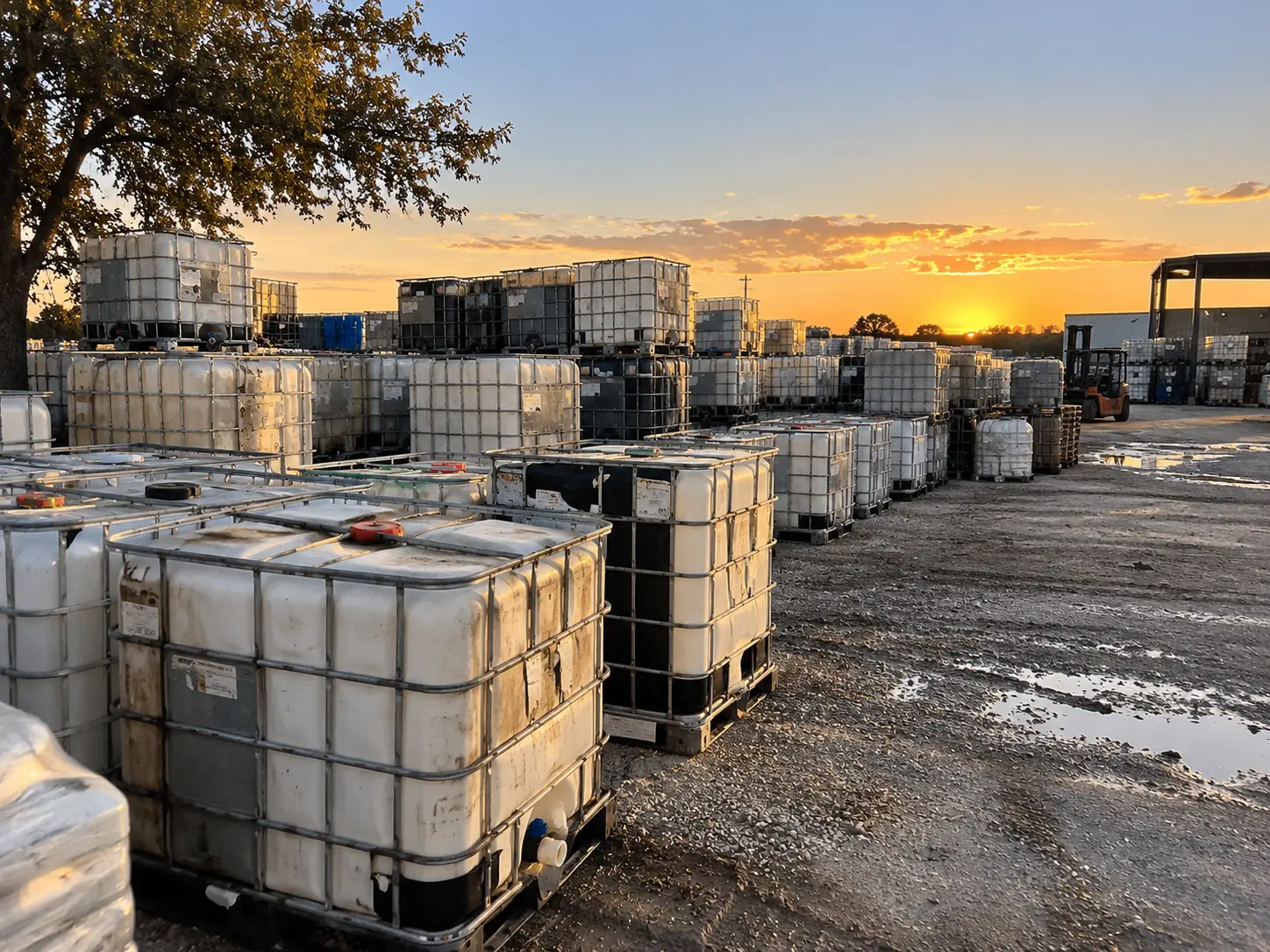
We see a lot of tote fleets. The best-run one we deal with is tracked in a shared spreadsheet by one person who is extremely consistent. The worst is tracked in a six-figure asset management platform that nobody updates because the mobile interface is unusable in a yard.
Discipline beats sophistication in this domain, up to a point. The useful question is where that point is.
What a good spreadsheet register contains
Eight columns. Not more, because every additional column is another thing to fall out of date.
| Column | Purpose | Updated when |
|---|---|---|
| Serial / asset number | Identity | Once, at induction |
| Capacity and type | Specification | Once |
| UN marking and recert date | Regulated eligibility | At each recertification |
| Current location / holder | Where it is | Every movement |
| Status | In use / in transit / at reclaim / lost | Every movement |
| Last wash date and programme | Cleanliness provenance | Each reclaim cycle |
| Last test date and result | Integrity provenance | Each reclaim cycle |
| Cycle count | Service life tracking | Each return |
The discipline that makes it work
- 01One person owns the register. Shared ownership means nobody owns it.
- 02Update at the point of movement, not at the end of the week. A register updated from memory on Friday is fiction by month three.
- 03Reconcile monthly against physical reality. Count what is on site and compare it to what the register says is on site.
- 04Record losses explicitly rather than leaving units in limbo. A unit with status "unknown" for six months is a lost unit that nobody has admitted to.
- 05Keep a dated copy each month. Version history is how you answer "when did this start going wrong?"
The four signals you have outgrown it
One: more than one person needs to write to it simultaneously
The moment two sites or two shifts both need to record movements in real time, a spreadsheet starts losing data. Shared cloud spreadsheets handle concurrency better than they used to and still produce conflicts when connectivity is poor — which, in a yard, it usually is.
Two: your monthly reconciliation takes more than an hour
This is the clearest quantitative signal. Reconciliation effort scales with fleet size and with the number of locations. When it crosses an hour it will keep growing, and the first thing to be skipped under pressure is the reconciliation — at which point the register degrades invisibly.
Three: units are at third-party sites you do not control
Tracking your own containers across your own sites is a bookkeeping problem. Tracking them across customers' sites is an information problem — you depend on somebody else to tell you something, and they have no incentive to. This is where a system with a customer-facing interface starts earning its cost.
Four: you cannot answer a recertification question quickly
If somebody asks which units are due their 30-month inspection in the next quarter and the answer requires an afternoon, you have a compliance exposure rather than an administrative inconvenience. That question should take thirty seconds.
What to do at each stage
| Fleet | Locations | Recommended approach |
|---|---|---|
| Under 100 units | One site | Spreadsheet, one owner, monthly reconciliation |
| 100–300 units | One or two sites | Shared cloud spreadsheet with strict update discipline |
| 100–300 units | Customer sites | Managed pool with the reclaim operation tracking |
| 300–1,000 units | Multiple | Managed pool, or purpose-built tracking |
| 1,000+ units | Multiple | Purpose-built tracking, with RFID where readable |
The third row is worth highlighting. If your containers are at customers' sites, the cheapest answer is usually not software — it is handing the tracking to whoever is already collecting and washing the units, because they are at those sites anyway.
On RFID
RFID is frequently proposed and rarely the binding constraint. It solves the labour cost of manual recording. It does not solve the information problem of a unit sitting at a customer's site, because that customer has no reader.
- Worth it when manual recording is a genuine labour cost — high volume, many movements per day
- Worth it when all touchpoints are within your own control and can be instrumented
- Not worth it when units sit at third-party sites without readers
- Never a substitute for the commercial mechanism that gets containers returned
A disciplined serial process beats badly-implemented RFID every time, and badly-implemented is the most likely kind — because it requires readers at sites you do not own.
The thing no system fixes
None of this addresses return discipline. A perfect register tells you precisely which units are not coming back; it does not make them come back. That is a commercial mechanism — a deposit, an invoice line item, a contract clause — and it has to exist before any tracking investment makes sense.
We have seen fleets implement sophisticated tracking and discover, with excellent precision, that they were losing 30% of their containers a year. The tracking was working perfectly. It was answering the wrong question.