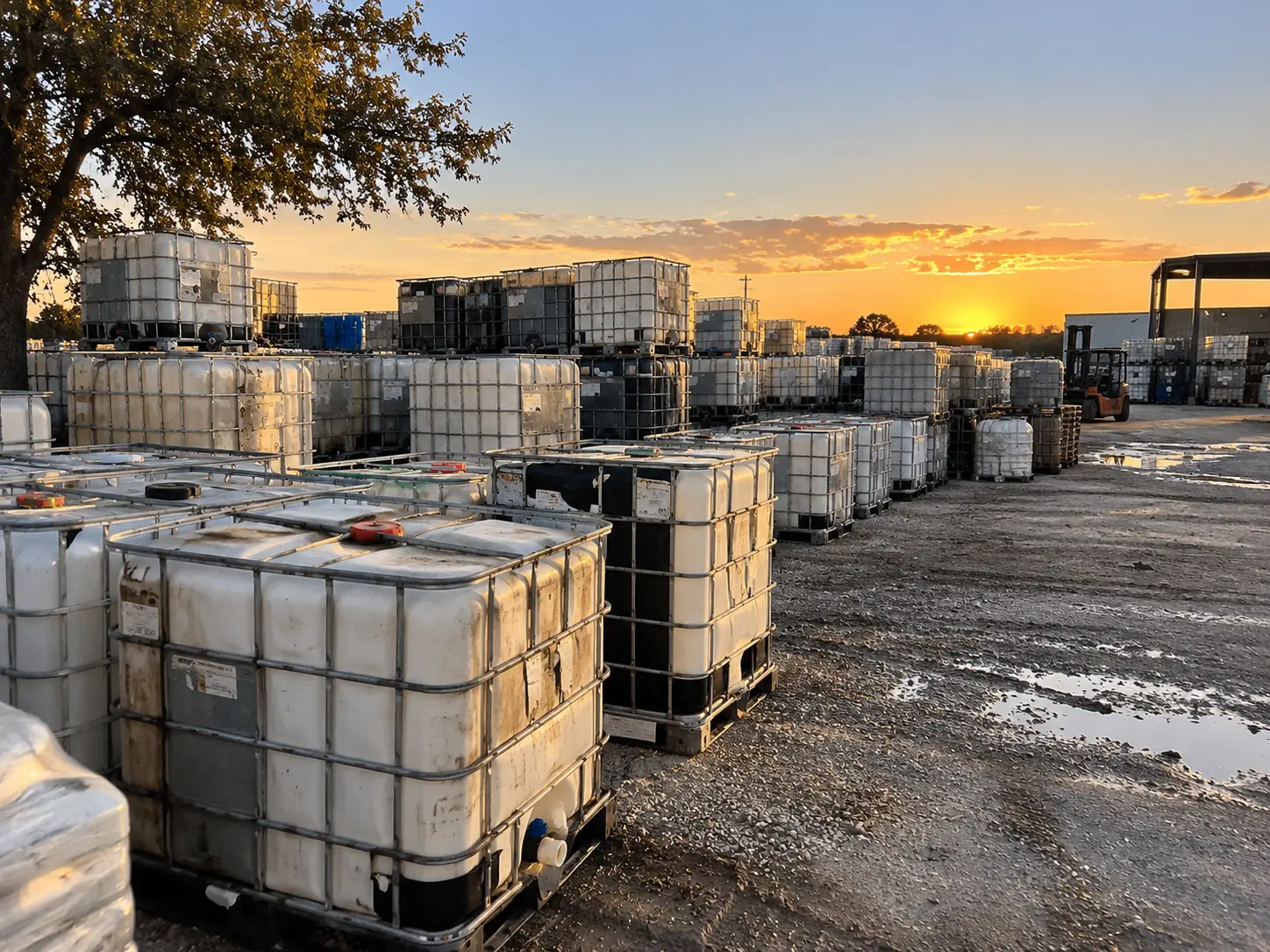
Start with the limit, because it is the most important thing on this page. Every bottle in this category failed a pressure and leak test. That failure usually means a slow loss under sustained pressure — irrelevant to a static tank at atmospheric pressure, and completely disqualifying for a container strapped to a trailer and driven across three states.
The eleven formats
B-01 Rain harvester
The most requested build by a wide margin. Top-cut bottle with a debris screen at the inlet, an overflow bulkhead near the top, and a 2-inch bottom draw-off. Linkable in series through the overflow so multiple units act as one larger store. Keeps its original cage and pallet, which means it can be forklifted into position as a single unit.
B-02 Aquaponics sump
Full-height bottle with side bulkheads for inlet and return plus a bottom drain. Cage retained because the hydrostatic load on a full-height tank is substantial. Fabricated only from bottles whose entire declared fill history was food-contact, which is a limited pool and a longer lead time.
B-03 Raised planter bed
The bottle is cut longitudinally into two troughs, perforated for drainage, and mounted in half cage sections at working height. Two beds per tote, which makes this the most material-efficient format in the list.
B-04 Livestock waterer
Low-profile open-top trough with a float-valve boss, a drain plug and a reinforced rim. Cage retained as a kick guard, which matters more than it sounds — an unguarded plastic trough in a cattle yard has a short life.
B-05 Jobsite washdown station
Elevated bottle on a cut cage stand with a tap manifold, a soap tray and a catch basin. Forklift-portable as one assembly, which is the whole point on a site that reorganises weekly.
B-06 Compost tumbler
Horizontal bottle on a rolling cage frame with a hinged access hatch and aeration ports. The 275-gallon volume is close to ideal for a small-holding composting cycle.
B-07 Firewood and bulk store
A cage-only build. The bottle is removed and granulated; the steel cage becomes a vented bulk container on its original pallet, stackable two high. Useful where the bottle has failed badly but the cage is perfect.
B-08 Grey-water settling tank
Baffled interior with staged draw-off points at three heights, for separation duty. Explicitly non-potable, and fabricated with vented lids because settling tanks generate gas.
B-09 Nursery irrigation header
Elevated bottle with a multi-outlet manifold for drip-line distribution plus an inline filter boss. Gravity pressure only, which suits drip but not sprinkler duty.
B-10 Spill containment bund
Bottle cut to a shallow tray and mounted in a cut cage base, sized to hold a single drum or a 275-gallon unit. Seamless, because a bund with a joint in it is not a bund.
B-11 Custom fabrication
Send a sketch with dimensions and the fittings you need. We prototype one, photograph it, and build the rest once you approve. Most of the ten formats above started as a customer sketch.
Fittings available on any build
| Fitting | Sizes | Typical use |
|---|---|---|
| Bulkhead tank fitting | 1/2" – 3" | Inlet, outlet, return |
| Overflow bulkhead | 2" – 3" | Rain harvesters, sumps |
| Float valve boss | 1/2" – 1" | Livestock waterers |
| Drain plug | 3/4" – 2" | All builds |
| Vented lid | 6" – 12" | Access and aeration |
| Debris screen | Mesh | Rain harvester inlets |
| Sight tube | 1/2" | Level indication |
Every opening is a proper bulkhead fitting with a gasket, never a drilled hole with a pipe pushed through it. Every cut edge is dressed and radiused. Every build is water-tested at full working level before it leaves.
What the material will and will not tolerate
- Freeze-thaw: HDPE is fine; the water inside is not. Drain below the lowest fitting before a hard freeze or you will split a bulkhead.
- UV: natural HDPE chalks on the surface and eventually embrittles. Ten years outdoors in northern latitudes is realistic; a sunnier climate is less.
- Temperature: atmospheric and ambient only. These are not hot-fill vessels.
- Load: a full-height 275-gallon tank is around 2,300 lb of water. Keep the cage, and stand it on something that can take it.
- Chemistry: whatever the source bottle held is still in the wall. Standard builds are for water, not for storing anything you care about the purity of.
Food-safe builds
Any build intended for growing edible produce or for aquaponics is fabricated only from bottles whose entire declared fill history was food-contact. That pool is much smaller than our general retired-bottle stock, so lead times run three to five weeks rather than one to two, and the source fill history is supplied with the build.
Tell us at order time rather than afterwards. A standard build cannot be retrospectively reclassified, for the same permeation reasons that prevent an industrial tote re-entering a food path.
- 38lb
- HDPE saved per build
- 2.4%
- Of intake diverted here
- 11
- Standard formats
- 0
- Builds for transport use
And at the end of the build's life
Send it back. It goes into the granulator and becomes recycled HDPE, exactly as the bottle would have done when it failed its pressure test — except a decade later and after a second useful life. That is the whole argument for this category: not that upcycling is a substitute for recycling, but that it buys a bottle ten more years before recycling becomes necessary.