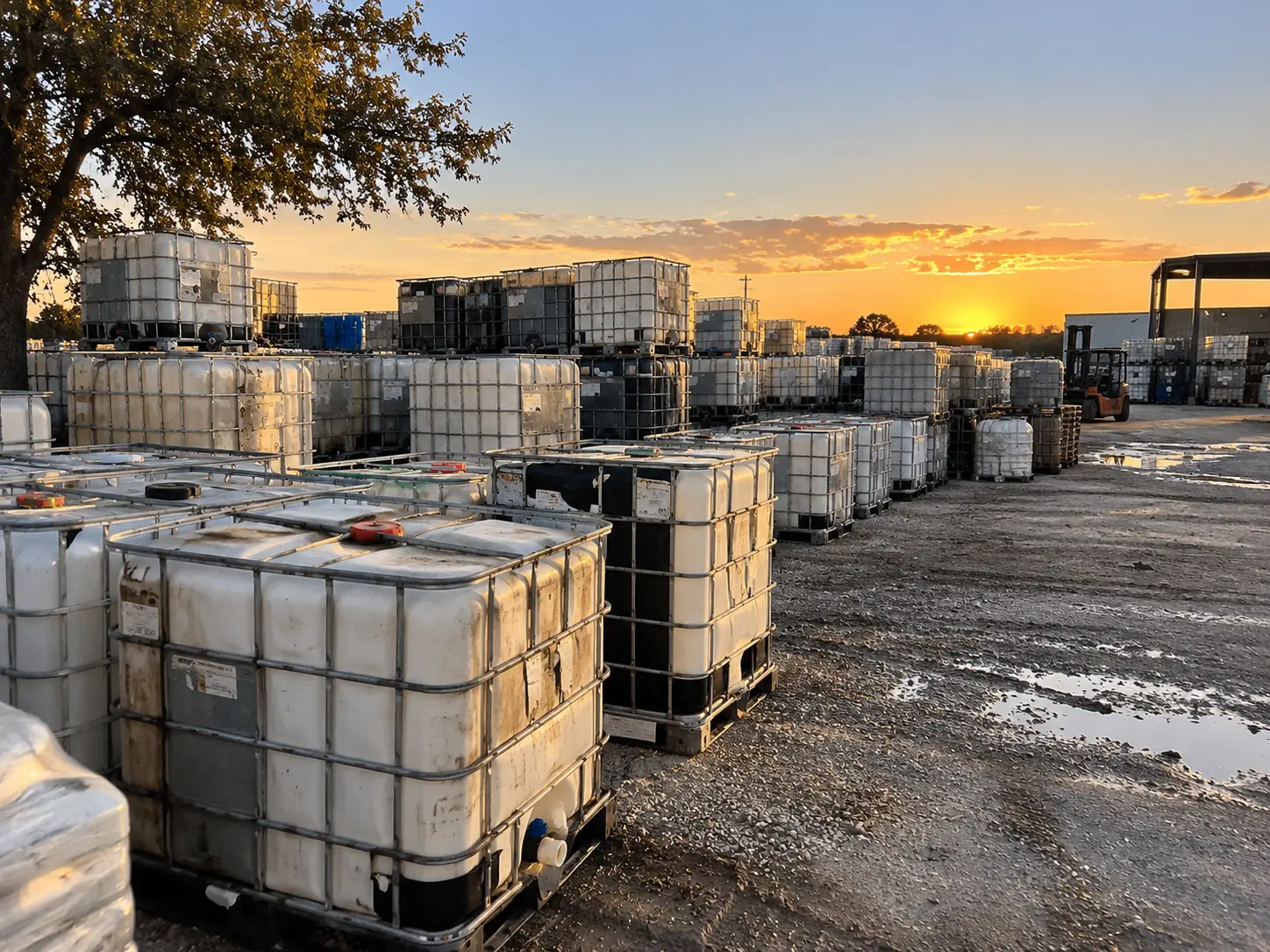
The single most common misconception about used IBC totes is that they are priced by weight. They are not. Scrap merchants price by weight, and that is precisely why a scrap merchant will pay you a fraction of what a reclaim operation will. A reclaim buyer is purchasing a container — an object whose value comes from what it can still do, not from what it is made of.
That distinction is worth real money. At the time of writing, the HDPE and steel in a 275-gallon composite tote, sold as mixed scrap, is worth a small fraction of what the same unit fetches as a reusable container. Which means the first question a buyer asks is never "how much does it weigh?" It is "what can this still hold?"
Factor one: previous contents
This is the dominant factor and it is not close. The declared fill history determines which wash programme a unit needs, which grades it can achieve afterwards, and therefore which customers it can be sold to. A tote that held a non-ionic surfactant is a straightforward caustic wash and comes out as grade A- or B. A tote that held a pigment dispersion will stain permanently and will never be sold to anyone who cares what the container looks like.
Worse, some previous contents permeate into the polyethylene wall rather than merely sitting on its surface. Aromatic solvents, chlorinated solvents and terpenes such as d-limonene all do this. No wash reaches absorbed material, so those units are restricted to duties where trace carryover does not matter.
Factor two: quantity and consistency
Forty-eight similar units fill a trailer exactly and can be graded as a batch by one technician working through a single mental model. Twelve units spread across six different capacities, three pallet types and two cage designs cost considerably more to handle per unit, because every one is a fresh assessment.
| Lot composition | Grading time per unit | Freight efficiency | Relative handling cost |
|---|---|---|---|
| 48 identical 275 gal units | 3 min | Full trailer | Lowest |
| 48 units, two capacities | 4 min | Full trailer | Low |
| 24 units, mixed capacities | 5 min | Half trailer | Moderate |
| 12 units, six capacities | 6 min | Quarter trailer | High |
| 6 units, all different | 6 min | Minimum charge | Highest |
None of this means a small mixed lot is unsellable. It means the per-unit number will be lower, and it is worth knowing why before you are surprised by it.
Factor three: the lane
This is the factor sellers almost never think about and the one most likely to change the number in your favour. Reclaim operations run outbound deliveries and need their trailers back. An empty return leg passing within a few miles of your site is the cheapest freight that exists in this industry, and a buyer will price accordingly.
The corollary is that flexibility is worth money. A seller who can accept a two-week collection window gets a better number than one who needs a fixed Tuesday, because the two-week window lets the buyer slot the pickup onto a movement that was already happening.
Always ask whether a lane is running. It is the only question in this process where the answer can change the price by double digits.
Factor four: loading conditions
A dock and a working forklift on site reduce a buyer's handling cost substantially. No dock means a flatbed or curtainside. No forklift means the buyer brings one, which means specific equipment on a specific trailer, which costs more. Gravel yards, gated sites with escort requirements and sites needing a safety induction all add time.
- Dock at any height, forklift available — best case, no deduction
- Ground level, forklift available — minimal impact
- Ground level, no forklift — buyer supplies one; expect a deduction
- Gravel or unpaved, no equipment — specific trailer required
- Gated with escort and induction — add handling time
- Stacked four deep behind other equipment — this is a cleanout, not a pickup
Factor five: cage and pallet condition
This is the one that surprises people most, because it means a unit with a failed bottle still has real value. The galvanised steel cage is the most carbon-intensive and longest-lived component of an IBC tote — a cage routinely outlives three bottles. A reclaim operation with a rebottling line will pay properly for a sound cage on a good pallet even when the bottle is scrap.
- 70lb
- Steel in a 275 gal cage
- 132lb CO₂e
- Embodied in that cage
- 3:1
- Bottles per cage, observed
- 98.4%
- Of intake cages we reuse
So when you are looking at a unit with a split bottle and thinking "that one is definitely scrap," check the cage. If the geometry is square and the welds are sound, that is a saleable component sitting inside a disposal problem.
What does not affect the price as much as you think
- 01Age. A ten-year-old bottle that passes a pressure test is worth more than a three-year-old one that does not. Age correlates with condition, but the test is the thing that matters.
- 02Dirt. Residue is what a wash line is for. Do not spend money cleaning units before sale — you will do badly what a caustic circuit does properly, and it will not move the number.
- 03Cosmetic scuffing on the cage. Scratches and galvanising wear affect grade, not function, and plenty of buyers do not care.
- 04Whether the valve works. Valves are cheap and 61% of intake gets a new one anyway.
- 05Missing caps. Also cheap. Keep them on in transit for cleanliness, but their absence is not a disqualifier.
What does disqualify a unit entirely
There is a short list, and it is worth knowing so you can separate those units out before you ask for a quote rather than discovering them at a weigh pad.
- Residues on a reclaimer's declared exclusion list — typically acutely toxic and P-listed materials, radiological or biohazardous residues, unstabilised reactive monomers and PCBs
- An undocumented fill history where the unit is intended for a food or pharmaceutical path
- Heat distortion severe enough that the bottle no longer sits in its cage
- Cage fatigue cracking at multiple weld joints
Everything else is a conversation. Part-full units, weathered units, units with labels that fell off in 2019 — all of these have answers, and the answers are usually better than the seller expects.
How to get the best number
- 01Count accurately and state the capacities. "About forty" turns into a deduction for uncertainty.
- 02Declare the previous contents honestly, including the awkward ones. Honesty is priced better than vagueness.
- 03Send photographs: one wide shot of the stack, one of a representative unit, one of a marking plate.
- 04Say what your site is like — dock, forklift, surface, access restrictions.
- 05Offer a collection window rather than a date, and ask whether a lane is running.
- 06Mention if you also buy totes. A delivery and a collection on one trailer removes a freight leg from both sides.
That is the whole process. Five factors, in order of weight, and none of them is the one most sellers lead with. If your empties are currently a line item on a disposal invoice, it is worth twenty minutes to find out what they are actually worth.