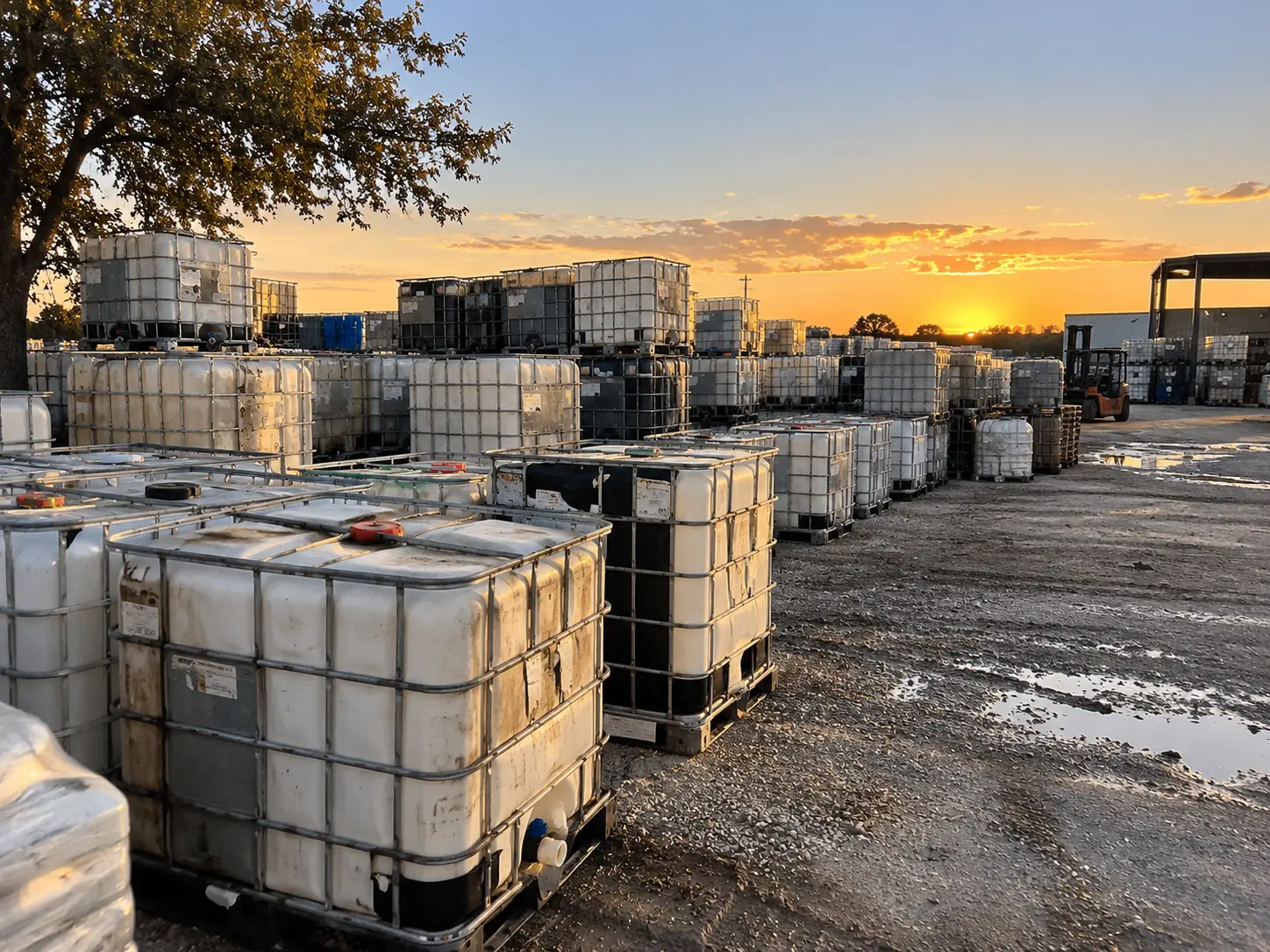
An industrial chemical blender uses containers steadily all year, indoors, with a loading dock. An agricultural retailer or a large farm uses them in a compressed spring window, stores them in a yard, and has a regulatory obligation about what is left inside. Everything follows from those three differences.
Characteristic one: the seasonal spike
Container demand in agriculture is not merely uneven, it is concentrated into a few weeks. Which creates two problems in sequence: a scramble for stock in March and April, and a yard full of empties from May onward with nothing to do until next spring.
| Period | Container state | The problem |
|---|---|---|
| Jan–Feb | Stock being secured | Everyone is buying at once; grade A- runs short |
| Mar–May | In use, high turnover | Peak demand, peak freight pressure |
| Jun–Aug | Emptying, accumulating | Yard fills; rinsate obligations arise |
| Sep–Nov | Standing in the yard | Weathering begins; labels fade |
| Dec–Feb | Still standing | Information decay; rainwater ingress |
The expensive part is the bottom two rows. A unit collected in June, when its fill history is fresh and its cap is still on, grades considerably better than the same unit collected the following February.
Characteristic two: outdoor storage
Few agricultural operations have indoor space for empty containers, which exposes them to the two things that actually degrade a tote: ultraviolet light and water.
- UV causes surface chalking and, over years, embrittlement — which shows up as a pressure test failure rather than as visible damage
- Rainwater ingress through a missing cap turns a 125 lb empty into a 2,300 lb full, changes the freight entirely, and splits the bottle at the first hard freeze
- Standing water around pallet feet accelerates timber rot and loads the base unevenly
- Sun on a part-full unit drives thermal cycling, which stresses the bottle around the valve boss
Three cheap mitigations: cap everything, keep units off bare ground, and if any shade is available, use it. None of that requires a building.
Characteristic three: rinsate
Crop protection products generally carry a triple-rinse obligation, and the rinsate is usually applied to the crop as part of the spray solution. That is the correct handling route and it has a container consequence worth understanding.
A properly triple-rinsed agricultural container arrives at a reclaim operation with very little residue — which is good — and a fill history that still determines everything about its next life. Rinsing addresses the residue, not the permeation, and several agricultural adjuvant systems are solvent-based.
| Product class | Permeation | Typical reuse path |
|---|---|---|
| Liquid fertiliser — UAN, urea solutions | None | Full reuse, any grade |
| Micronutrient solutions | None | Full reuse, any grade |
| Water-based herbicide formulations | Minimal | Full reuse |
| Emulsifiable concentrates | Moderate | Restricted to compatible duty |
| Solvent-based adjuvants | High | Restricted; often cosmetic grades |
| Oil-based surfactant adjuvants | Moderate | Restricted to compatible duty |
| Seed treatment colourants | High, with staining | Cosmetic grades only |
Note that the two highest-volume categories — liquid fertiliser and micronutrients — are the most benign. Most agricultural intake is excellent reuse stock.
Specifying for agricultural service
Four specification choices that make a material difference in this sector specifically.
- 01Plastic or steel pallet bases rather than timber. Outdoor storage and timber rot are a poor combination, and the reuse rate difference is substantial.
- 02Vented fill caps as standard. Gravity discharge into a sprayer tank is the normal operation and a sealed tote will not do it.
- 03EPDM gaskets for fertiliser and water-based formulations; check the compound for any solvent-based adjuvant.
- 04Grade B or B- for most duties. Agricultural service does not require cosmetic condition, and paying for grade A- is usually paying for appearance nobody will see.
That last point is worth emphasising because agricultural buyers are frequently sold up. Fertiliser does not care what the cage looks like.
The return arrangement that works
Agricultural container flows suit a simple two-directional arrangement better than most sectors, because the demand spike and the empty accumulation are separated by a few months rather than happening simultaneously.
- Spring: delivery of reconditioned stock, timed to the application window
- Summer: collection of the previous season's empties, on a running lane, with the fill history fresh
- Netted invoice across both movements
- A Reclaim Ledger certificate covering the diverted volume, which several agricultural retailers now use in their own supplier reporting
The June collection is the one that pays. By February the same units have lost their labels, gained rainwater and dropped a grade — for no reason other than time.
A note on the regulated side
Crop protection containers carry handling obligations that vary by product and jurisdiction, and some are covered by dedicated stewardship schemes. We handle the container stream where the rinsate obligation has been met and the fill history is declarable; we do not take units whose declared contents fall on our published exclusion list.
If you are unsure which of your containers fall where, send the declaration first. It is a five-minute conversation and it is considerably better than discovering the answer at an intake pad in the middle of a busy week.