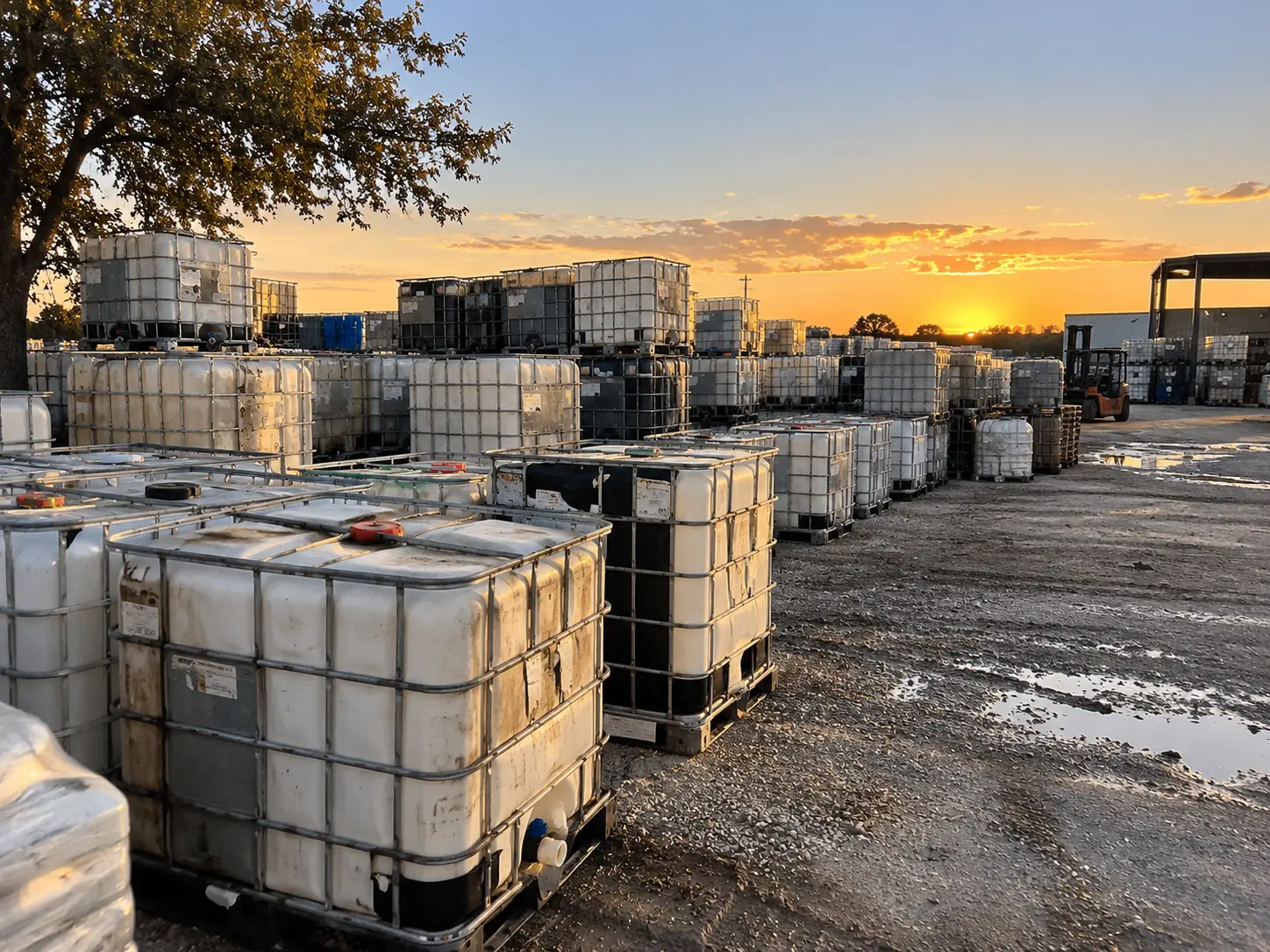
Craft brewing and distilling run into the same container problem from three directions at once, and the scale makes all three awkward.
Where the totes come from
- 01Cleaning and sanitation chemistry. Caustic, acid, peracetic acid and foam cleaners arrive in totes and are consumed steadily all year. This is the largest and most consistent source.
- 02Glycol. Propylene glycol for the chilling loop, delivered in bulk and topped up periodically.
- 03Ingredients. Liquid malt extract, fruit purée, juice concentrate and occasionally liquid sugar — food-contact material, which is an entirely different container category.
The first two produce empties on a steady trickle. The third produces a food-grade container question that most producers have not thought about until a QA conversation forces it.
Problem one: the volume is awkward
Twenty to thirty units a year, accumulating a couple at a time, is below the minimum pickup for most reclaim operations at any distance. Which is why so many craft producers end up with a stack behind the brewhouse and no obvious route out of it.
| Units available | Distance from reclaim yard | Realistic route |
|---|---|---|
| 4–10 | Under 150 mi | Standard pickup — this works |
| 4–10 | Over 150 mi | Needs a running lane; register and wait |
| 12–24 | Under 350 mi | Standard pickup |
| 12–24 | Over 350 mi | Running lane, or accumulate further |
| 24+ | Any | Standard pickup, good freight economics |
The practical answer for most craft producers is to accumulate to twenty-four units and register the lot so it can be matched to an outbound lane. That turns a year of accumulation into one collection with reasonable freight economics.
Problem two: the food-grade line
This is the one that causes genuine confusion. A tote that held liquid malt extract is a food-contact container with a food-only history. A tote that held caustic is not, and no amount of rinsing changes that.
Which means a producer receiving both needs to keep them separate from the moment they are emptied, not sort them out later.
- Mark and segregate ingredient totes from chemistry totes at the point of emptying
- Never use a chemistry tote for anything food-contact, even temporarily, even for water
- Never use an ingredient tote for cleaning chemistry — it permanently loses its food status
- Keep the delivery paperwork for ingredient totes; the fill history is what gives them their value
That third point is where the real loss happens. An ingredient tote with a clean food-only history is worth considerably more and can re-enter a food path. The same tote after one cycle holding caustic cannot, ever. Using it as a convenient caustic container destroys the thing that made it valuable.
Problem three: the repurposing temptation
Craft producers are resourceful and a 275-gallon tote is an obviously useful object. Several things people do with them are fine; several are not.
| Use | Verdict | Reason |
|---|---|---|
| Spent grain or trub collection | Fine | Non-potable, non-regulated, cage supports the load |
| Cleaning solution make-up tank | Fine | But it permanently ends any food future |
| Rainwater or wash-down water | Fine | Keep it off the food side |
| Glycol loop reservoir | Fine | Compatible and sensible |
| Fermentation vessel | No | Not designed for it; cleaning cannot be validated |
| Potable water storage | No | Unless the fill history was food-only and you treat the water |
| Anything transported on a vehicle | No | A repurposed tote is not a transport container |
| Liquid ingredient storage, from a chemistry tote | No | Permeation; this is the serious one |
The useful rule: once a tote has held cleaning chemistry, it is a utility container forever. Decide which side of that line each unit is on before you need it for something.
What to buy, for each use
- 01Cleaning chemistry — reconditioned grade B. Appearance is irrelevant, the chemistry is aqueous, and it is the cheapest option by a wide margin.
- 02Glycol — reconditioned grade B. Glycols barely permeate and do not care about cosmetic condition.
- 03Liquid ingredients — food-grade on a segregated path, or rebottled on a segregated path. The rebottled route is underused and usually the right answer: a new bottle that has never held anything, in a reclaimed cage.
- 04Utility and wash-down — grade B-, or an upcycled build if it is going to live outside as a static tank.
The arrangement that suits this sector
Craft producers do best on a simple annual cycle rather than a managed pool, because the volumes do not justify tracking infrastructure.
- Accumulate empties, segregated by food and non-food, with caps on
- Register the lot at around twenty-four units and give a wide collection window
- Combine the collection with a delivery of the next year's chemistry totes where possible, so one trailer does both
- Keep the ingredient-tote paperwork; it is the difference between a food-grade credit and a utility-grade one
Four steps, once a year, and it converts a yard problem into a small credit plus a clear food-grade story for whoever audits you next.